
It is 2:14 in the morning and the ceiling has your full attention. Nothing has actually happened. The email has not arrived, the results are not back, the conversation is three days away — and your chest is tight, your jaw aches, and your mind is rehearsing the worst version of all three.
Most of us scroll past articles like this one. Lists of Bible verses for anxiety look too easy from the outside, and they land differently when you are the one who actually feels anxious at 2 a.m. We have read Philippians 4:6 a hundred times. The words are familiar. Some nights they do not reach the floor.
So this is not a list to skim. It is sixteen passages on worry and anxiety, each with the part that usually gets left out: who wrote it, where they were standing, and what it is actually asking you to do. Almost all of them were written by people in real danger.
One plain sentence first: Scripture and professional care are not rivals. If anxiety is running your days, therapy and medical treatment belong alongside prayer, never instead of it.

Face your giants. Discover what makes someone truly brave.1 Samuel 17 · 11 min
That was just the opening. Open the app and search #002 to hear the full 11-minute story — free.
Keep listening free in the app Free on iOS & Android — no sample needed

When Your Mind Will Not Stop Racing
Anxiety runs on repetition. Reach for these three when the same thought comes round for the ninth time.
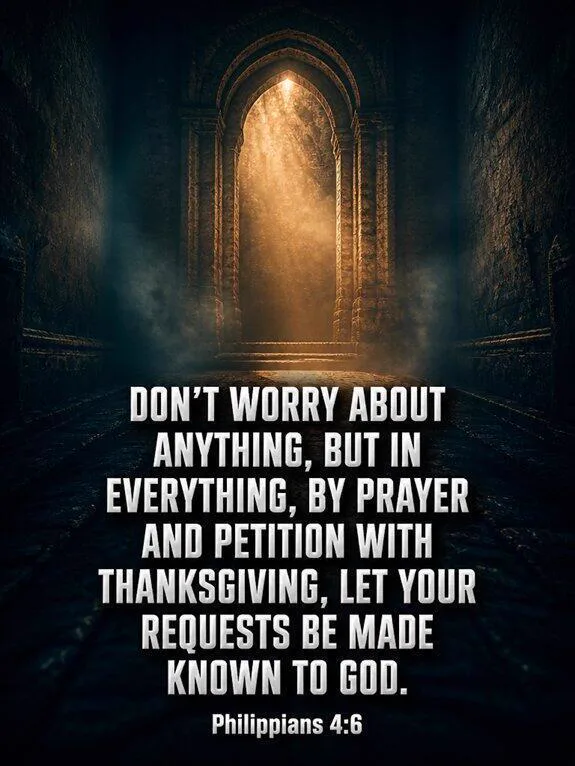
Philippians 4:6-7 — What to Do While You Are Still Anxious
“In nothing be anxious, but in everything, by prayer and petition with thanksgiving, let your requests be made known to God. And the peace of God, which surpasses all understanding, will guard your hearts and your thoughts in Christ Jesus.” — Philippians 4:6-7 (WEBU)
Paul wrote this under guard, with his own trial unresolved. That matters, because the verse is almost always read as an order: stop feeling anxious. Notice it never says that. It says what to do with the anxiety — hand it over one specific item at a time, with thanksgiving. The promise that follows is not that the situation resolves. It is that peace will “guard” your heart and your thoughts, a garrison word, the kind used for soldiers posted at a gate. The peace is stationed before the answer arrives.
Psalm 94:19 — Comfort That Arrives Mid-Complaint
“In the multitude of my thoughts within me, your comforts delight my soul.” — Psalm 94:19 (WEBU)
Psalm 94 is not a serene psalm. It opens by demanding to know how long the wicked will get away with it, and it never settles that question. This line about a crowded mind sits in the middle of a protest, which is the point: comfort turns up while the argument is still running. Most of us wait for a quiet mind before we pray, and a quiet mind is the one thing anxiety refuses to hand over. Pray with the noise still going. That is the condition the psalm was written in.

1 Peter 5:7 — A Throwing Word, Not a Sighing Word
“casting all your worries on him, because he cares for you.” — 1 Peter 5:7 (WEBU)
In the original this is not a fresh command. It hangs off the previous line about humbling yourself — one motion, not two. The verb behind “casting” is a throwing word, and the only other place the New Testament uses it, people are flinging their cloaks onto the back of a colt. Nothing gentle about it. It is getting a weight off your own shoulders and onto something built to carry it. And the reason attached is not “because worry is unproductive”. It is “because he cares for you”. Peter grounded the instruction in affection, not efficiency.

Psalm 55:22 — The Line Peter Was Quoting
“Cast your burden on the LORD and he will sustain you. He will never allow the righteous to be moved.” — Psalm 55:22 (WEBU)
Peter did not invent that image; he was reaching for a psalm his readers already knew. It is worth reading the two together, because the psalm shows us the state we are allowed to be in when we do it. Psalm 55 is not composed. David is describing a betrayal by somebody who used to walk to the house of God beside him, and a few lines earlier he says outright that he would like wings so he could fly away and be at rest. It is a cry for help with no dignity left in it.
And that is where the instruction lands: give your burdens to God, not once you have processed them into something presentable, but in the middle of wanting to run. Notice too what is promised in return — he will sustain you. Not lift you out, not resolve it by Friday. Hold you up while it is still happening.

When the Fear Is About Tomorrow
Most anxiety is about a day that has not arrived, judged with information you do not have yet.
Matthew 6:34 — Tomorrow Gets Its Own Grace
“Therefore don’t be anxious for tomorrow, for tomorrow will be anxious for itself. Each day’s own evil is sufficient.” — Matthew 6:34 (WEBU)
Jesus said this outdoors, on a hillside, at the end of a long passage about worry, and the build-up matters. He starts at the basics — “don’t be anxious for your life: what you will eat, or what you will drink” — then points at the sky: “See the birds of the sky, that they don’t sow, neither do they reap, nor gather into barns. Your heavenly Father feeds them.” Then at the ground: “Consider the lilies of the field, how they grow. They don’t toil, neither do they spin, yet I tell you that even Solomon in all his glory was not dressed like one of these.” Two ordinary things anybody on that hillside could see without turning their head.
In the middle of it he asks the question the whole passage turns on: “Which of you by being anxious, can add one moment to his lifespan?” That is not a rebuke, it is an audit. Worry feels like work — it has the effort and the exhaustion of work — and he is pointing out that it produces nothing. And when he calls the crowd “you of little faith,” it lands as diagnosis rather than insult: not you are bad at this, but you are carrying something you were never asked to carry.
Only then comes verse 34. Notice what he still does not promise. He never says tomorrow will be fine — he says it will have trouble of its own and today’s is enough to be getting on with. That is a rationing instruction, not optimism. Anxiety imports next month’s problems into tonight, where you have neither the facts nor the grace to handle them. Planning is fine; carrying is not. If a worry belongs to Thursday, write it down and let Thursday have it. When the same loop runs for hours, Bible Verses for Overthinking and Anxious Thoughts goes further into breaking the cycle.

Proverbs 3:5-6 — Straight Paths, Not Visible Ones
“Trust in the LORD with all your heart, and don’t lean on your own understanding. In all your ways acknowledge him, and he will make your paths straight.” — Proverbs 3:5-6 (WEBU)
This gets read as a promise that God will show you the plan in advance. It says something narrower and far more useful: he makes the path straight — walkable, not previewed. Much of anxiety is the attempt to solve a problem with information that does not exist yet, and “lean on your own understanding” names that habit precisely. Leaning is what you do when you need something to take your weight. The alternative is not switching your mind off; it is letting the next step be enough. You get one step of light, not the whole road.

Joshua 1:9 — An Order, Not Encouragement
“Haven’t I commanded you? Be strong and courageous. Don’t be afraid. Don’t be dismayed, for the LORD your God is with you wherever you go.” — Joshua 1:9 (WEBU)
The opening question is doing more work than it looks. “Haven’t I commanded you?” means this is not a pep talk — it is an order being repeated to somebody who has already been given it and is still standing still. Joshua had just taken over from Moses with a river in front of him and no obvious way across, which is roughly where anxiety leaves us when a decision cannot be made yet.
What makes the verse usable on a bad day is the last clause. “Be strong and courageous” on its own is the kind of advice that helps nobody; the reason attached is not that you have it in you, but that the LORD your God is with you wherever you go. Wherever is the word to sit with. Not once you are through this, not if you handle it well — wherever you go, including the version of tomorrow you are dreading tonight. The courage is commanded because the presence is already a fact, not the other way round.

When You Need Peace That Holds Under Pressure
Calm that depends on circumstances is not peace, it is good weather. These three survive a bad forecast.
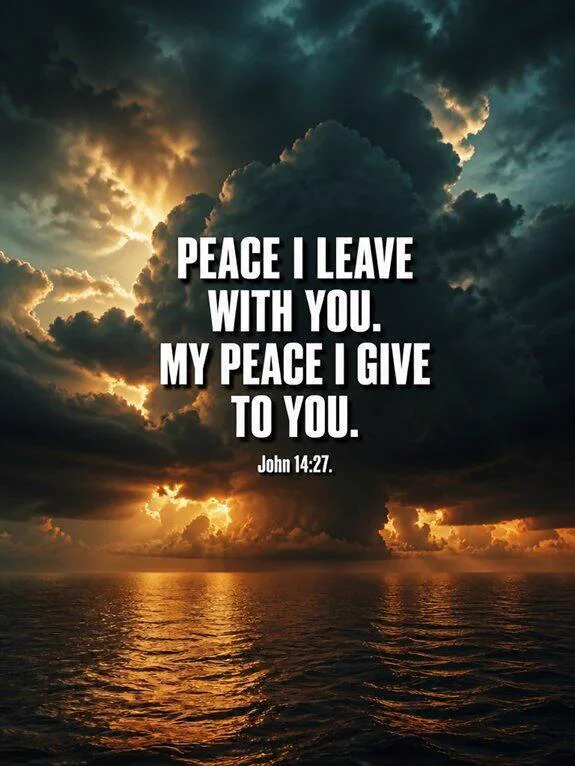
John 14:27 — A Goodbye Word With Weight In It
“Peace I leave with you. My peace I give to you; not as the world gives, I give to you. Don’t let your heart be troubled, neither let it be fearful.” — John 14:27 (WEBU)
Jesus said this hours before his arrest, in a borrowed room, to friends who would scatter before morning. The word for peace was the ordinary greeting and farewell of the day — roughly what “take care” does as somebody walks out of the door. He picks up that everyday goodbye and loads it: not as the world gives. The world’s version is a formality, and it lasts as long as the circumstances underneath it. His is handed over as property, on the worst night of his life, to people about to have the worst night of theirs.
Isaiah 41:10 — Who Is Doing the Holding
“Don’t you be afraid, for I am with you. Don’t be dismayed, for I am your God. I will strengthen you. Yes, I will help you. Yes, I will uphold you with the right hand of my righteousness.” — Isaiah 41:10 (WEBU)
Isaiah is speaking to a people staring at an empire capable of erasing them, which is why the verse stacks its promises like a raised voice: “I am with you… I will uphold you.” Four of the five are things God does, not things you have to manage, and on a bad day that is the point. Faith is not the strength of your grip — anxiety strips your grip inside a minute. It is his hold on you. The verse still works on the nights you cannot manufacture any confidence, because you are not its subject.

2 Timothy 1:7 — Where the Dread Does Not Come From
“For God didn’t give us a spirit of fear, but of power, love, and self-control.” — 2 Timothy 1:7 (WEBU)
This comes from Paul’s last surviving letter, written in custody, to a young leader who appears to have been genuinely timid — the letter keeps telling him not to be ashamed. So the line is not a telling-off for feeling afraid. It is a statement about origin: the spirit of fear is not the one handed to you. What was handed to you is power, love, and a mind under control — a mind that is sound and steady, not one that never races. Read that way it stops being an accusation on frightening days and does what it did for Timothy: it separates the fear from your identity.

Isaiah 26:3 — Perfect Peace Has a Condition Attached
“You will keep whoever’s mind is steadfast in perfect peace, because he trusts in you.” — Isaiah 26:3 (WEBU)
“Perfect peace” sounds like the least achievable phrase in the Bible until you read what it is attached to. The peace is not described as a feeling that arrives and stays; it is what happens to a mind that is steadfast — fixed on something, leaning its weight somewhere. In Hebrew the phrase behind “perfect peace” is literally peace repeated twice, shalom shalom, the way you would say it to somebody to settle them.
So this is not a verse that asks you to get your mind and heart in order before God will meet you. It runs the other way: the mind is kept, passively, and what keeps it is where it is fixed. On the nights you cannot produce any calm of your own, that distinction is the whole difference between a promise you have failed and one you can still take.

When Anxiety Reaches Your Body
When adrenaline takes over, reasoning goes first. These two are short enough to hold when nothing else stays in your head.
Psalm 23:4 — Where the Psalm Changes Person
“Even though I walk through the valley of the shadow of death, I will fear no evil, for you are with me. Your rod and your staff, they comfort me.” — Psalm 23:4 (WEBU)
Read the psalm from the top and something shifts exactly here. The opening verses describe God in the third person — he leads, he restores, he provides. Then the valley arrives and the psalm turns and speaks straight to him: “you are with me.” In the dark, David stops describing God from a distance and starts addressing him. Notice too that the valley is a route rather than an address: you walk through it. The rod and the staff are two tools, a club for whatever is out there and a crook for pulling a sheep back onto the path. Comfort here is equipment, in somebody else’s hands.

Matthew 11:28-30 — The Yoke Is the Teaching
“Come to me, all you who labor and are heavily burdened, and I will give you rest. Take my yoke upon you and learn from me, for I am gentle and humble in heart; and you will find rest for your souls. For my yoke is easy, and my burden is light.” — Matthew 11:28-30 (WEBU)
A first-century listener would not have heard “yoke” as a farming image first. A teacher’s yoke meant his reading of the law — the load his followers carried by following him. So the offer is a swap rather than a holiday: you are already wearing a yoke, and this one is lighter. That reframes the invitation for anybody whose faith has quietly turned into a performance review. The rest on offer is not an empty calendar; it is rest for your soul. If trying harder has left you exhausted, the problem may be the yoke rather than the effort.

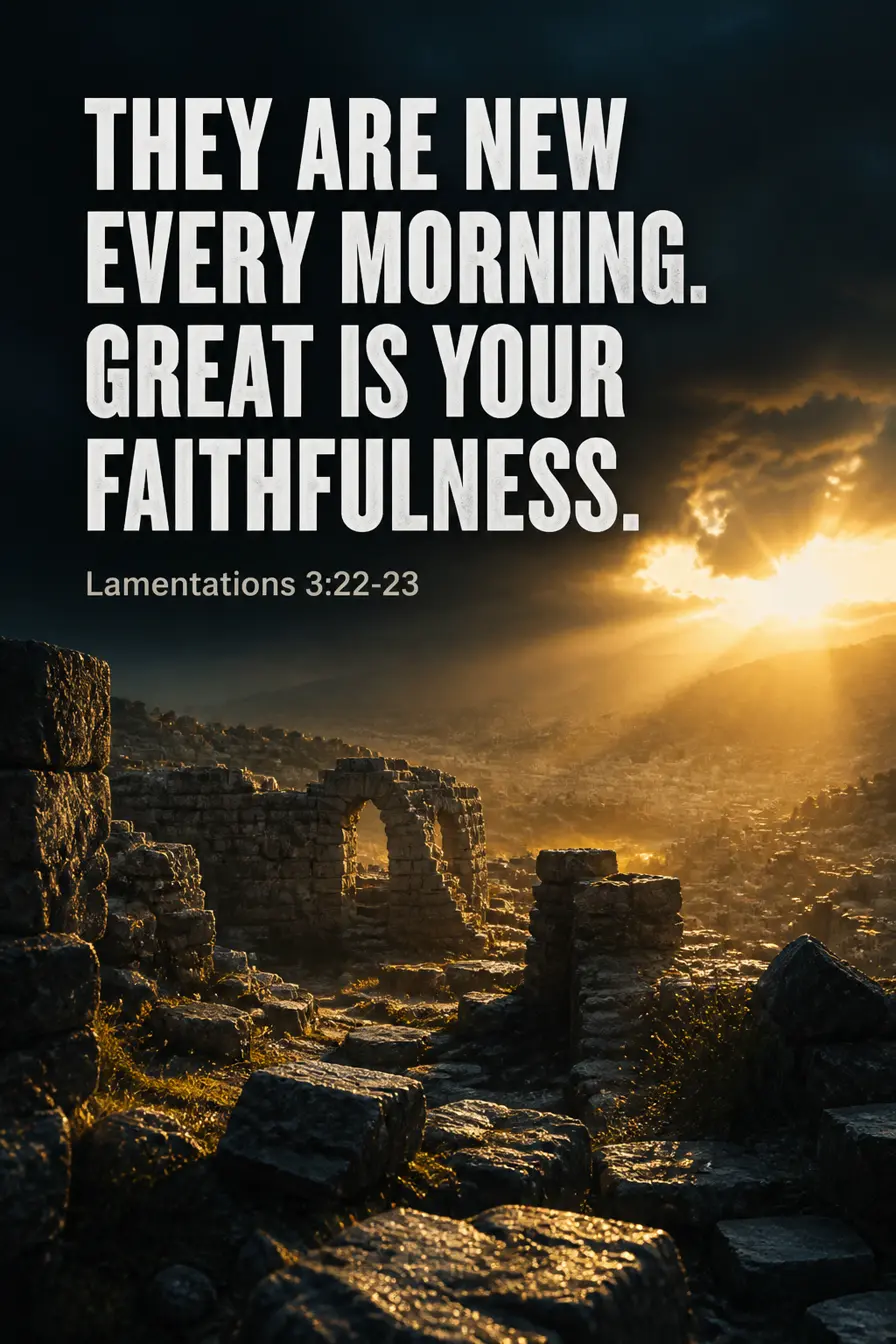
Lamentations 3:22-23 — Something That Resets While You Sleep
“It is because of the LORD’s loving kindnesses that we are not consumed, because his mercies don’t fail. They are new every morning. Great is your faithfulness.” — Lamentations 3:22-23 (WEBU)
This is the most quoted line in a book written over the ruins of a burned city, by somebody who spends the surrounding chapters saying that God has walled him in and made him walk in darkness. He does not withdraw any of that. The hope arrives in the middle of the complaint, not after it has been resolved.
The mechanism is the useful part for a 3 a.m. mind. The mercies are new every morning — which means they are not a supply we have been drawing down all week and might have exhausted by Thursday. Anxiety keeps a ledger and assumes we are already overdrawn. This says the ledger resets while you are asleep. Great is your faithfulness is his line, not yours: the reliability being praised belongs to God, on a night when the writer has none of his own left.
When Anxiety Tells You That You Are on Your Own
Romans 8:38-39 — A List That Ends Where Yours Does Not
“For I am persuaded that neither death, nor life, nor angels, nor principalities, nor things present, nor things to come, nor powers, nor height, nor depth, nor any other created thing will be able to separate us from God’s love which is in Christ Jesus our Lord.” — Romans 8:38-39 (WEBU)
Anxiety is a list-maker. It works through everything that could go wrong and never reaches the end, because there is always one more item waiting. Paul writes a list too, and his is deliberately exhaustive — death, life, angels, rulers, the present, the future, powers, height, depth, and a catch-all for anything he missed. The difference is where it lands: his list closes, yours does not. Notice how it opens, as well. “I am persuaded” is a conclusion somebody reached, not a mood they woke up in — a verdict reached under pressure, handed to you for the nights your own list refuses to stop. If the future is where your fear lives, Bible Verses for Hope in Difficult Times sits alongside this one.

Revelation 21:4 — The End of the Story, Told in Small Detail
“He will wipe away every tear from their eyes. Death will be no more; neither will there be mourning, nor crying, nor pain any more. The first things have passed away.” — Revelation 21:4 (WEBU)
For a book full of thrones and trumpets, the moment it chooses to close on is startlingly small: somebody’s hand, somebody’s face. Not there will be no more sorrow announced from a distance — he will wipe away every tear from their eyes, one at a time, which is a thing you do while standing close enough to touch.
Anxiety is bad at endings. It can model every way a situation goes wrong and has nothing to say about how any of it finishes, which is why our worst nights have no last page. This is the last page. It does not make tonight easier by itself. It changes the size of tonight, which on some nights is the more useful of the two. If the future is the shape your fear takes, Bible Verses for Hope for the Future stays on that ground.

One Practice to Start Tonight
One habit done imperfectly for a fortnight beats four done perfectly for a day. This one comes out of Philippians 4:6 and 1 Peter 5:7. Keep a pen and an index card by the bed; when the loop starts, do three things in order.
Name it as a request, not a mood. “Everything is falling apart” is not something anybody can hand over. “The scan on Tuesday” is. Write the specific thing in five words or fewer.
Hand it over out loud. Whisper it if the house is asleep, but say it rather than think it — thinking is the medium the loop already owns. Read the card, say what you are asking God to do with it, then add one thing you are thankful for. That last step is in the verse for a reason: it stops the request filling the screen.
Have a rule for the return. It will come back, often within minutes. Do not re-argue it and do not write a second card. Say “already handed over”, turn the card face down, and let that be the whole response. If nights are the hardest part, Scripture read aloud gives your attention somewhere to go besides the ceiling.
For the acute end of this — racing heart, tunnel vision, no air — Bible Verses for Panic Attacks and Anxiety is built for worse moments.
Frequently Asked Questions
What is the most calming verse in the Bible?
Philippians 4:6-7 is the one most people land on, and it earns the place, because it tells you what to do while you are anxious instead of ordering you to stop. It gives an action — a specific request in every situation, handed over with thanksgiving — and promises peace that arrives before the circumstances change. For something shorter to hold at 3 a.m., 1 Peter 5:7 does the same work in eleven words, and Isaiah 26:3 explains why it holds: the mind is kept, not self-calmed.
How do you ask God to take away anxiety?
Ask for something specific rather than for the feeling to stop. Philippians 4:6 says to make your requests known “in everything, by prayer and petition with thanksgiving” — a named request, not a mood. So: say the actual thing out loud (“the scan on Tuesday”), say what you are asking God to do with it, and add one thing you are thankful for. Psalm 55 shows you do not have to be composed to do this; it is a cry for help from somebody who wanted to grow wings and leave. And 1 Peter attaches the reason: God cares for you. The instruction is grounded in affection, not in your technique.
Which Bible verse says “do not fear”?
More than one, and they differ in a way worth knowing. Isaiah 41:10 — “Don’t you be afraid, for I am with you” — attaches the reason to God’s presence and lists four things he does. Joshua 1:9 gives it as an order to somebody already commanded: “Be strong and courageous. Don’t be afraid… for the LORD your God is with you wherever you go.” Matthew 6:34 narrows it to time: don’t be anxious for tomorrow. None of the three tells you to stop feeling afraid by force; each one names something true and lets the fear be measured against it.
What Bible verses talk about fear?
Beyond the three above, the ones people return to are Psalm 23:4 (fear in the middle of a valley you are walking through), 2 Timothy 1:7 (fear is not the spirit you were given), and John 14:27 (peace handed over on the worst night of Jesus’s life). If fear rather than worry and anxiety is the dominant note for you, Bible Verses for Overcoming Fear works that ground directly.
Does the Bible say anxiety is a sin?
No. Scripture treats anxiety as something to bring to God rather than a verdict on your faith. The psalms are full of people describing dread in detail and being answered, not scolded. Paul writes about pressure that made him despair of life itself. The instruction is always what to do next with the fear, never a demand that you stop feeling it.
What if you are too anxious to concentrate on reading?
Shorten the text until it fits. One line held for a minute does more than a chapter nobody can follow — “when I am afraid, I will put my trust in you” is a complete verse and takes a single breath. Reading aloud helps too, because hearing the words occupies the attention the spiral is using.
Can Bible verses replace therapy or medication for anxiety?
No, and treating them as alternatives is how people end up worse. Anxiety disorders have a physical dimension that responds to treatment, and prayer is no more a substitute for that than for a cast on a broken arm. Speak to your doctor. Scripture belongs alongside that care.
Where to Take This Next
Pick one verse from this page — not eleven — and keep it somewhere you will collide with it: the lock screen, the bathroom mirror, the card by the bed. Anxiety is repetitive, so our answer has to be repetitive too. On the nights it comes back, you will not be starting from nothing.
More passages, grouped by what the week is doing to you, are in the anxiety archive, and Calming Bible Verses for Anxiety is the quieter companion to this one. When the fear arrives with no cause you can point to, the passages on being anxious for no reason begin where God began with Elijah: food and sleep.