Nobody prints the hard half. Search for something to hold onto during a bad week and the same dozen lines come back, each one cropped to its encouraging clause, and every one of them is true. The trouble is what sits outside the crop marks. The same books that supply those lines also record a prophet asking God to kill him, a widow who changed her own name to Bitter, and an apostle writing to a church that he had given up on staying alive.
Those sentences were not edited out. They are in the same chapters. Sometimes they are four verses away from the line on the card.
That matters if you are in a hard season right now, because a hope that has to look away from your situation to keep working is not much use inside it. The Bible verses for hope in difficult times below are printed with the dark half attached — the complaint and the answer, in the order Scripture puts them.

Renew your strength. Learn to soar instead of flap.Isaiah 40 · 12 min
That was just the opening. Open the app and search #003 to hear the full 12-minute story — free.
Keep listening free in the app Free on iOS & Android — no sample needed

The Comfort Verse Has Five More Sentences
The most quoted passage in the Bible about comfort in hard times sits at the start of 2 Corinthians. It is genuinely one of the warmest things Paul ever wrote.
2 Corinthians 1:3-4 — The Father of Mercies
“Blessed be the God and Father of our Lord Jesus Christ, the Father of mercies and God of all comfort, who comforts us in all our affliction, that we may be able to comfort those who are in any affliction, through the comfort with which we ourselves are comforted by God.” — 2 Corinthians 1:3-4 (WEBU)
Read the shape of it rather than only the warmth. Comfort arrives, and then it moves. It comes from God to you in all your affliction, and it goes out from you to people in any affliction — not the same affliction, any of them. Whatever you are being carried through is not only for you, which is a strange thing to be told mid-crisis and a load-bearing one later.

That is where most lists stop. Four verses later, Paul explains what he had needed comforting for.
2 Corinthians 1:8 — He Says He Despaired of Life
“For we don’t desire to have you uninformed, brothers, concerning our affliction which happened to us in Asia: that we were weighed down exceedingly, beyond our power, so much that we despaired even of life.” — 2 Corinthians 1:8 (WEBU)
Sit with the phrase beyond our power. This is the man who wrote that he could do all things through Christ, telling a church in writing that something went past what he could carry. And then the harder clause: we despaired even of life. Not discouraged. Not stretched. He stopped expecting to survive.
Notice he chose to tell them. We don’t desire to have you uninformed — he could have kept it out of the letter and lost nothing from his argument. He put it in. Whatever else the New Testament is, it is not a collection of people pretending the bottom does not exist.

2 Corinthians 1:9 — The Reason He Gives for It
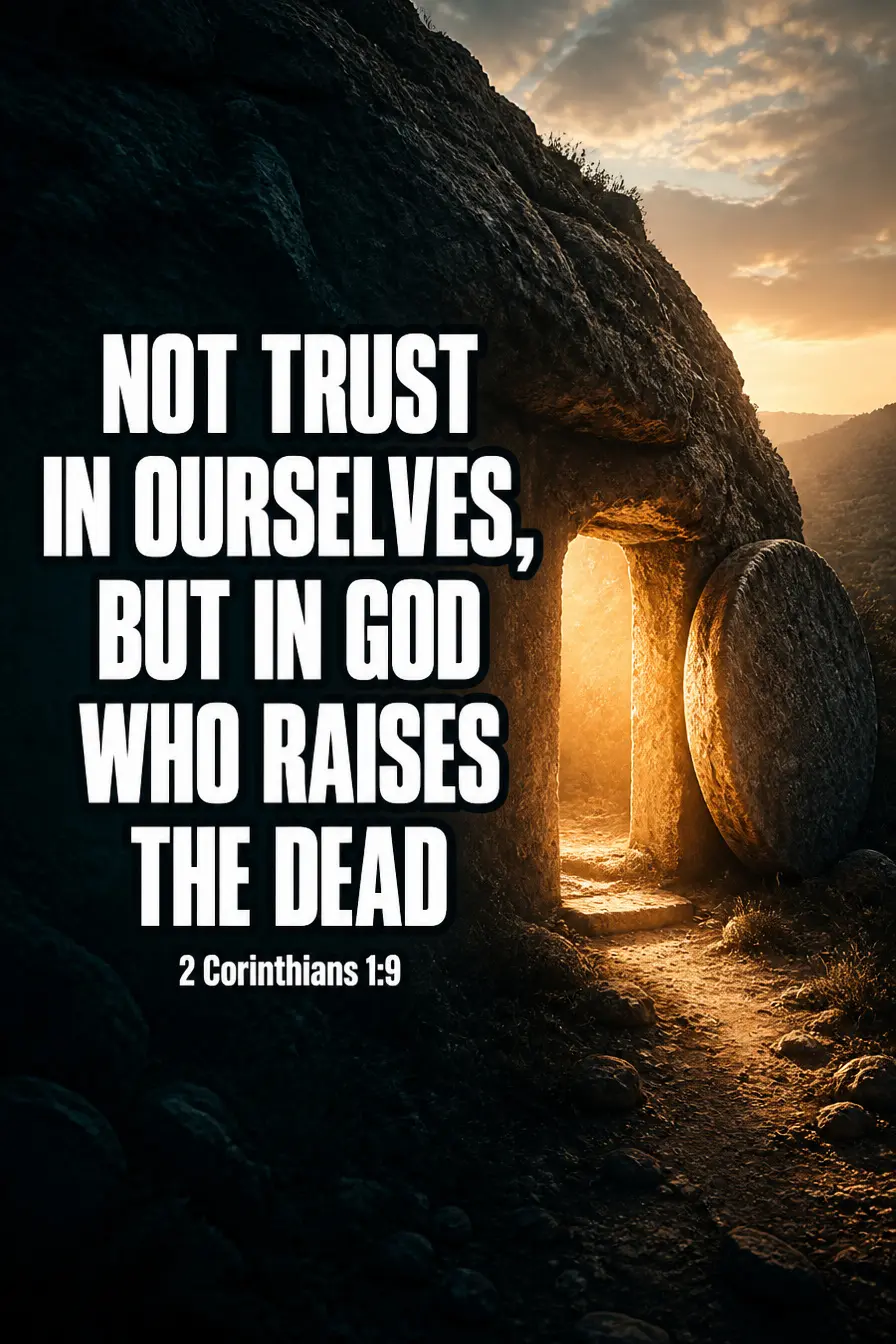
“Yes, we ourselves have had the sentence of death within ourselves, that we should not trust in ourselves, but in God who raises the dead,” — 2 Corinthians 1:9 (WEBU)
The sentence of death within ourselves is courtroom language — the verdict had already been read, as far as he was concerned. Then comes a small word that changes the whole passage: that. It introduces a purpose. Paul is not saying the crisis happened to have a silver lining. He is saying it ran that deep in order to move his trust off one thing and onto another.
And look at which name for God he picks. Not the God who comforts, which is what he opened with. God who raises the dead — the only description that is any use to a man who has already accepted he is finished. Hope in Scripture is not usually the reassurance that the worst will not happen. It is the claim that God works on the other side of the worst.
2 Corinthians 1:10 — Three Tenses in One Breath
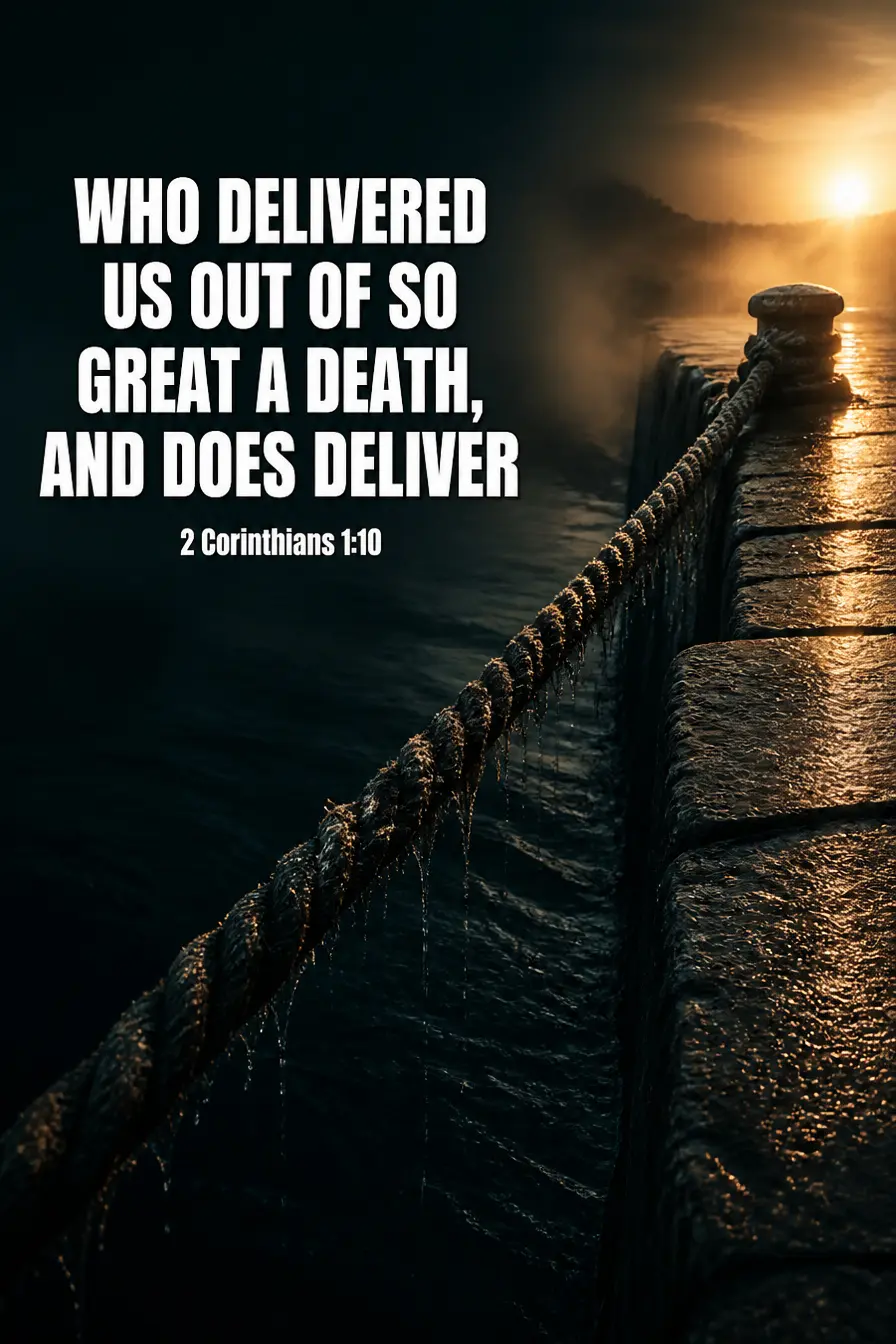
“who delivered us out of so great a death, and does deliver, on whom we have set our hope that he will also still deliver us,” — 2 Corinthians 1:10 (WEBU)
Count the verbs. Delivered — past. Does deliver — present, happening while he writes. Will also still deliver — future. One sentence, three tenses, the same verb each time.
That is worth borrowing directly. When the middle of a hard season goes flat and you cannot feel anything, the past tense is still available: something has already been carried you out of. Paul builds his forward-looking hope out of a completed rescue, not out of optimism about what comes next.
Where God Is While It Is Actually Happening
Psalm 46:1 — A Very Present Help
“For the Chief Musician. By the sons of Korah. According to Alamoth. God is our refuge and strength, a very present help in trouble.” — Psalm 46:1 (WEBU)
The load-bearing word is in. Not a help before trouble arrives and not a help once it clears — a very present help in it. The next verse pushes on the same point by choosing the least stable images available: “though the earth changes, though the mountains are shaken into the heart of the seas” (Psalm 46:2, WEBU). Mountains are the standard biblical picture of what does not move. The psalm says even if those end up in the sea, the sentence still holds.

The Prayer That Just Asks How Long
Psalm 13:1 — Four Questions, No Apology
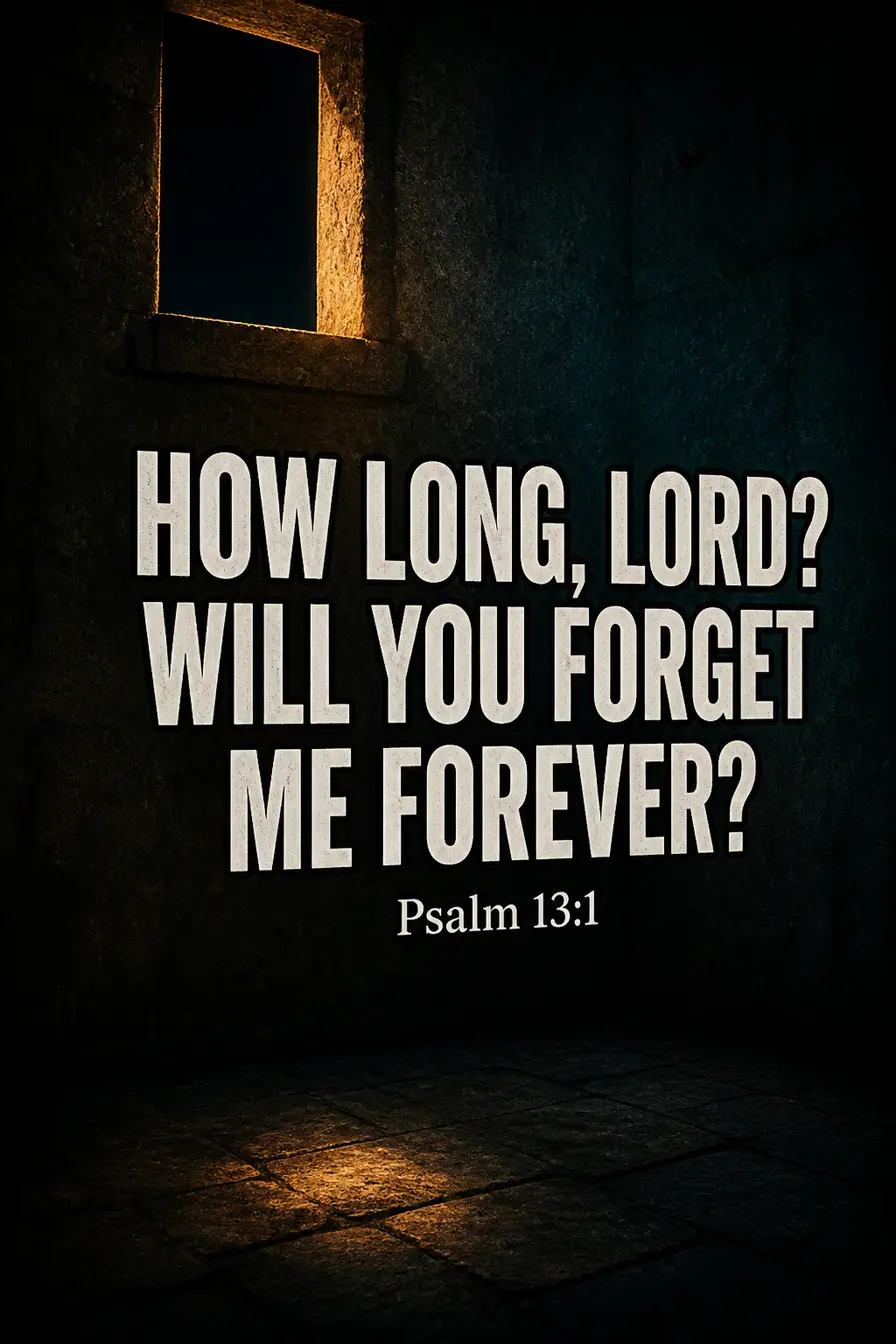
“For the Chief Musician. A Psalm by David. How long, LORD? Will you forget me forever? How long will you hide your face from me?” — Psalm 13:1 (WEBU)
David asks how long four times in the opening two verses, and nobody in the text tells him to phrase it more carefully. The second verse carries the other two: “How long shall I take counsel in my soul, having sorrow in my heart every day? How long shall my enemy triumph over me?” (Psalm 13:2, WEBU).
“Sorrow in my heart every day” is the detail that gives it away. This is not one bad night. It is the grinding kind of hard time, the sort where the date has stopped meaning anything. That prayer was collected, set to music, and given to the worship leader. Somebody decided a congregation should have words for this.
Psalm 13:5 — The Turn Is in the Same Poem
“But I trust in your loving kindness. My heart rejoices in your salvation.” — Psalm 13:5 (WEBU)
Psalm 13 is six verses long. The complaint runs to verse four and the turn lands in verse five, which means the distance from “will you forget me forever” to “my heart rejoices” is about thirty seconds of reading.
Nothing in the psalm says his circumstances changed. No enemy is defeated between verse four and verse five; the situation on the ground is identical. What moves is where he is looking. That is the honest shape of hope in a hard season — not a resolution, but a turn, made while the trouble is still running.
Not every prayer in the Bible gets there. One of them never turns at all: Psalm 88 argues with God for eighteen verses and finishes “You have put lover and friend far from me, and my friends into darkness.” (Psalm 88:18, WEBU). It was kept in the book anyway, which is a kindness to anyone who cannot reach verse five today — we look at it closely in our study of comforting verses for grief and mourning.

The Woman Who Changed Her Name
Naomi lost her husband and both her sons in a foreign country during a famine. The book of Ruth records what she said walking back into her home town.
Ruth 1:20 — Do Not Call Me Naomi
“She said to them, “Don’t call me Naomi. Call me Mara, for the Almighty has dealt very bitterly with me.” — Ruth 1:20 (WEBU)
Naomi means pleasant. Mara means bitter. She is standing in front of neighbours who have known her for decades and telling them her name no longer fits, and she does not soften where she thinks the loss came from: “the Almighty has dealt very bitterly with me”.
The book does not correct her. There is no narrator’s note explaining that she was being unfair, and no friend arrives with a better theology. Her sentence is recorded as she said it.
Ruth 1:21 — Out Full, Home Empty
“I went out full, and the LORD has brought me home again empty. Why do you call me Naomi, since the LORD has testified against me, and the Almighty has afflicted me?”” — Ruth 1:21 (WEBU)
Full and empty are inventory words, and that is what makes the line land. She left with a husband and two sons and came back with neither, and she says it in the plainest arithmetic available.
What she cannot see, standing there, is the person beside her. Ruth is in that scene, and Naomi counts herself empty anyway — which is not stupidity, it is what loss does to your eyesight. If you are doing the same maths about your own life this week, the passage is not going to scold you for it.

Ruth 4:17 — What the Neighbours Say at the End
“The women, her neighbors, gave him a name, saying, “A son is born to Naomi”. They named him Obed. He is the father of Jesse, the father of David.” — Ruth 4:17 (WEBU)
Three chapters later the same women are back, and they use her old name. Not Mara. Naomi.
Two more details do the rest of the work. The baby is not hers — he is Ruth’s — and they name him to her anyway, so the emptiness gets filled from a direction she was not watching. And the last line of the book quietly attaches her grandson to a family tree: Obed, Jesse, David. The woman who told a whole town to call her Bitter ends up two generations from Israel’s king. She had no way of knowing that in chapter one, which is the point of putting chapter one in.
What God Did First for a Man Who Wanted to Die
1 Kings 19:4 — It Is Enough
“But he himself went a day’s journey into the wilderness, and came and sat down under a juniper tree. Then he requested for himself that he might die, and said, “It is enough. Now, O LORD, take away my life; for I am not better than my fathers.”” — 1 Kings 19:4 (WEBU)
The timing is what makes this passage useful. Elijah has just come off the single greatest public victory of his career, on Mount Carmel, in front of the whole nation. One chapter later he is a day’s walk into the desert asking God to end his life.
Hard seasons do not always arrive after failure. Sometimes they arrive straight after the win, when the adrenaline drains and there is nothing behind it. If that is where you are, you are in old company, and the Bible does not treat it as a scandal.
1 Kings 19:5 — Arise and Eat
“He lay down and slept under a juniper tree; and behold, an angel touched him, and said to him, “Arise and eat!”” — 1 Kings 19:5 (WEBU)
Here is the answer heaven sends a suicidal prophet: a nap and a meal.
No rebuke. No reminder of what he had just witnessed on the mountain. No instruction to pray harder. He is allowed to sleep, then woken and fed, then allowed to sleep again — the sequence runs twice before God says anything at all about the future. Only afterwards does he travel on: “he arose, and ate and drank, and went in the strength of that food forty days and forty nights” (1 Kings 19:8, WEBU).
Which is worth stating plainly, because it is Scripture’s own order of operations. Sleep, food and a body that has been looked after come before the conversation. And if the weight does not lift, put yourself in the hands of a doctor or a counsellor — needing that help is not a smaller faith, and it sits alongside prayer rather than replacing it.
Hope That Does Not Depend on the Harvest
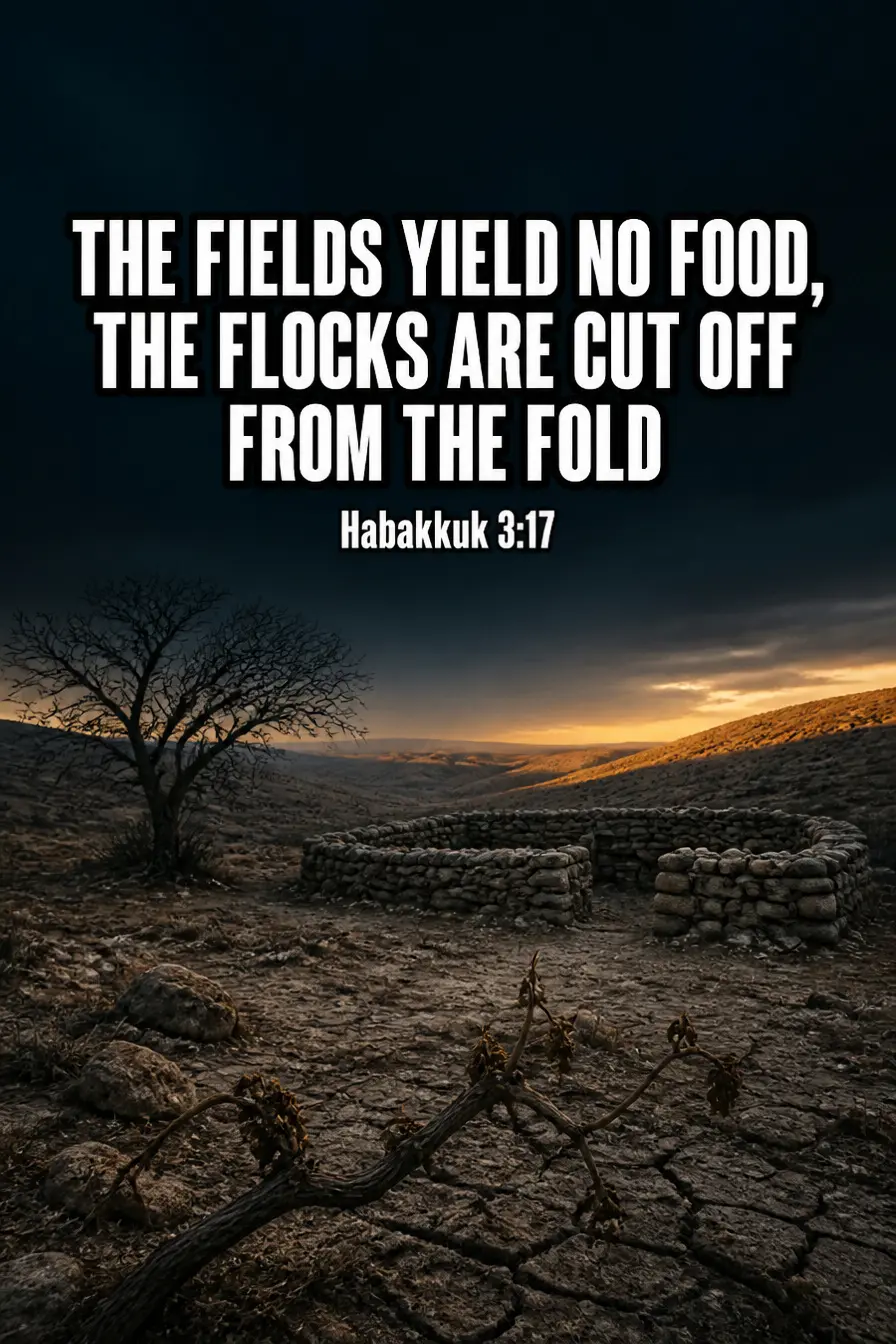
Habakkuk 3:17 — Six Things Failing at Once
“For even though the fig tree doesn’t flourish, nor fruit be in the vines, the labor of the olive fails, the fields yield no food, the flocks are cut off from the fold, and there is no herd in the stalls,” — Habakkuk 3:17 (WEBU)
Habakkuk is not listing metaphors. In an agricultural economy this is the whole balance sheet: figs, grapes, olives, grain, sheep, cattle. Six income streams, and he names them failing one after another until nothing is left standing.
He does not round it off to “if things go wrong”. He counts. That is what makes the next verse cost something, because the sentence has been priced before it is spoken.
Habakkuk 3:18 — The Word Everything Hangs On
“yet I will rejoice in the LORD. I will be joyful in the God of my salvation!” — Habakkuk 3:18 (WEBU)
Yet. One syllable, and it is doing all the structural work in the passage.
Habakkuk does not say the harvest will recover, and he does not say the failures were smaller than they looked. He says the joy is attached somewhere the harvest cannot reach. “In the LORD”, not in the fields — and “I will”, future tense, a decision rather than a mood he happens to be in. This is the difference between hope and optimism. Optimism is a forecast about circumstances; this is a commitment about where you are anchored while the forecast is bad.

When You Cannot Feel Any of It
Some weeks none of the above lands. The verses are true, you believe them in principle, and they bounce. Scripture has a page for that too, and its instruction is oddly practical.
Psalm 77:11 — Go Back and Count
“I will remember the LORD’s deeds; for I will remember your wonders of old.” — Psalm 77:11 (WEBU)
Read what this psalm asks before it gets here. “Will the Lord reject us forever? Will he be favorable no more?” and “Has God forgotten to be gracious? Has he, in anger, withheld his compassion?” (Psalm 77:7, 9, WEBU). Those are not rhetorical. He genuinely does not know.
And his way out is not a feeling. It is an act of memory, stated as a decision — “I will remember” — and aimed at specifics: the LORD’s deeds, wonders of old, things that actually happened. When trusting God in the present has gone quiet, the psalm sends you backwards to the evidence rather than inwards to your mood.

Romans 8:38-39 — The List of Things That Cannot Reach You
“For I am persuaded that neither death, nor life, nor angels, nor principalities, nor things present, nor things to come, nor powers,” — Romans 8:38 (WEBU)
“nor height, nor depth, nor any other created thing will be able to separate us from God’s love which is in Christ Jesus our Lord.” — Romans 8:39 (WEBU)
Paul writes a list and then closes the gaps in it. Death and life covers the two states available. Things present and things to come covers time. Height and depth covers space. Then, in case a reader is still hunting for the exception that applies to them, any other created thing.
What the list does not promise is that none of those things will happen to you. Several of them will. The promise is narrower and sturdier: none of them can get between you and God’s love. That is where lasting hope is fastened — not to the outcome, but to a relationship the outcome cannot cut.

2 Corinthians 4:17 — Weighed Against Something
“For our light affliction, which is for the moment, works for us more and more exceedingly an eternal weight of glory,” — 2 Corinthians 4:17 (WEBU)
Be careful with the word light here. It is the same writer who three chapters earlier said he despaired of life, so he is not calling your trouble small. He is calling it light on a scale, against a weight he names in the next breath as eternal.
The following verse gives the practice attached to it: “while we don’t look at the things which are seen, but at the things which are not seen. For the things which are seen are temporal, but the things which are not seen are eternal.” (2 Corinthians 4:18, WEBU). Not denial of what is visible — a refusal to let the visible be the only thing on the scale.

Verses to Keep Close This Week
Everything above is the argument. These are the lines to have written down somewhere you will see them, and each belongs to a fuller study of its own.
- “but those who wait for the LORD will renew their strength. They will mount up with wings like eagles. They will run, and not be weary. They will walk, and not faint.” (Isaiah 40:31, WEBU) — the order is odd on purpose: fly, run, then walk. See verses for strength and hope.
- “It is because of the LORD’s loving kindnesses that we are not consumed, because his mercies don’t fail.” (Lamentations 3:22, WEBU) — written by a man looking at a burned city. More in hope for the future.
- “Now may the God of hope fill you with all joy and peace in believing, that you may abound in hope in the power of the Holy Spirit.” (Romans 15:13, WEBU) — hope as something you are filled with rather than something you generate. See hope, love and God’s promises.
- “In the world you have trouble; but cheer up! I have overcome the world.” (John 16:33, WEBU) — Jesus says trouble is expected, in the same sentence as the reassurance.
- “He will wipe away every tear from their eyes. Death will be no more; neither will there be mourning, nor crying, nor pain any more.” (Revelation 21:4, WEBU) — the long horizon, and God’s own hand doing the wiping.
- “My grace is sufficient for you, for my power is made perfect in weakness.” (2 Corinthians 12:9, WEBU) — the answer Paul got when the thing was not taken away. Covered fully in verses for strength and hope.
- “Many are the afflictions of the righteous, but the LORD delivers him out of them all.” (Psalm 34:19, WEBU) — note that it starts by conceding the plural.
- “all things work together for good for those who love God, for those who are called according to his purpose.” (Romans 8:28, WEBU) — it says all things work together, not that all things are good. More in hope and encouragement.
- “Count it all joy, my brothers, when you fall into various temptations,” (James 1:2, WEBU) — “count” is a deliberate act of arithmetic, not a feeling you are ordered to have.
- “these God has prepared for those who love him.” (1 Corinthians 2:9, WEBU) — the end of a sentence about what no eye has seen.
If you want one practice rather than seven verses, take the one Psalm 77 uses. Write down three things God has already done in your life, with dates if you have them. Keep the list where you can reach it on the days when believing anything feels beyond you. God’s faithfulness is easier to trust when it is written down in your own handwriting than when you are trying to summon a feeling about it.
What Holding On to Hope Looks Like Day to Day
None of this is a single decision you make once. Hope in God is closer to a daily job than a moment of clarity, and the practical shape of it in Scripture is unglamorous.
Read something true out loud. God’s word is the raw material, not because reading is magic, but because a hard season shrinks your vocabulary down to the two or three sentences your fear keeps repeating. Reading Scripture aloud puts different words in the room. “Trust in the LORD with all your heart, and don’t lean on your own understanding.” (Proverbs 3:5, WEBU) is a reasonable place to start on a day when your own understanding has run out.
Say the ugly version to God. Psalm 62 gives permission in a single line: “Trust in him at all times, you people. Pour out your heart before him. God is a refuge for us.” (Psalm 62:8, WEBU). Pouring out is not the same as tidying up first.
Ask for mercy rather than for answers. Mercy is the request the psalms make more than any other, and it is smaller and far more available than an explanation. Praise to God can wait for a week when you have it; asking for mercy needs nothing you do not already have.
Let somebody comfort you, and then comfort others. That movement is the whole point of the passage this article opened with. People who find comfort in a bad year turn out to be the ones who can offer comfort in somebody else’s, and the source of all comfort is the same in both directions.
Let the strength be borrowed. “I can do all things through Christ who strengthens me.” (Philippians 4:13, WEBU) — written in a letter about being content on very little, not about achievement. The strength you need is described throughout the New Testament as arriving from somewhere other than yourself, which is good news on the days when you have run out of your own.
Questions About Hope in Hard Times
What are the best Bible verses for hope in difficult times?
The most useful ones are the passages that name the difficulty rather than skipping it. 2 Corinthians 1:8-10 has Paul admitting he despaired of life and then setting his hope on “God who raises the dead”. Habakkuk 3:17-18 lists six things failing and answers with “yet I will rejoice”. Psalm 13 moves from “how long” to “my heart rejoices” in six verses. Romans 8:38-39 is the anchor underneath all of them.
Does the Bible say it is wrong to feel hopeless?
No. Elijah asked God to take his life (1 Kings 19:4), Naomi told her town to rename her Bitter (Ruth 1:20), and Paul wrote that he despaired of life itself (2 Corinthians 1:8). None of the three is rebuked for saying it. Scripture records the words and then keeps going with the person — which is a very different response from being told to cheer up.
How do you hold on to hope when nothing changes?
Psalm 77 gives the method: remember specific past deeds rather than waiting to feel differently. Psalm 13:5 shows the same move — the psalmist’s circumstances are unchanged between verse four and verse five, and what shifts is where he looks. Hope in the Bible is usually a decision made inside the trouble, not a mood that arrives once it clears.
What is the difference between hope and optimism?
Optimism is a prediction that things will improve. Biblical hope is confidence in who God is, which does not depend on the forecast. Habakkuk 3:18 is the clearest example: he expects the harvest to fail completely and says he will rejoice in the Lord anyway, because the joy is attached to God rather than to the fields.
Where is God when life is falling apart?
Psalm 46:1 answers with one preposition. God is “a very present help in trouble” — not before it and not after it. The psalm then chooses the most extreme collapse it can picture, mountains falling into the sea, and says the promise still stands. God’s presence in Scripture is consistently described as company inside the trouble rather than removal from it.
Where to Start Tonight
If this season has gone on long enough that you have stopped expecting it to end, the verses above are not asking you to feel better first. Paul did not. Naomi did not. Elijah slept and ate before God said anything to him at all.
So take the smallest of the practices. Eat something, sleep if you can, and write down three things God has already done. Then read Psalm 13 straight through — all six verses, complaint included — and let it be your words tonight.
More on this in our hope collection.