
Nothing has happened. That is the part that makes it worse. The bills are paid, nobody is ill, the week ahead is ordinary, and you woke at four with your chest tight and your jaw clenched and a certainty that something is wrong. No obvious trigger, no clear reason — just a wave of anxiety that arrived on its own. Then the second layer arrives: if there is no reason, the problem must be you.
We treat being anxious for no reason as a modern complaint, the kind of thing that needs a diagnosis before anyone will take it seriously. Scripture got there a long time earlier. It describes dread with no object in language so exact it is uncomfortable to read, and when it tells the story of a man in that state, the first thing God does for him is not a sermon.
It is a meal. Then a nap. Then another meal.
What follows is what Scripture actually says about unexplained anxiety — the kind that arrives without an obvious trigger and leaves you searching for an apparent reason that is not there.

Face your giants. Discover what makes someone truly brave.1 Samuel 17 · 11 min
That was just the opening. Open the app and search #002 to hear the full 11-minute story — free.
Keep listening free in the app Free on iOS & Android — no sample needed

Scripture Has Words for Dread With No Object
Deuteronomy 28 is a list of what national collapse would feel like from the inside. Buried in it is a description of anxiety that nobody expects to find in a legal document from the Bronze Age.
“Among these nations you will find no ease, and there will be no rest for the sole of your foot; but the LORD will give you there a trembling heart, failing of eyes, and pining of soul.” — Deuteronomy 28:65 (WEBU)
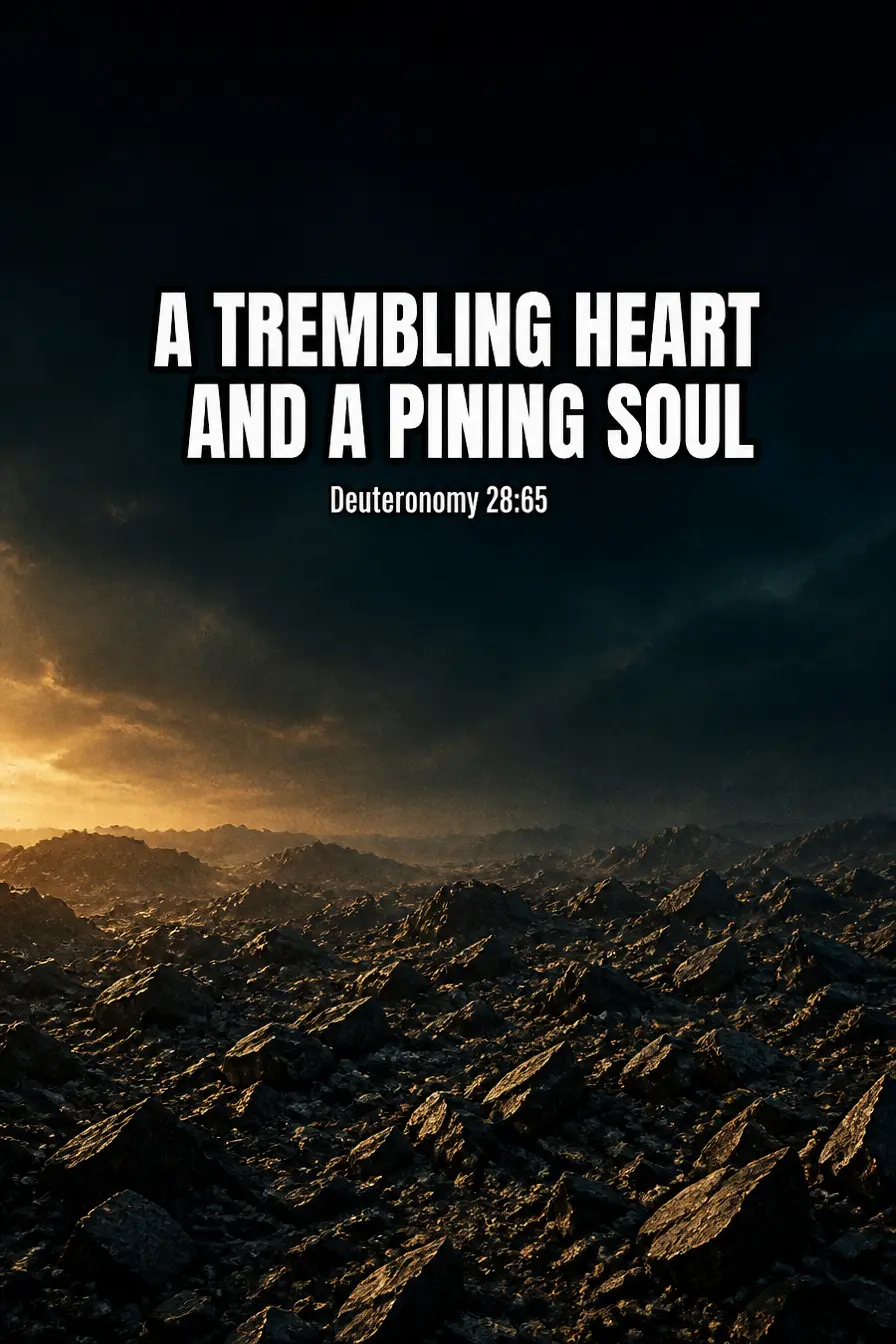
“No rest for the sole of your foot.” A trembling heart. Failing eyes. A pining soul. Four physical symptoms in one verse — a list of anxiety symptoms written down long before anyone had a word for them, and set out without a single moral comment attached. Whoever wrote this had watched it happen to someone.
“Your life will hang in doubt before you. You will be afraid night and day, and will have no assurance of your life.” — Deuteronomy 28:66 (WEBU)
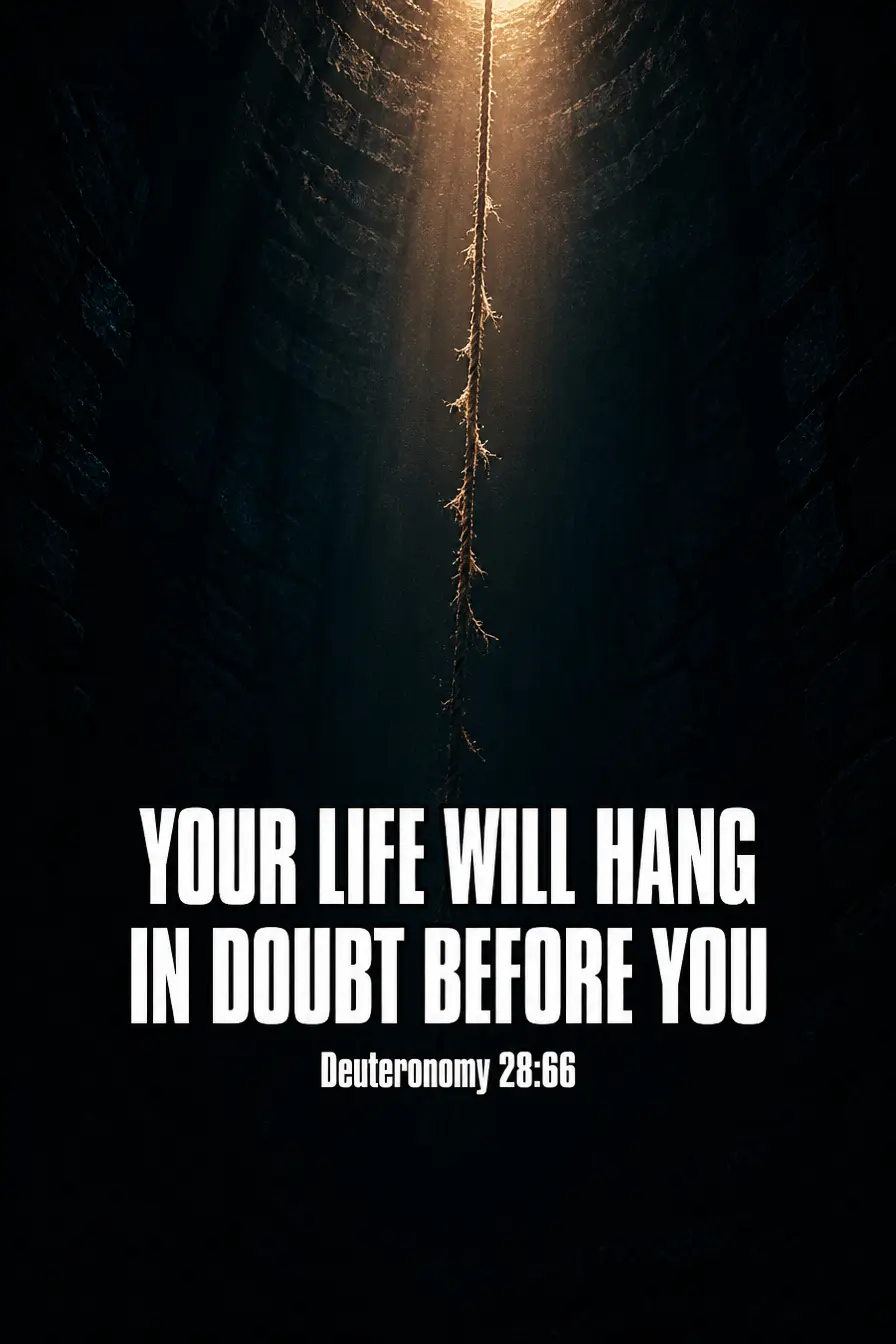
Your life will hang in doubt before you. Not your circumstances — your life, hanging in front of you like something you are watching rather than living. “No assurance” is the operative phrase, and it is what separates this from ordinary fear. Ordinary fear has a subject. This has none, and runs night and day. It is the sense that something is wrong with no sentence to finish.
Then comes the verse that most people have never heard and immediately recognize.
“In the morning you will say, “I wish it were evening!” and at evening you will say, “I wish it were morning!” for the fear of your heart which you will fear, and for the sights which your eyes will see.” — Deuteronomy 28:67 (WEBU)
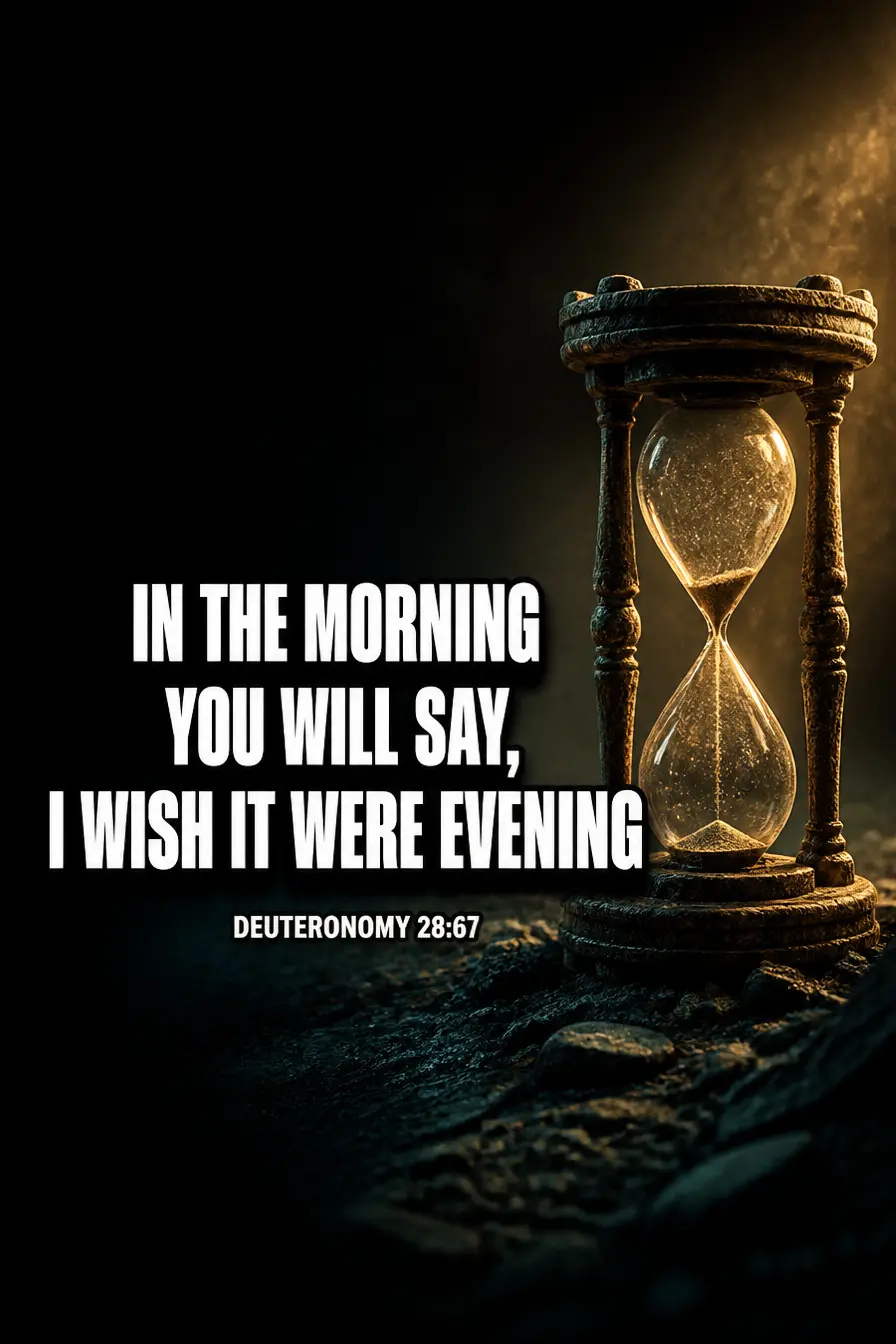
In the morning, “I wish it were evening!” In the evening, “I wish it were morning!” Wanting to be at any point on the clock except this one, and finding that the next point is no better when you get there. That is the loop, written down roughly three thousand years ago.
The relevant thing is not the poetry. It is that the Bible describes this state, at length, without once suggesting the person feeling it has done something to deserve it — which is more than most of us grant ourselves at four in the morning.
The Prophet Who Collapsed the Day After Winning
Elijah’s breakdown in 1 Kings 19 is the passage for this, and we almost always tell it wrong — as a story about a discouraged man who needed to remember God’s power. Read the order of events and it is not that at all.
The day before, he had won. Publicly, decisively, against four hundred and fifty opposing prophets on Mount Carmel, with fire falling from the sky in front of the entire nation. It is the high point of his career. Then Queen Jezebel sends one threatening message, and this happens.
“When he saw that, he arose and ran for his life, and came to Beersheba, which belongs to Judah, and left his servant there.” — 1 Kings 19:3 (WEBU)

He runs about a hundred miles, then leaves the only other person with him and goes on alone. Nothing in his circumstances had actually deteriorated — he had just won. Anxiety can feel most convincing at the precise moment the danger has passed. The collapse arrives after the danger, not during it, which is the pattern anyone who has fallen apart on the first quiet weekend after a hard season will recognize.
“But he himself went a day’s journey into the wilderness, and came and sat down under a juniper tree. Then he requested for himself that he might die, and said, “It is enough. Now, O LORD, take away my life; for I am not better than my fathers.”” — 1 Kings 19:4 (WEBU)
“It is enough. Now, O LORD, take away my life.” Bible Verses for Hope in Difficult Times sits with that sentence at length. What matters here is what God does about it, because it is not what anyone expects.
“He lay down and slept under a juniper tree; and behold, an angel touched him, and said to him, “Arise and eat!”” — 1 Kings 19:5 (WEBU)
He sleeps. An angel arrives — and says arise and eat. Not arise and pray. Not a correction, not a promise, not a reminder of Carmel. Food.
“He looked, and behold, there was at his head a cake baked on the coals, and a jar of water. He ate and drank, and lay down again.” — 1 Kings 19:6 (WEBU)

Bread and water, already made, waiting by his head. He eats, and then — this is the detail that gets skipped — he lay down again. He goes back to sleep. Nobody wakes him for a conversation.
“The LORD’s angel came again the second time, and touched him, and said, “Arise and eat, because the journey is too great for you.”” — 1 Kings 19:7 (WEBU)
The journey is too great for you. Twice fed, twice allowed to sleep, and the only explanation offered is about capacity rather than character. Bible Verses for Strength and Hope works through that line on its own.
“He arose, and ate and drank, and went in the strength of that food forty days and forty nights to Horeb, God’s Mountain.” — 1 Kings 19:8 (WEBU)
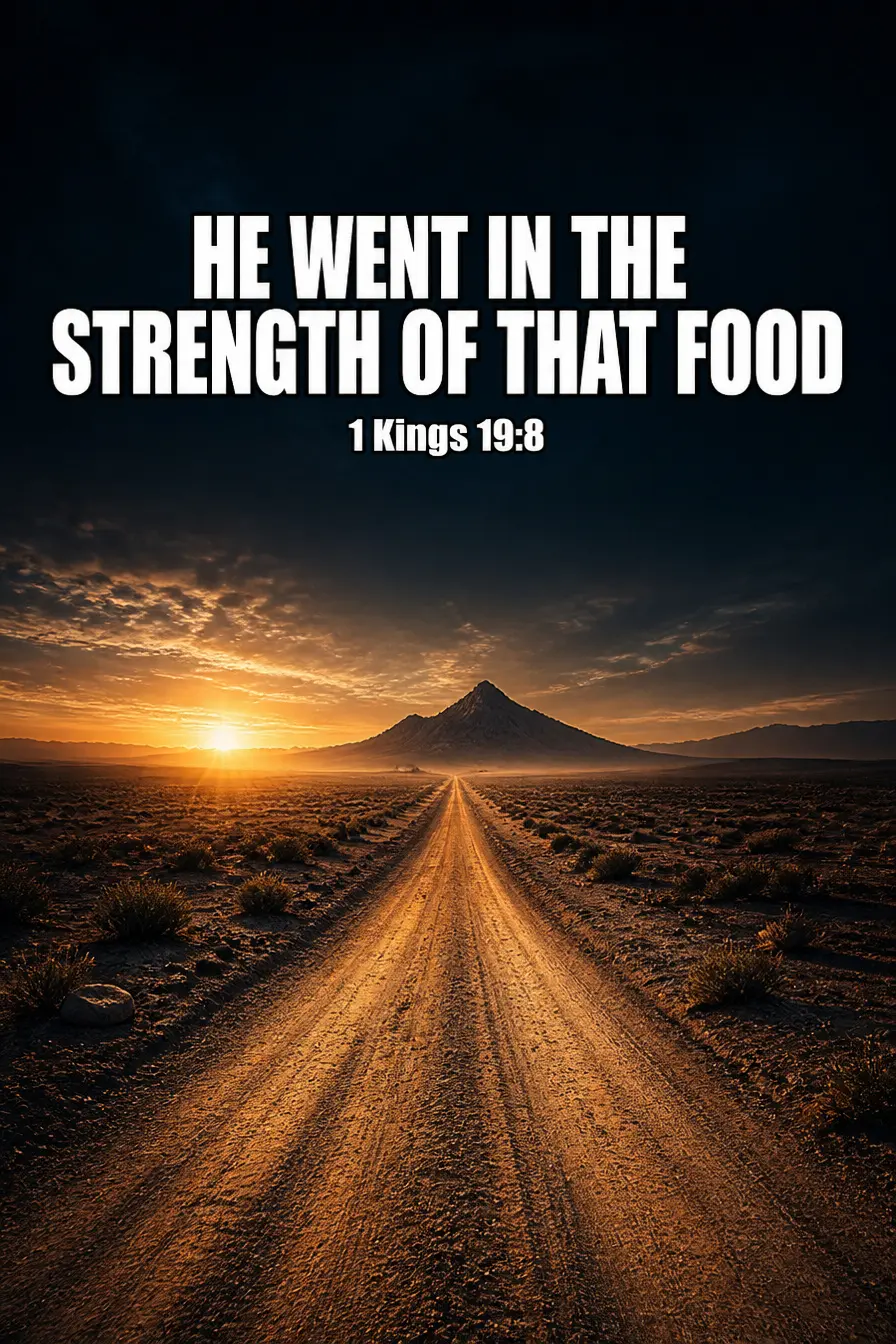
In the strength of that food. The forty days that follow run on breakfast. Two meals and two sleeps come before one word of theology, and the text is not embarrassed about it.
Which is the plainest thing to say here: if this is ongoing anxiety, and it is starting to interfere with your daily activities — your sleep, your body, your work — then it is time to seek professional help, and that sits alongside faith rather than against it. The passage above is the Bible treating a body before it treats anything else.
The Question God Asked Instead
Only after the food does the conversation start, and the opening line is not what a discouraged prophet would expect.
“He came to a cave there, and camped there; and behold, the LORD’s word came to him, and he said to him, “What are you doing here, Elijah?”” — 1 Kings 19:9 (WEBU)

What are you doing here? It is a question, not a verdict. God asks him to say it, which is a different move from telling him what he ought to feel. And Elijah answers with the sentence that shows exactly how the state distorts the facts.
“He said, “I have been very jealous for the LORD, the God of Armies; for the children of Israel have forsaken your covenant, thrown down your altars, and killed your prophets with the sword. I, even I only, am left; and they seek my life, to take it away.”” — 1 Kings 19:10 (WEBU)

“I, even I only, am left.” Hold onto that, because it is measurably false and he believes it completely. He had a servant with him four verses ago. Obadiah had hidden a hundred prophets in caves, and Elijah knew about it. The state he is in has not invented a feeling; it has rewritten a fact.
“He said, “Go out and stand on the mountain before the LORD.” Behold, the LORD passed by, and a great and strong wind tore the mountains and broke in pieces the rocks before the LORD; but the LORD was not in the wind. After the wind there was an earthquake; but the LORD was not in the earthquake.” — 1 Kings 19:11 (WEBU)

Wind that breaks rocks. An earthquake. Both are exactly the kind of thing Elijah had seen at Carmel, and God is deliberately not in either of them. The man who was reached by fire from heaven last week is not going to be reached that way this week.
“After the earthquake a fire passed; but the LORD was not in the fire. After the fire, there was a still small voice.” — 1 Kings 19:12 (WEBU)

A still small voice. The Hebrew is closer to a sound of thin silence, which is a stranger phrase and a better one. Whatever it was, it was quiet enough that a man in a cave had to come to the entrance to hear it.
“When Elijah heard it, he wrapped his face in his mantle, went out, and stood in the entrance of the cave. Behold, a voice came to him, and said, “What are you doing here, Elijah?”” — 1 Kings 19:13 (WEBU)

The same question, word for word. God asks it a second time and lets Elijah give the same wrong answer a second time, and does not argue with him about it. What corrects the distortion is not a rebuke.
“Yet I reserved seven thousand in Israel, all the knees of which have not bowed to Baal, and every mouth that has not kissed him.”” — 1 Kings 19:18 (WEBU)

Seven thousand. Elijah had said “I only am left”. The correction is a number, delivered flatly, after food and sleep and two chances to say the wrong thing out loud. God does not tell him to feel better. He tells him he has miscounted by seven thousand.
When You Cannot Name What Is Wrong
Elijah at least had Jezebel to point at. Scripture also carries the harder version, where anxiety episodes arrive for seemingly no reason and the writer says so plainly rather than tidying it up.
“For the thing which I fear comes on me, that which I am afraid of comes to me.” — Job 3:25 (WEBU)
Job is describing anticipation that ran ahead of the event — he was afraid of it before it happened, and the feelings of anxiety and the thing arrived together. The verse is often quoted as if it were a warning about attracting trouble by worrying. It is not a warning. It is a man saying the dread came first.
“I am not at ease, neither am I quiet, neither do I have rest; but trouble comes.”” — Job 3:26 (WEBU)
Three negatives in a row: not at ease, not quiet, no rest. Job is a book where the sufferer complains at enormous length and is never once told to stop, which is not how most of us let ourselves talk.
“You hold my eyelids open. I am so troubled that I can’t speak.” — Psalm 77:4 (WEBU)
“You hold my eyelids open.” Four in the morning, addressed to God as the one doing it. And the psalmist adds, a verse earlier, that his soul refused to be comforted — the honest report of a night when nothing helps and the comfort is available and does not land.
“Deep calls to deep at the noise of your waterfalls. All your waves and your billows have swept over me.” — Psalm 42:7 (WEBU)
“Deep calls to deep.” One thing setting off another underneath the surface, out of sight, where the connection cannot be traced. It is the closest Scripture comes to describing anxiety that seems to have no source — sudden anxiety, without a clear reason, arriving from somewhere you cannot see. A few verses later the same psalm asks its own soul why it is downcast — a question, again, rather than an accusation.
“Why are you in despair, my soul? Why are you disturbed within me? Hope in God! For I shall still praise him, the saving help of my countenance, and my God.” — Psalm 42:11 (WEBU)
“Why are you in despair, my soul? Why are you disturbed within me? Hope in God!” The psalm ends on an instruction the writer is giving himself, out loud, without pretending it has already worked.
The Prayer for When There Is Nothing to Report
Which leaves the practical problem. Prayer usually starts with a subject, and this has none. David wrote the prayer for exactly that.
“Search me, God, and know my heart. Try me, and know my thoughts.” — Psalm 139:23 (WEBU)
“Search me, God, and know my heart; test me and know my anxious thoughts”, as many translations render the second line. The whole request is an admission that the person praying cannot do the search himself. He is not reporting a problem. He is asking someone with better access to go and find it.
“See if there is any wicked way in me, and lead me in the everlasting way.” — Psalm 139:24 (WEBU)
And the ending is a direction rather than an explanation. “Lead me in the everlasting way” — the prayer does not require the search to come back with an answer first. That matters at four in the morning, when the honest report is that there is nothing to report.
The rest of Scripture keeps company with this rather than solving it.
“In nothing be anxious, but in everything, by prayer and petition with thanksgiving, let your requests be made known to God.” — Philippians 4:6 (WEBU)
Do not be anxious about anything, but in every situation, by prayer and petition, with thanksgiving, present your requests to God. Bible Verses for Anxiety takes the passage verse by verse; the useful part tonight is that everything includes the requests you cannot name.
“The LORD is near to those who have a broken heart, and saves those who have a crushed spirit.” — Psalm 34:18 (WEBU)
The LORD is close to the brokenhearted and saves those who are crushed in spirit. Nearness is stated as a fact about where God is, not as a reward for calming down.
“You will keep whoever’s mind is steadfast in perfect peace, because he trusts in you.” — Isaiah 26:3 (WEBU)
You will keep in perfect peace those whose minds are steadfast, because they trust in you.
“When I am afraid, I will put my trust in you.” — Psalm 56:3 (WEBU)
“When I am afraid, I will put my trust in you.” David wrote it while in the hands of an enemy king, which is worth knowing before it turns up on a bookmark.
“casting all your worries on him, because he cares for you.” — 1 Peter 5:7 (WEBU)
Cast all your anxiety on him because he cares for you. Casting is a throwing word, used for slinging a load off a shoulder.
“In the same way, the Spirit also helps our weaknesses, for we don’t know how to pray as we ought. But the Spirit himself makes intercession for us with groanings which can’t be uttered.” — Romans 8:26 (WEBU)
The Spirit helps us in our weakness, because we do not know what we ought to pray for. Paul builds the not-knowing into the system rather than treating it as a failure.
“I laid myself down and slept. I awakened, for the LORD sustains me.” — Psalm 3:5 (WEBU)
“I laid myself down and slept. I awakened, for the LORD sustains me.” Sleep is described as something God does for a person rather than something the person achieves.
“When you lie down, you will not be afraid. Yes, you will lie down, and your sleep will be sweet.” — Proverbs 3:24 (WEBU)
When you lie down, you will not be afraid; your sleep will be sweet.
A note on wording, since it causes confusion. These quotations are the World English Bible, which is public domain, while most readers know the NIV or another modern version. The sense is the same and only the English differs — Psalm 139:23 as “know my anxious thoughts” and this text’s “know my thoughts” are the same line.
What to Do at Four in the Morning
Elijah’s sequence is the template, and it runs in an order most practical strategies reverse. None of what follows is a way to reduce anxiety on demand; it is the order the passage itself uses, and it starts with the body.
- Eat and sleep before you interpret. Two meals and two sleeps came before one word of theology. If you have not eaten properly or slept properly, the meaning you assign to the feeling at four in the morning is not evidence about your faith. Hunger and exhaustion are anxiety triggers in their own right, and they are the two the text deals with first. Treat the body, exactly as the passage does.
- Say what is wrong out loud, even if it is wrong. God asked twice and let Elijah give the same distorted answer both times. Getting the sentence out of your head and into words is the step, and its accuracy is not the entry requirement. Naming the underlying anxiety is not the same as explaining it.
- Look for the miscount. “I only am left” was off by seven thousand. Anxiety without a reason almost always contains a claim of fact — nobody cares, this always happens, it will never lift. Writing the claims down over a week will help you identify patterns in them, and those thought patterns are checkable against something countable in a way the feeling is not.
- Ask God to do the search. “Search me, God, and know my heart” is the prayer for when you cannot name it. It hands over the finding as well as the fixing.
- Expect quiet rather than fire. The wind, the earthquake and the fire were all the wrong channel that week. If the dramatic thing is not arriving, that is not the same as nothing arriving.
- Give it a horizon. “In the morning you will say, I wish it were evening” is the loop, and it breaks when one hour is treated as one hour instead of as evidence about all of them.
Common Questions About Feeling Anxious for No Reason
Why do you feel anxious for no reason when nothing is wrong?
Often because the body is still running a response that its original cause has finished with — you experience anxiety after the danger rather than during it, with no obvious trigger left to point at. Elijah collapsed the day after his greatest victory, not during the threat. Scripture describes this state directly in Deuteronomy 28:65-67 — a trembling heart, no assurance, wanting morning at evening and evening at morning — and attaches no blame to it.
Is feeling nervous for no reason a sin?
Nothing in the passages above treats it that way. God’s first response to Elijah was food, sleep and a question; Job complains at length and is never told to stop; the psalmist reports that his soul refused to be comforted. What Scripture asks for is where the anxiety gets taken, not whether it is felt.
What does the Bible say about waking up anxious?
Psalm 77:4 puts it as directly as it can be put: “You hold my eyelids open. I am so troubled that I can’t speak.” Psalm 3:5 answers it with sleep described as something God does for a person — “I laid myself down and slept. I awakened, for the LORD sustains me.” Both are in the Bible, and neither cancels the other.
What is the best prayer when you cannot explain how you feel?
Psalm 139:23-24. “Search me, God, and know my heart. Try me, and know my thoughts… and lead me in the everlasting way.” It is built for exactly this: it asks God to run the search, and it asks for direction without requiring the search to report back first.
Does anxiety mean you lack faith?
No. People with anxiety fill the Bible, and it never uses the symptoms of anxiety as a measure of anybody’s faith. Elijah had just called fire down from the sky and asked to die the following day. Both are in the same chapter, and the text draws no line between them. Faith and a nervous system are two different things, and the passage treats the second one with food.
Seven Thousand
What Elijah needed was not a feeling. It was a number, and it arrived last — after the bread, after the sleep, after the question he answered wrong twice.
So if nothing is wrong and you feel like this anyway, the order in that chapter is the useful part. It does not promise to manage anxiety away. Eat something. Sleep if you can. Say the sentence out loud, even the untrue one. Then ask God to search for what you cannot find, and let the count be corrected later. More of it is in the Anxiety Archive, and Bible Verses for Panic Attacks and Anxiety covers the version that arrives all at once.