
Worry is the tax you pay on a future that has not arrived. You lie down, and the mind starts its rounds: the conversation at work, the money, the thing the doctor said, the child who has gone quiet. None of it is happening right now. All of it is being lived through anyway.
A sentence with no situation attached is easy to agree with and hard to use, and that is the trouble with most collections of bible verses about worry. So we have kept each verse below with where it was spoken and to whom. Worry, it turns out, is one of the few subjects Jesus preached on at length, and one Paul admitted to in writing.

Face your giants. Discover what makes someone truly brave.1 Samuel 17 · 11 min
That was just the opening. Open the app and search #002 to hear the full 11-minute story — free.
Keep listening free in the app Free on iOS & Android — no sample needed

Why Your Bible May Not Use the Word “Worry”
Search for worry in the World English Bible, which every quote below uses, and you will find almost nothing. The Greek word behind it, merimnaō, is rendered anxious nearly everywhere other versions say worry: where the NIV has “do not worry about tomorrow”, ours reads “don’t be anxious for tomorrow”. Search for anxious and the whole subject opens up.
One passage keeps the older word, and it is the one most people already have by heart.
1 Peter 5:6-7 — Casting Is a Throwing Word
“Humble yourselves therefore under the mighty hand of God, that he may exalt you in due time, casting all your worries on him, because he cares for you.” — 1 Peter 5:6-7 (WEBU)
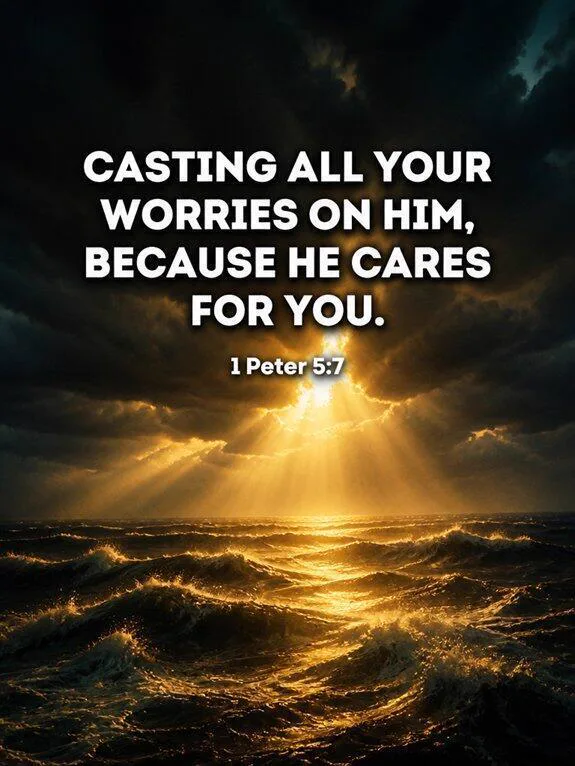
Casting is not a gentle verb. It is the word used when the disciples throw their cloaks onto a colt: physical, and one way. Notice what it is attached to — humble yourselves, then cast. Peter treats holding on to our worries as a quiet form of pride, as if the outcome depended on us keeping watch. And cares is a different word from worries: God holds the thing without fretting over it.
What Jesus Said About Worry in Matthew 6
The longest thing anyone in Scripture says about worry is ten verses of the Sermon on the Mount. Jesus uses the word six times in that stretch. It is an argument, not a collection of encouragements, so we are taking it in order.
Matthew 6:25 — The Question Underneath
“Therefore I tell you, don’t be anxious for your life: what you will eat, or what you will drink; nor yet for your body, what you will wear. Isn’t life more than food, and the body more than clothing?” — Matthew 6:25 (WEBU)
Food and clothing sound quaint until you translate them: rent, work, whether there will be enough. He does not call these worries trivial. The question at the end is the move. He is not denying the need; he is asking whether the need has been allowed to become the whole of the life.
Matthew 6:26 — Your Heavenly Father Feeds Them
“See the birds of the sky, that they don’t sow, neither do they reap, nor gather into barns. Your heavenly Father feeds them. Aren’t you of much more value than they?” — Matthew 6:26 (WEBU)

This is easy to misread as an instruction to do nothing. Birds are not idle; they spend the whole day finding food. What they do not do is store: no sowing, no reaping, no barns. The worry Jesus describes is not about working. It is about the barn, and whether the barn is what is keeping you upright.
Matthew 6:27 — One Moment
“Which of you by being anxious, can add one moment to his lifespan?” — Matthew 6:27 (WEBU)
A cost-benefit question. Worry presents itself as preparation, as though turning a thing over for the fourth time were work. Jesus asks what it has ever produced. Not one moment — only the feeling of doing something, which is why we find it so hard to stop.
Matthew 6:28-30 — Consider the Lilies
“Why are you anxious about clothing? Consider the lilies of the field, how they grow. They don’t toil, neither do they spin, yet I tell you that even Solomon in all his glory was not dressed like one of these. But if God so clothes the grass of the field, which today exists and tomorrow is thrown into the oven, won’t he much more clothe you, you of little faith?” — Matthew 6:28-30 (WEBU)

Consider means study, not glance. The detail people skip is the oven: in a land short of wood, dried grass and wildflowers were fuel. Jesus picks the most disposable thing in the field and argues upward from it. And you of little faith is said to disciples, which means worry is a problem for people who already trust him.
Matthew 6:31-32 — Your Father Knows
“Therefore don’t be anxious, saying, ‘What will we eat?’, ‘What will we drink?’ or, ‘With what will we be clothed?’ For the Gentiles seek after all these things; for your heavenly Father knows that you need all these things.” — Matthew 6:31-32 (WEBU)
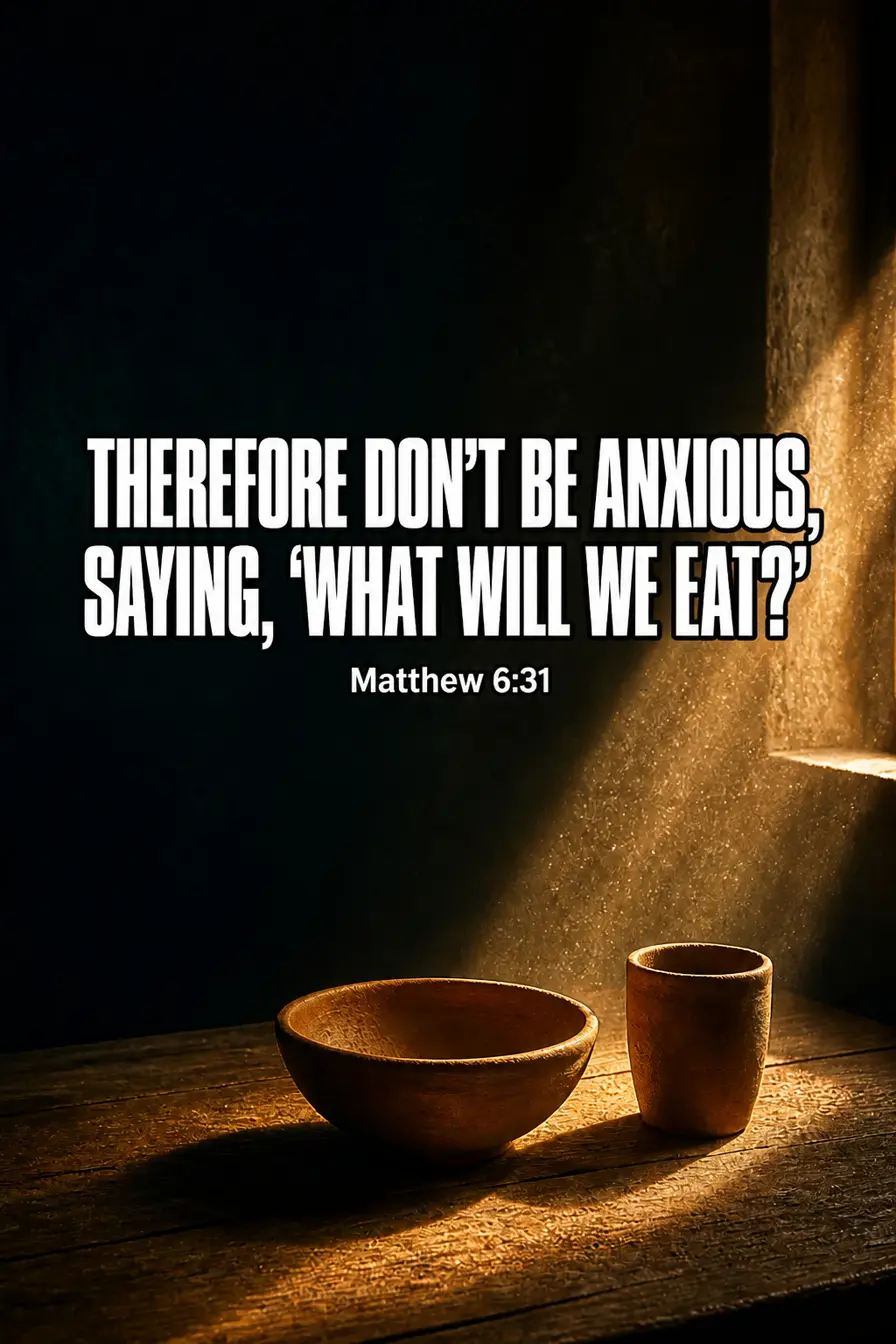
Worry here is something you say: the same three questions on a loop. The answer is not that the needs are imaginary but that they are already known. Much of our worry is the fear that nobody has noticed what we are facing, and this verse removes that fear first.
Matthew 6:33 — First, Not Only
“But seek first God’s Kingdom and his righteousness; and all these things will be given to you as well.” — Matthew 6:33 (WEBU)
First is an ordering word. It does not say seek only the Kingdom and ignore the rent; it says put one thing at the top and let the rest line up behind it. Worry flattens every concern to the same height. This verse restores a top.
Matthew 6:34 — Don’t Worry About Tomorrow
“Therefore don’t be anxious for tomorrow, for tomorrow will be anxious for itself. Each day’s own evil is sufficient.” — Matthew 6:34 (WEBU)

The final clause is almost always trimmed off the poster: today already has enough evil in it. Jesus is not describing a pleasant world in which worry is silly. He is pointing out that worry makes you carry two days at once, today’s real weight plus tomorrow’s imagined one, and nobody was built to carry both.
Three More Times Jesus Named It
Matthew 6 is the sermon. These are the moments when Jesus addressed worry in a particular person or situation.
Luke 10:41-42 — One Thing Is Needed
“Jesus answered her, “Martha, Martha, you are anxious and troubled about many things, but one thing is needed. Mary has chosen the good part, which will not be taken away from her.”” — Luke 10:41-42 (WEBU)

Martha is not doing anything wrong. She is hosting, and her sister has left her to it. He uses her name twice, the way you speak to someone you are fond of. The diagnosis is precise: many things. Worry is a problem of quantity, too many things holding equal weight. The answer is not “care less” but one thing first, with the rest arranged behind it.
Matthew 13:22 — The Cares That Choke
“What was sown among the thorns, this is he who hears the word, but the cares of this age and the deceitfulness of riches choke the word, and he becomes unfruitful.” — Matthew 13:22 (WEBU)
Cares is the same Greek root again. The seed is not eaten by birds or scorched by sun. It comes up, and then something growing alongside it takes the light and the water. Worry is described as a competitor for the same resources, which is why a worried month is usually a month in which nothing else grew, prayer included.
Matthew 10:19-20 — Worrying About What to Say
“But when they deliver you up, don’t be anxious how or what you will say, for it will be given you in that hour what you will say. For it is not you who speak, but the Spirit of your Father who speaks in you.” — Matthew 10:19-20 (WEBU)
This one is for the conversation you keep rehearsing. The disciples are being warned about arrest and trial, the most frightening audience there is, and the instruction is not to script it in advance. If you lie awake drafting what you will say to a boss or a relative, and what they will think of you, the help is promised in that hour, not the night before.
Paul Admitted He Worried
Two verses are left off most lists, and they change how the rest should be read. The same Greek word Jesus uses in Matthew 6 is used by Paul about himself and about his closest friend.
2 Corinthians 11:28 — Pressed Daily
“Besides those things that are outside, there is that which presses on me daily: anxiety for all the assemblies.” — 2 Corinthians 11:28 (WEBU)
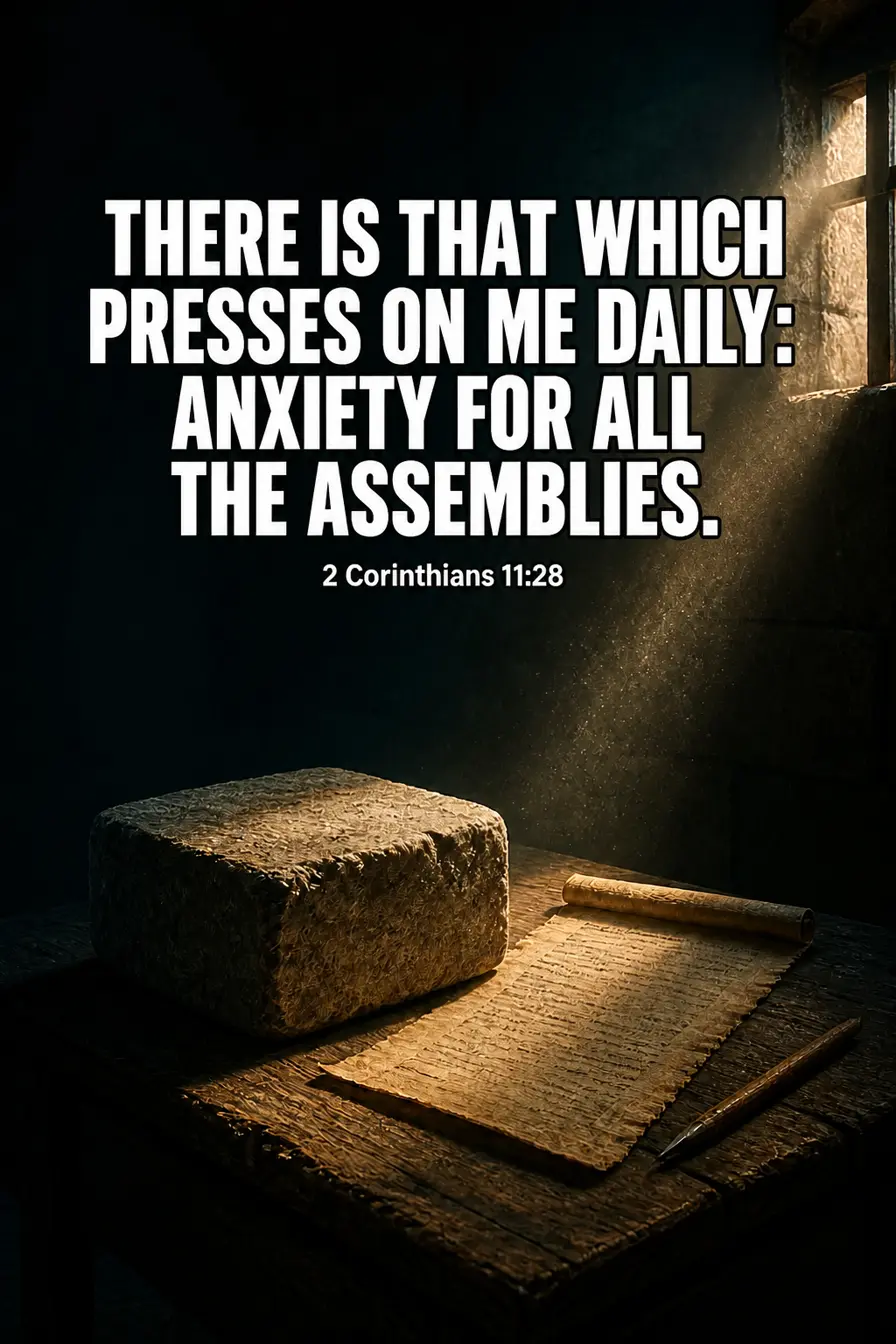
Read what comes before it: shipwrecks, beatings, a night and a day adrift at sea, hunger, cold. Then Paul says that besides all that, what presses on him every day is anxiety for the churches. The man who wrote “in nothing be anxious” also wrote this, without apology. Worry about people you love is not evidence that your faith has failed. It is the cost of caring about something you cannot control.
Philippians 2:20 — The Good Kind of Care
“For I have no one else like-minded, who will truly care about you.” — Philippians 2:20 (WEBU)
Paul is recommending Timothy, and care here is merimnaō, the word translated “be anxious” two chapters later. The same verb is praise in one place and a warning in another. What separates them is direction: care that moves toward a person and acts is love; care that circles back on itself and acts on nothing is worry.
Philippians 4:6-7 — What to Do With It
“In nothing be anxious, but in everything, by prayer and petition with thanksgiving, let your requests be made known to God. And the peace of God, which surpasses all understanding, will guard your hearts and your thoughts in Christ Jesus.” — Philippians 4:6-7 (WEBU)
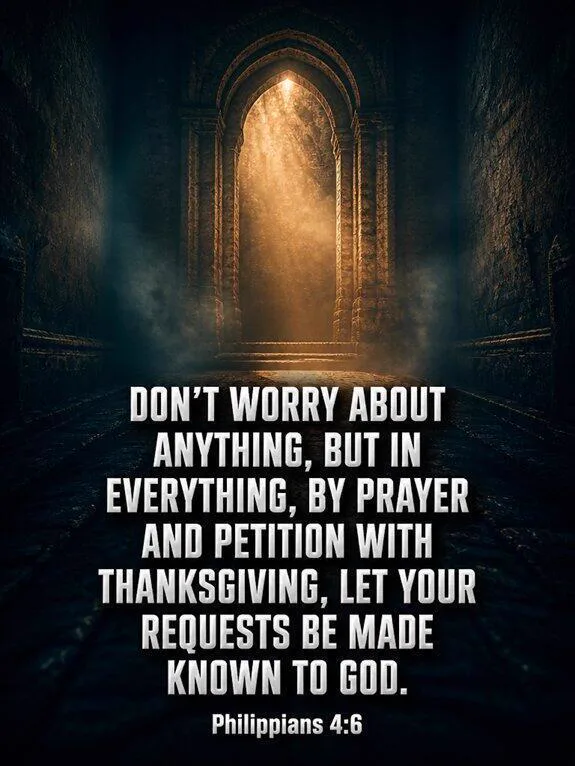
Read after 2 Corinthians 11, this stops sounding like an order to feel nothing. The instruction is about where the anxiety goes: petition is a specific-request word. Name the thing, one item at a time, and attach thanks to it. Paul wrote this in custody awaiting a verdict, and the peace he describes is posted as a guard around your thoughts — protection, not a change of mood.
The Old Testament on Worry
The Hebrew Scriptures have their own words for it, and some of the sharpest lines on the subject are here.
Psalm 37:7-8 — Fretting Goes Somewhere
“Rest in the LORD, and wait patiently for him. Don’t fret because of him who prospers in his way, because of the man who makes wicked plots happen. Cease from anger, and forsake wrath. Don’t fret; it leads only to evildoing.” — Psalm 37:7-8 (WEBU)
Don’t fret appears twice, and the second time with a consequence. The Hebrew word means to burn or grow heated. Fretting is not a private discomfort; it is a road, and worry about what other people are getting away with curdles into resentment more often than we admit.
Psalm 127:2 — He Gives Sleep
“It is vain for you to rise up early, to stay up late, eating the bread of toil, for he gives sleep to his loved ones.” — Psalm 127:2 (WEBU)

Rising early and staying late is the most recognisable behaviour of a worried person, and this verse calls it vain: not wicked, just pointless. The bread of toil is food eaten without tasting it. Sleep is offered as a gift rather than an achievement, which reframes three in the morning as something to receive rather than something we are failing at.
Psalm 139:23-24 — Ask for the Search
“Search me, God, and know my heart. Try me, and know my thoughts. See if there is any wicked way in me, and lead me in the everlasting way.” — Psalm 139:23-24 (WEBU)

The Hebrew word behind thoughts is specific: it means disquieting, branching thoughts, which is why other translations say “anxious thoughts”. Worry runs its own audit all night, hostile and never concluding. This is the same examination handed to somebody who already knows the answer and is not looking for a reason to reject you.
Proverbs 12:25 — A Kind Word
“Anxiety in a man’s heart weighs it down, but a kind word makes it glad.” — Proverbs 12:25 (WEBU)

The remedy in this verse is not something the worried person does. It comes from somebody else’s mouth. That makes it the one verse here you can act on for another person tonight, and it explains why worry gets heavier in isolation: the prescribed treatment needs a second party.
Jeremiah 17:7-8 — Not Concerned in the Drought
“Blessed is the man who trusts in the LORD, and whose confidence is in the LORD. For he will be as a tree planted by the waters, who spreads out its roots by the river, and will not fear when heat comes, but its leaf will be green, and will not be concerned in the year of drought.” — Jeremiah 17:7-8 (WEBU)
Concerned is the Hebrew word for worry, and the verse does not promise the drought will skip this tree. Heat comes. The difference is underground, in roots that reached water before the dry year began. The verses just before describe the other kind of person as a bush in the desert: a life that only looks for help once the trouble has arrived.
2 Thessalonians 3:16 — Peace at All Times
“Now may the Lord of peace himself give you peace at all times in all ways. The Lord be with you all.” — 2 Thessalonians 3:16 (WEBU)
At all times in all ways is deliberately without exceptions, and himself does the work: not peace handed over as a substance, but the Lord of peace giving it in person. Paul closes a letter to a church unsettled by rumours about the future this way, which tells you what he thought they needed last.
How to Stop Worrying, in Practice
Reading twenty verses in one evening changes very little. Carrying one for a fortnight changes a great deal. We have seen the list get read, help for an hour, and leave nothing reachable on the night it matters.
Pick the verse that made you stop, most likely the one that described something you had not put into words. Learn it well enough to say without looking. Then attach it to the moment worry actually arrives, which for most people is the first minute awake, the commute, or the hour after the house goes quiet.
The second habit comes from Martha. Write down everything currently holding equal weight, then mark the one thing that is needed today. Worry works by making six items the same size, and putting them on paper in an order is most of the relief.
If worry is stopping you sleeping or eating, or it has lasted months, tell a doctor as well as God. Scripture and medical care, including therapy, are not rivals, and treating them as opponents costs people years.
Questions People Ask About Worry
Is worrying a sin?
Not in the sense that every anxious feeling is a failure. Jesus tells his disciples “don’t be anxious” as a command, and worry that pushes trust aside is something to repent of. But the same Greek word describes Paul’s daily anxiety for the churches (2 Corinthians 11:28) and Timothy’s care for the Philippians (Philippians 2:20). The feeling is not the sin; what matters is whether it is carried alone or handed over. An anxiety disorder is a medical condition, not a moral one.
What does Matthew 6:25 say?
Jesus says “don’t be anxious for your life: what you will eat, or what you will drink; nor yet for your body, what you will wear”, then asks “Isn’t life more than food, and the body more than clothing?” It opens the longest teaching on worry in the Bible, which runs to verse 34.
Which Bible verse says don’t worry about tomorrow?
Matthew 6:34: “don’t be anxious for tomorrow, for tomorrow will be anxious for itself. Each day’s own evil is sufficient.” Translations that use the word worry render it “do not worry about tomorrow”.
What does the Bible say about worrying what others think?
Matthew 10:19-20 is the closest: “don’t be anxious how or what you will say”. Jesus said it to disciples facing courts, and the promise is help at the moment you need it rather than a script prepared the night before.
How can a Christian overcome worry?
The verses describe it as an action repeated, not a feeling switched off. Cast the specific worry (1 Peter 5:7), turn it into a named request with thanksgiving (Philippians 4:6), put one thing first (Matthew 6:33), and let somebody speak a kind word into it (Proverbs 12:25).
Worry that has run for years does not stop in an evening. Take the one verse that stayed with you, put it where the worry actually shows up, and give it two ordinary weeks.
When you want more, Bible Verses for Overthinking and Anxious Thoughts goes further into the racing mind, Bible Verses for Anxiety That Will Calm Your Mind covers the physical side of anxiety, Bible Verses for When Fear and Worry Won’t Stop is for the nights it will not let go, and the full Anxiety archive holds the rest.