You have probably done this before. Read the verses, felt steadier for an evening, and then woken at four in the morning with the same weight sitting on your chest. If that has happened enough times, it starts to feel like the problem is you — that other people read these words and are genuinely delivered, while you keep needing them again.
Here is the thing that changes how the bible verses for overcoming fear read. Search the Bible for a person who stopped being afraid, permanently, and you will not find one. David writes “when I am afraid” as a standing condition. Paul, who wrote most of the New Testament, describes arriving somewhere “in weakness, in fear, and in much trembling”. The disciples panic in a boat with Jesus asleep in it.
What Scripture describes is not the deletion of fear. It is a change in what fear is allowed to decide, and that is the thread we have followed through every verse below. That is a smaller claim than most articles make, and it is the one you can actually act on tonight.

Face your giants. Discover what makes someone truly brave.1 Samuel 17 · 11 min
That was just the opening. Open the app and search #002 to hear the full 11-minute story — free.
Keep listening free in the app Free on iOS & Android — no sample needed

What “Overcoming Fear” Means in the Bible
The word we reach for is conquer, and it sets the wrong expectation. Fear in Scripture behaves less like an enemy to be destroyed and more like weather to be travelled through — the psalms are full of people who felt it fully and moved anyway. There is no antidote here that removes anxiety and fear on contact, and every page that offers one is describing something the text does not.
Psalm 112:7 — Steadfast, Not Fearless
“He will not be afraid of evil news. His heart is steadfast, trusting in the LORD.” — Psalm 112:7 (WEBU)
Read the second sentence as the explanation of the first, because that is how the psalmist builds it. The heart is not described as calm; it is described as steadfast — a word about staying put rather than staying comfortable. The promise is not that bad news stops arriving or stops hurting. It is that it stops relocating you.
What Jesus Said About Overcoming Fear
Four moments, and none of them is a lecture. In every one, Jesus is dealing with frightened people in real time, which is why we have kept the situation attached to each line.
Mark 4:39-40 — The Question He Asks in the Storm
“He awoke and rebuked the wind, and said to the sea, “Peace! Be still!” The wind ceased and there was a great calm. He said to them, “Why are you so afraid? How is it that you have no faith?”” — Mark 4:39-40 (WEBU)
Notice the order, because it is easy to get backwards. He calms the storm first, then asks the question. The disciples are not scolded into courage while the boat is filling; they are rescued, and then asked to think about what just happened. Several of them were commercial fishermen who had spent their lives on that lake, which means their fear was expert judgement, not weakness. Jesus does not dispute their reading of the weather. He disputes their reading of who was in the boat.
Mark 5:36 — Only Believe
“But Jesus, when he heard the message spoken, immediately said to the ruler of the synagogue, “Don’t be afraid, only believe.”” — Mark 5:36 (WEBU)
The message Jairus has just heard is that his daughter is dead. This is the worst sentence in the book, and Jesus answers it in four words. Only is doing something specific — it narrows the man’s job to one thing at the moment he has no capacity for anything else. Fear expands the list of what you are supposed to handle. This shrinks it back to one item.
John 16:33 — Peace Inside Trouble, Not Instead of It
“I have told you these things, that in me you may have peace. In the world you have trouble; but cheer up! I have overcome the world.”” — John 16:33 (WEBU)
Jesus states the trouble as a fact, in the present tense, to people he loves. No conditions, no timeline for it ending. The peace is located somewhere else entirely — “in me”, not in the improved circumstances. Any promise you have been offered that peace arrives when the trouble leaves is a better-sounding offer than this one, and it is not the one he made.
John 14:27 — A Peace the World Cannot Match
“Peace I leave with you. My peace I give to you; not as the world gives, I give to you. Don’t let your heart be troubled, neither let it be fearful.” — John 14:27 (WEBU)
Not as the world gives is the clause that matters, and it is a comparison of terms. The peace on offer everywhere else is conditional: it arrives when the problem is solved and leaves when the next one starts. Jesus hands this over on the evening of his arrest, to men who scatter before dawn, which means it was never keyed to their circumstances improving. Whatever this peace is, it is not the feeling of things going well.
Matthew 6:34 — The Day You Are Actually Living In
“Therefore don’t be anxious for tomorrow, for tomorrow will be anxious for itself. Each day’s own evil is sufficient.” — Matthew 6:34 (WEBU)

That last line is unusually blunt and often trimmed off the poster: today has enough evil in it already. Jesus is not describing a pleasant world. He is pointing out that fear works by making you live two days at once, carrying today’s actual load plus tomorrow’s imagined one, and that nobody was built to carry both.
First: Name What You Are Afraid Of
Fear thrives on staying vague, because a threat without edges is the kind that can paralyze us. The psalms are relentless about dragging it into the open and giving it a name, even in the midst of the danger itself.
Psalm 27:1 — “Whom Shall I Fear?”
“The LORD is my light and my salvation. Whom shall I fear? The LORD is the strength of my life. Of whom shall I be afraid?” — Psalm 27:1 (WEBU)
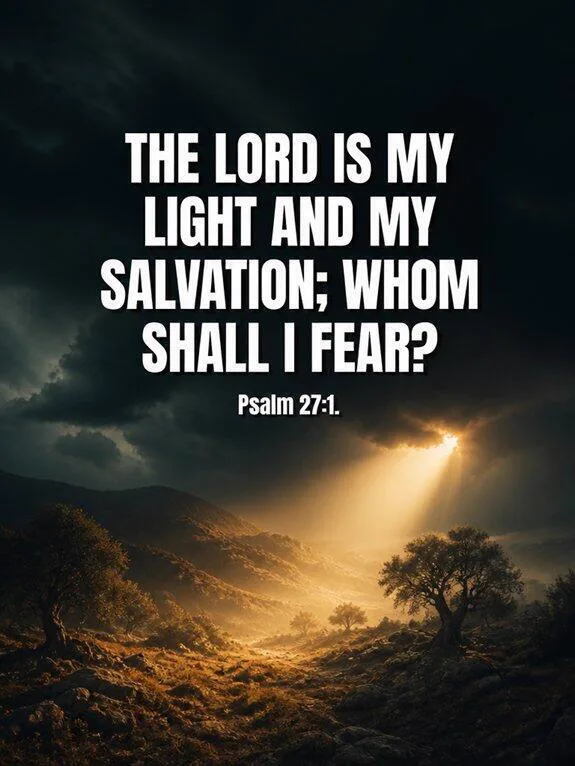
David does not tell himself to relax. He asks a question with a blank in it and makes the fear fill in the blank: whom, exactly? The next verses of this psalm are full of armies and enemies who are entirely real, so this is not denial. It is the difference between a dread that has no shape and a threat you can put next to something bigger.
Psalm 34:4 — Delivered From the Fears, Not the Facts
“I sought the LORD, and he answered me, and delivered me from all my fears.” — Psalm 34:4 (WEBU)
Look carefully at what he was delivered from. Not his enemies. Not his circumstances. His fears. The verse separates the situation from the terror about the situation and only claims the second. That is a smaller promise than the one people usually take from it, and a far more useful one, because it is available tonight whether or not a single external thing has changed.
Second: Hand It Over Instead of Carrying It
Philippians 4:6-7 — What to Do While Anxious
“In nothing be anxious, but in everything, by prayer and petition with thanksgiving, let your requests be made known to God. And the peace of God, which surpasses all understanding, will guard your hearts and your thoughts in Christ Jesus.” — Philippians 4:6-7 (WEBU)

This is the most misread verse on the subject. It lands on people as an order to stop feeling anxious, which is not something anyone can obey, and then failing to obey it adds guilt to the fear. Read the grammar again: the instruction is about what to do with the anxiety — bring it, item by item, as a request. Paul wrote it from prison awaiting a verdict. The peace of God is described as a guard posted around your thoughts, which is protection, not a change of mood.
1 Peter 5:6-7 — Casting Is a Throwing Word
“Humble yourselves therefore under the mighty hand of God, that he may exalt you in due time, casting all your worries on him, because he cares for you.” — 1 Peter 5:6-7 (WEBU)
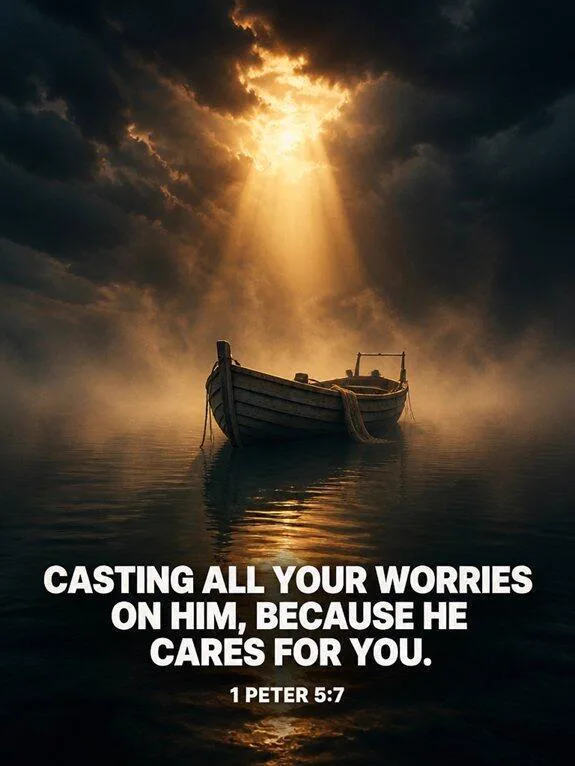
Casting is not a gentle word. The Greek verb is the one used for flinging a heavy load off your shoulders onto an animal that can carry it — the same word used when the disciples throw their cloaks onto a colt. It is a physical, one-directional action. Whatever this verse is asking, it is not asking you to hold the worry more calmly.
Psalm 55:22 — And He Will Sustain You
“Cast your burden on the LORD and he will sustain you. He will never allow the righteous to be moved.” — Psalm 55:22 (WEBU)
The verb Peter reached for came from here — this psalm is where the image starts. And the psalm is bleak: David is writing about betrayal by a close friend, not a bad afternoon. Sustain means to hold something up continuously, not to fix it once. It is a promise of ongoing weight-bearing, which is what you need when the thing you are afraid of is not going to resolve this week.
Third: Move Before the Feeling Changes
Waiting to feel brave is the most common place this stalls. Scripture consistently puts the action first and lets the feeling catch up or not, and what it offers in the meantime is the presence of God rather than a better forecast.
Joshua 1:9 — Courage Arrives as an Instruction
“Haven’t I commanded you? Be strong and courageous. Don’t be afraid. Don’t be dismayed, for the LORD your God is with you wherever you go.”” — Joshua 1:9 (WEBU)
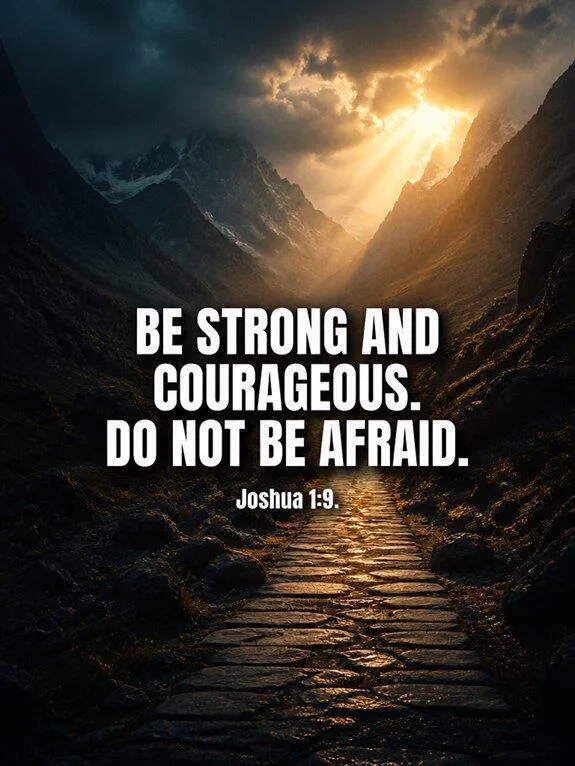
Courage shows up here as a command, which only makes sense once you know the moment. Joshua has just buried Moses and inherited a job nobody wanted. God does not wait for him to feel ready, because an instruction can be obeyed by somebody who feels nothing of the sort. Be strong and courageous is not a mood being requested. It is a thing you do while still afraid, on the strength of the clause at the end.
Isaiah 41:10 — Strengthen, Help, Uphold
“Don’t you be afraid, for I am with you. Don’t be dismayed, for I am your God. I will strengthen you. Yes, I will help you. Yes, I will uphold you with the right hand of my righteousness.” — Isaiah 41:10 (WEBU)
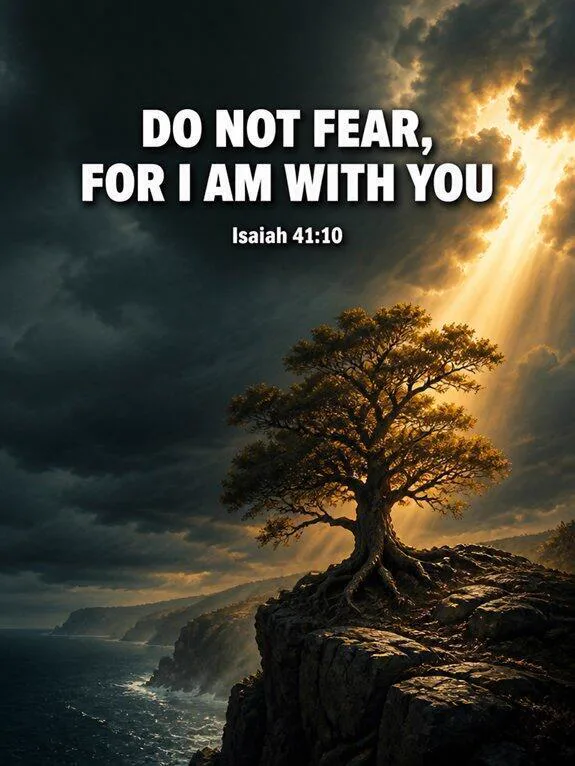
The three verbs at the end escalate, and the order is the point. Strengthen adds something to you so you can act. Help joins you in the acting. Uphold takes your weight when the first two were not enough and you have stopped acting altogether. On the days you cannot manufacture any strength at all, the verse has already anticipated that and put a hand underneath you.
Deuteronomy 31:6 — He Will Not Forsake You
“Be strong and courageous. Don’t be afraid or scared of them, for the LORD your God himself is who goes with you. He will not fail you nor forsake you.”” — Deuteronomy 31:6 (WEBU)
Moses is 120 years old, has been told he will not cross the river, and these are close to his last words to a nation he spent forty years leading through a desert. He does not tell them the fortified cities ahead are smaller than they look. He hands over the only thing that carried him — himself is who goes with you — and the promise not to forsake them is deliberately not a promise that it will be easy. The arrangement simply does not depend on Moses being there to see it.
Romans 8:31 — If God Is for Us
“What then shall we say about these things? If God is for us, who can be against us?” — Romans 8:31 (WEBU)

Paul asks it as a real question, not a rhetorical flourish, and he asks it in a letter that goes on to list famine, persecution and the sword as live possibilities. He is not claiming nothing can come against you. He is asking what any of it can finally settle, given who is on the other side. Fear answers questions it was never given the facts for; this verse hands the question back.
Hebrews 13:6 — “The Lord Is My Helper”
“So that with good courage we say, “The Lord is my helper. I will not fear. What can man do to me?”” — Hebrews 13:6 (WEBU)

With good courage we say — the courage is in the saying. This is a sentence you are meant to speak out loud, and the writer is quoting a psalm back at people under real pressure, which tells you the practice is older than the letter. Saying a true thing aloud when you do not yet feel it is not pretending. It is putting a second voice in a room that currently has only one.
2 Timothy 1:7 — Not the Spirit You Were Given
“For God didn’t give us a spirit of fear, but of power, love, and self-control.” — 2 Timothy 1:7 (WEBU)
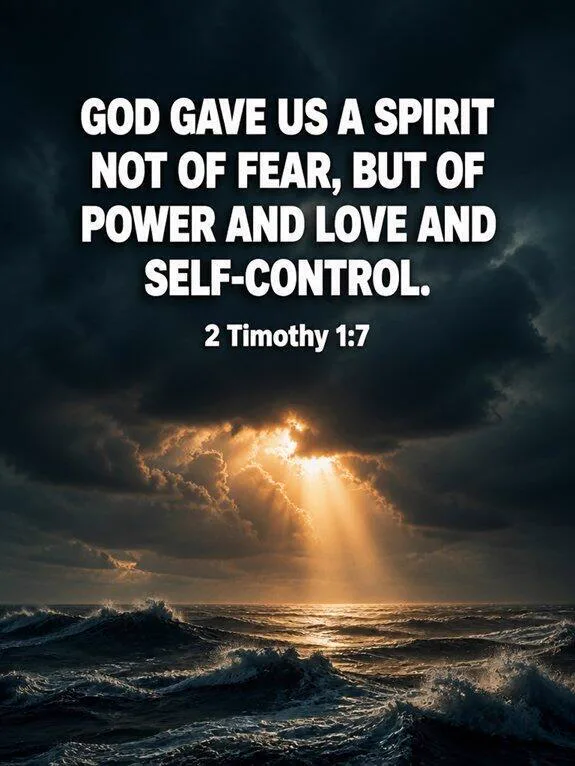
Paul wrote this from a Roman prison to a younger man he suspected was losing his nerve, which is worth knowing before the verse gets used as a rebuke. It is not “you should not be afraid”. It is a claim about origin: whatever this spirit of fear is, it did not come from God, so it does not get to speak with his authority. The third gift is the surprising one — self-control, the plain ability to choose your next action, listed alongside power and love rather than below them.
Fourth: Give It Somewhere to Go, Every Morning
One good day does not settle this. What follows is the part that compounds, and it is the part most of us skip.
Lamentations 3:22-23 — New Every Morning
“It is because of the LORD’s loving kindnesses that we are not consumed, because his mercies don’t fail. They are new every morning. Great is your faithfulness.” — Lamentations 3:22-23 (WEBU)

These lines were written in the rubble of Jerusalem after the city was destroyed and its people deported, by somebody looking at the wreckage. That matters, because new every morning is not a sunny observation from a comfortable life. It is a decision made in the worst possible conditions to expect one more day’s supply. Great is your faithfulness is a claim about God’s track record, not the writer’s mood.
Proverbs 3:5-6 — Acknowledge Him in All Your Ways
“Trust in the LORD with all your heart, and don’t lean on your own understanding. In all your ways acknowledge him, and he will make your paths straight.” — Proverbs 3:5-6 (WEBU)
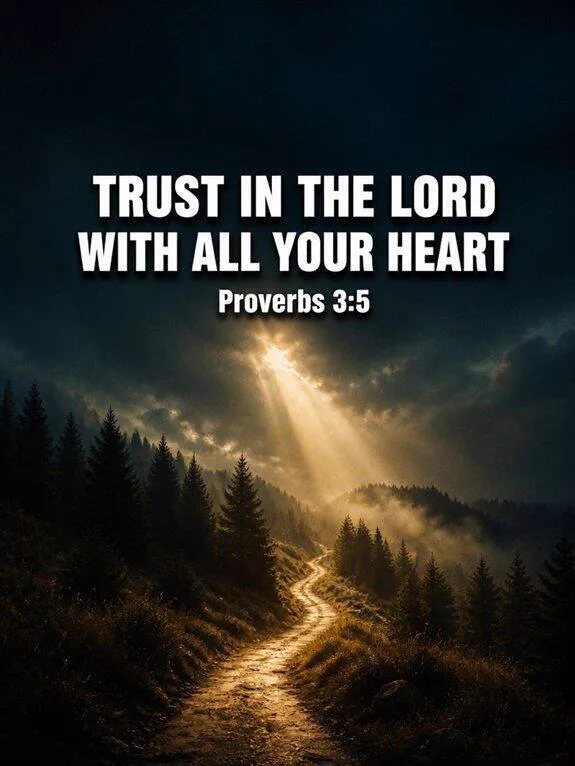
Don’t lean is a posture, not a ban on thinking. The image is of putting your full weight on something — and your own understanding is exactly what fear hijacks, because anxious reasoning feels like careful reasoning from the inside. To acknowledge him in all your ways means the ordinary ones, the decisions too small to pray dramatically about. That is where the habit is actually built.
Psalm 23:4 — Fear No Evil
“Even though I walk through the valley of the shadow of death, I will fear no evil, for you are with me. Your rod and your staff, they comfort me.” — Psalm 23:4 (WEBU)

The rod and the staff are two different tools and the comfort comes from both. The staff is the crook that guides and retrieves a sheep; the rod is the club the shepherd carried to break the teeth of whatever came out of the dark. One of these is gentle and one is not, and a frightened animal is comforted by the second. Being cared for and being defended are not the same promise, and this verse makes both.
When Fear Is Bigger Than a Practice
Fear that stops you sleeping, eating or leaving the house is not a spiritual failure, and none of this replaces a doctor or a therapist. Scripture and clinical care sit alongside each other; treating them as rivals costs people years.
Psalm 46:1-2 — Refuge and Strength
“God is our refuge and strength, a very present help in trouble. Therefore we won’t be afraid, though the earth changes, though the mountains are shaken into the heart of the seas;” — Psalm 46:1-2 (WEBU)
The examples chosen are deliberately enormous — the ground itself moving, mountains going into the sea. Whoever wrote this was not thinking about mild worry. A very present help means help that is already here rather than help that is coming, which is the distinction that matters at three in the morning. It is why the command not to fear recurs hundreds of times throughout both testaments and almost always arrives attached to a reason.
Isaiah 26:3 — Perfect Peace
“You will keep whoever’s mind is steadfast in perfect peace, because he trusts in you.” — Isaiah 26:3 (WEBU)
The same word as Psalm 112 returns: steadfast. Not a mind that is quiet, a mind that stays put. And the peace is described as something God keeps you in, an active holding rather than a state you achieve and then have to maintain by yourself.
1 John 4:18 — Perfect Love Casts Out Fear
“There is no fear in love; but perfect love casts out fear, because fear has punishment.” — 1 John 4:18 (WEBU)
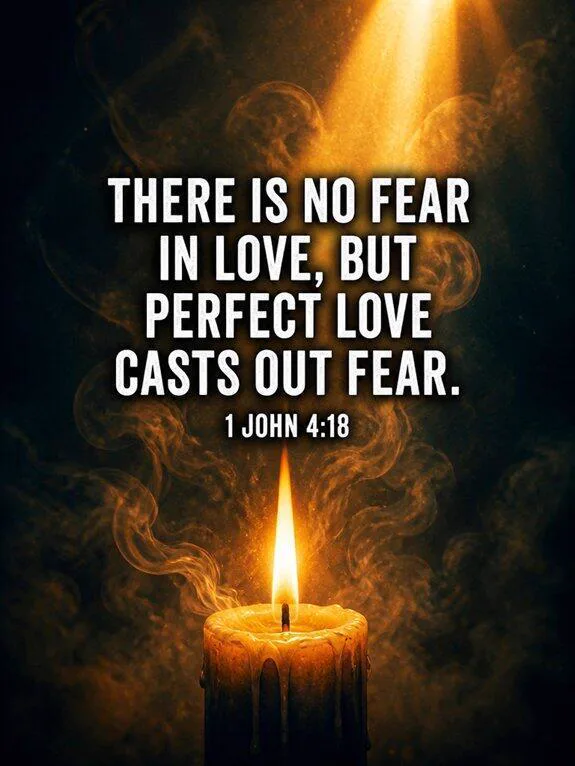
John names which fear he means, and the clause is usually skipped: because fear has punishment. He is talking about the fear of being found out and rejected — the one that runs underneath a surprising amount of ordinary anxiety. Love does not argue that fear down. It removes the thing it was afraid of. Casts out is the same forceful verb used for driving something from a house.
The Practice, in Plain Terms
Reading twenty verses changes very little. Carrying one changes a great deal, and the gap between them is repetition under pressure.
Pick one verse from this page — the one that made you stop, not the one that sounds most correct. Memorize it properly, meaning you can say it without looking; a short verse takes roughly four repetitions a day for three days. Then attach it to the moment fear actually shows up: the first minute after waking, the walk to the meeting, the hour after the house goes quiet. Say it out loud there.
If you want a second anchor, keep a page where you write down what you were afraid of and the date. Journaling this way is unglamorous and it does one thing nothing else does: three months on, you can read what you were certain about in March. Most of it did not happen, and the entries that did happen were survived. Fear makes confident predictions and never files a correction, so we have to file them ourselves.
Do this with one verse for a fortnight before adding a second.
Questions People Ask About Overcoming Fear
How do you overcome fear biblically?
Not by feeling less afraid. Scripture’s pattern is to name the fear specifically, hand it over as a request rather than carrying it, then act on the instruction before the feeling shifts. Joshua 1:9, Philippians 4:6-7 and 1 Peter 5:7 are the three that map onto those steps, and none of them promises the fear will be gone first.
What did Jesus say about overcoming fear?
He calmed the storm before he asked the disciples why they were afraid (Mark 4:39-40), told Jairus “Don’t be afraid, only believe” on hearing his daughter had died (Mark 5:36), and stated plainly that in the world you have trouble while locating peace in himself rather than in the trouble ending (John 16:33). The pattern is presence and rescue first, explanation afterwards.
What does the Bible say when you are scared?
Deuteronomy 31:6 uses the word itself: “Don’t be afraid or scared of them, for the LORD your God himself is who goes with you.” The reason given is company, not courage. Moses does not say the danger is smaller than it looks; he says who is going in with them, and that reason holds on the days the feeling does not change.
What Bible verse destroys anxiety?
No single verse works as a switch, and any page promising one is selling something. Philippians 4:6-7 is the most used, and it is most useful once you read it as an instruction about what to do while anxious rather than an order to stop. Psalm 34:4 is the honest companion: it promises deliverance from the fears, not from the circumstances.
What does the Bible say about the spirit of fear?
2 Timothy 1:7 says God did not give it: “For God didn’t give us a spirit of fear, but of power, love, and self-control.” The verse is about where the fear came from rather than how strong it is, which matters because it removes the authority fear claims over you without pretending it is absent.
How do you make fear go away?
Scripture never promises it goes away, which is why so many people conclude they are doing faith wrong. David writes “when I am afraid” as a recurring condition. What changes is that fear stops deciding — you feel it and go anyway, and over months of that the feeling loses its grip on your choices.
Fear that has been with you for years does not leave in an evening, and nothing on this page suggests otherwise. Take one verse, put it where the fear actually arrives, and give it two weeks of ordinary days. That is slower than most articles promise and it is the pace at which this genuinely works.
When you want more, Fear Not Bible Verses for Anxious Moments counts how often the command appears and who spoke it, Bible Verses About Peace covers the overlap with anxiety, and the full Fear archive holds the rest.