
When it is actually happening, you cannot read. That is the first thing worth saying, because most pages of bible verses for anxiety attacks are written as though the reader were sitting calmly with a cup of tea. In the middle of it your chest is tight, your hands are unreliable, and a paragraph is beyond you.
This page is built the other way round. The short verses first — one line each, the kind you can hold when nothing longer will fit. Then what to pray, then what to do afterwards when you are wrung out.
And one thing before any of it: Scripture already has words for this. Somebody wrote them down about three thousand years ago and they were kept.

Face your giants. Discover what makes someone truly brave.1 Samuel 17 · 11 min
That was just the opening. Open the app and search #002 to hear the full 11-minute story — free.
Keep listening free in the app Free on iOS & Android — no sample needed

Scripture Already Describes It
Psalm 55:4-5 — Trembling and Horror
“My heart is severely pained within me. The terrors of death have fallen on me. Fearfulness and trembling have come on me. Horror has overwhelmed me.” — Psalm 55:4-5 (WEBU)
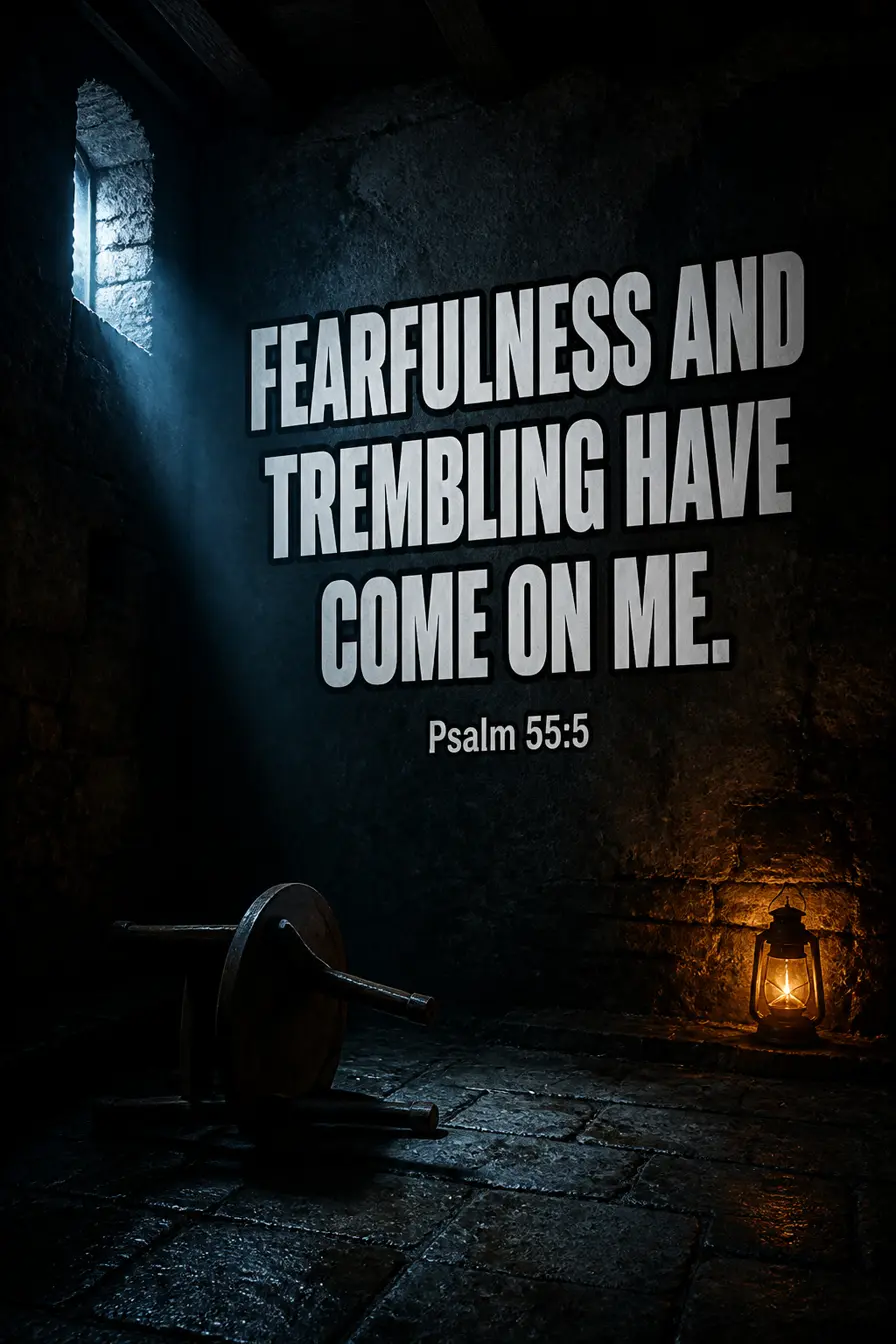
Read that again slowly. A pained heart, terrors of death, trembling, and being overwhelmed by horror — four symptoms in two verses, and anybody who has had a panic attack recognises the list. This is not a metaphor about a difficult week. David is describing a body in crisis, and the description survived into the Bible without being tidied up.
If you have ever felt that what happens to you is too undignified to bring to God, this verse is the answer. It is already in there.
Psalm 18:6 — “He Heard My Voice”
“In my distress I called on the LORD, and cried to my God. He heard my voice out of his temple. My cry before him came into his ears.” — Psalm 18:6 (WEBU)
Cried is not a composed word. And the answer described is not advice or a change of circumstances — it is being heard, which is what a person in the middle of one actually needs first. The verse spends more words on the hearing than on the rescue.
Jonah 2:2 — Out of the Belly
“He said, “I called because of my affliction to the LORD. He answered me. Out of the belly of Sheol I cried. You heard my voice.” — Jonah 2:2 (WEBU)
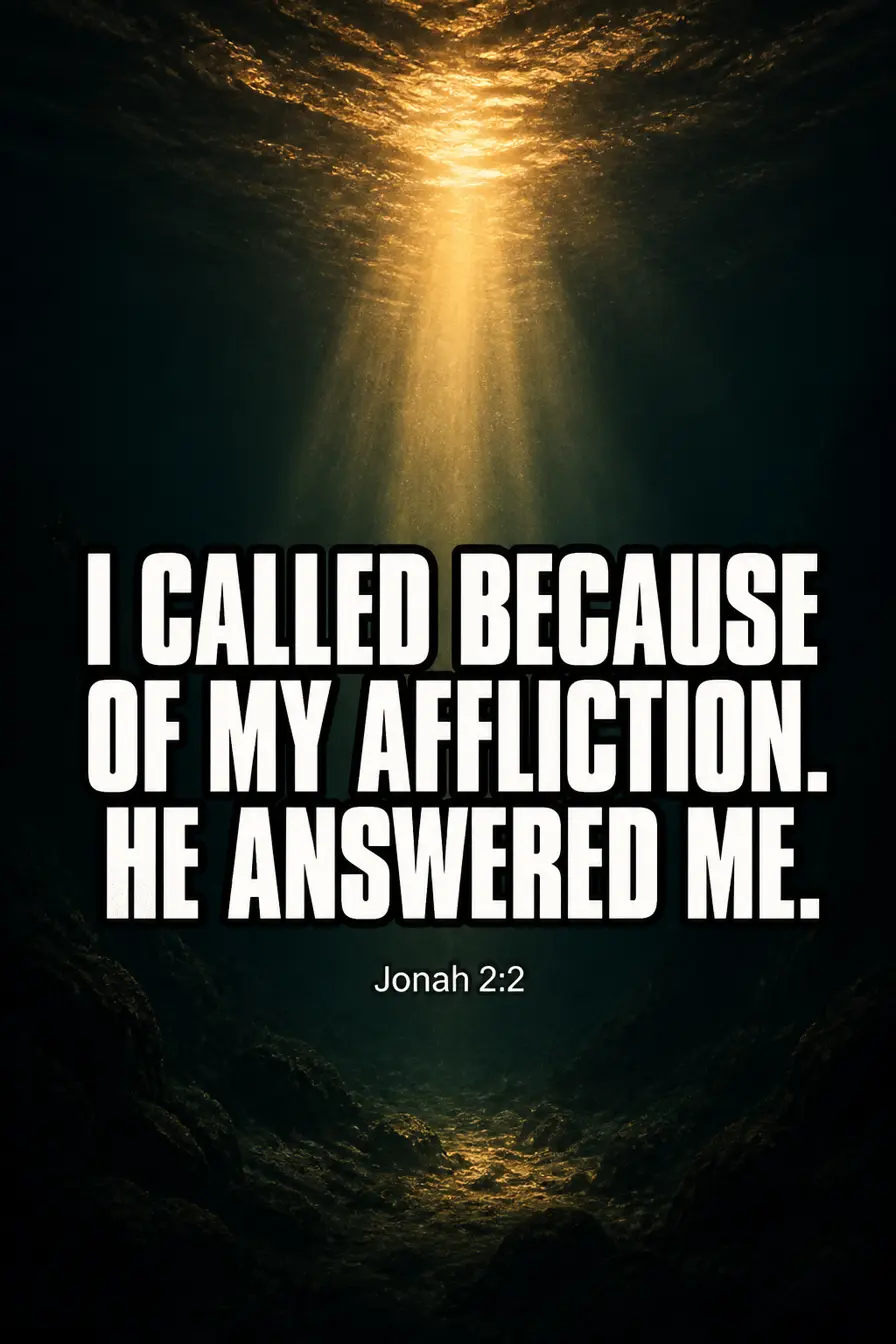
Prayed from inside the worst of it, not afterwards from safety. Jonah does not wait until he is out to speak, and he does not make the prayer presentable first. Whatever is happening to you right now is a legitimate place to pray from, and this is the passage that proves it.
Short Verses for the Middle of It
Every one of these is one line. Pick one — not five — and learn it before you need it. The temptation for all of us is to collect several and hold none.
Psalm 56:3 — Nine Words
“When I am afraid, I will put my trust in you.” — Psalm 56:3 (WEBU)
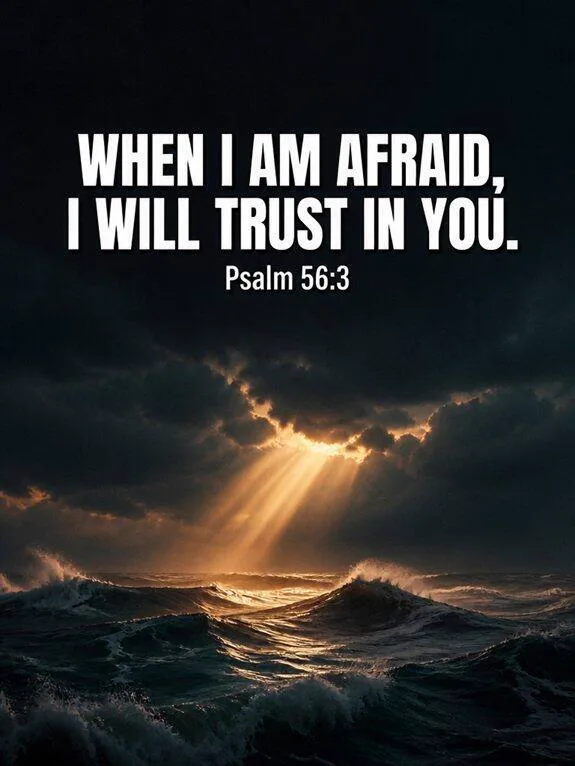
The shortest useful verse there is, and when rather than if — the fear is assumed. Trust is what David does inside it, not after it passes. Nine words fit in a mind that cannot hold a sentence.
Psalm 34:4 — Delivered From the Fears
“I sought the LORD, and he answered me, and delivered me from all my fears.” — Psalm 34:4 (WEBU)
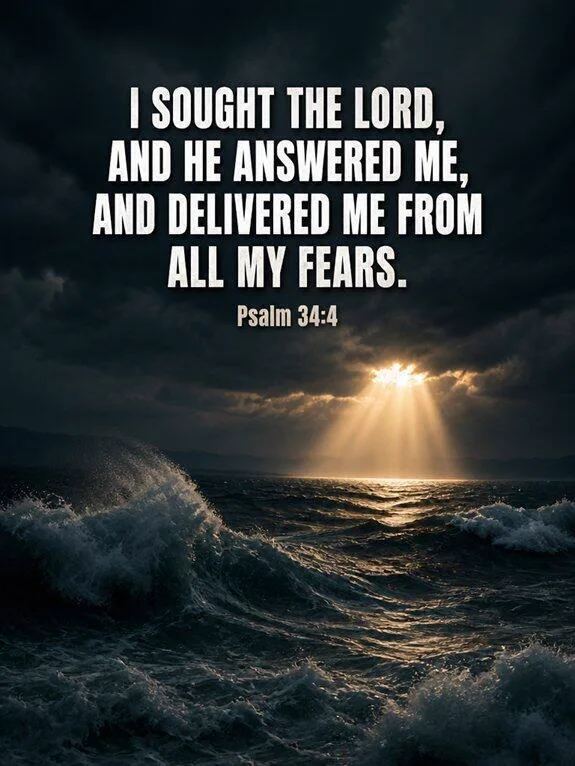
Look at what he was delivered from — not his enemies, his fears. The verse separates the situation from the terror about it and claims only the second, which is exactly the right promise for something that is happening in your body rather than in the room.
Psalm 46:1-2 — A Very Present Help
“God is our refuge and strength, a very present help in trouble. Therefore we won’t be afraid, though the earth changes, though the mountains are shaken into the heart of the seas;” — Psalm 46:1-2 (WEBU)
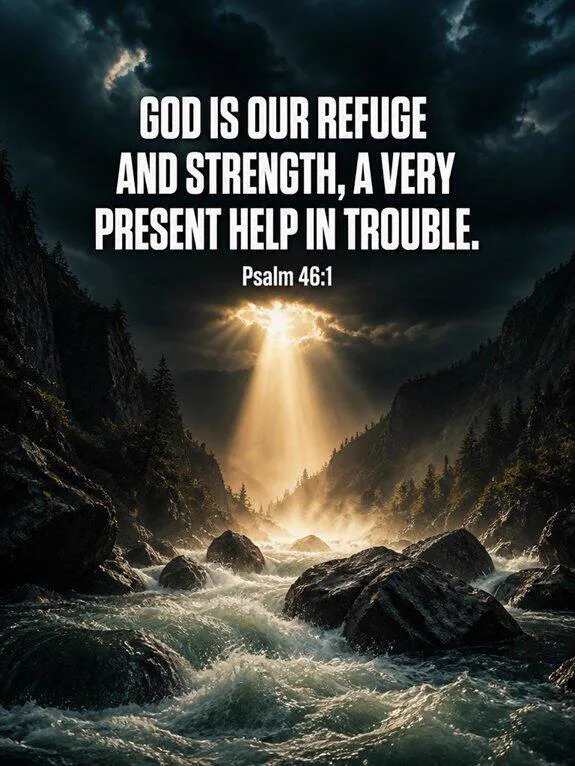
A very present help means already here, not on the way. And the examples chosen are enormous — the ground itself moving, mountains going into the sea — which is oddly comforting when your own sense of scale has gone and a small thing feels like the end of the world.
Isaiah 41:10 — “I Will Uphold You”
“Don’t you be afraid, for I am with you. Don’t be dismayed, for I am your God. I will strengthen you. Yes, I will help you. Yes, I will uphold you with the right hand of my righteousness.” — Isaiah 41:10 (WEBU)
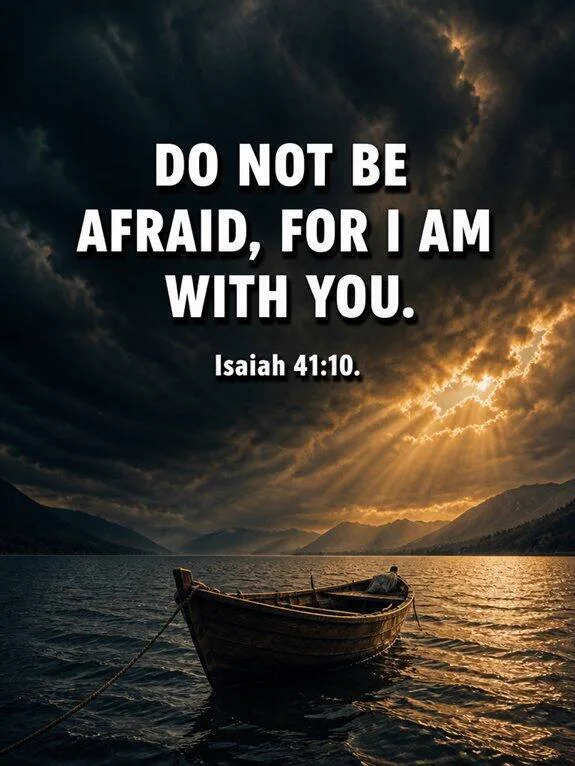
The verbs escalate: with, strengthen, help, uphold. The last one is the one for this — it takes your weight when you have stopped being able to do anything at all, which is the state a panic attack puts you in.
Isaiah 26:3 — Perfect Peace
“You will keep whoever’s mind is steadfast in perfect peace, because he trusts in you.” — Isaiah 26:3 (WEBU)
Steadfast means fixed on something, not emptied of everything — which matters, because in an attack the mind is not going to be emptied. And notice who does the keeping: you will keep. The peace is something God holds you inside rather than a state you have to reach by concentrating, which is beyond you at that moment anyway.
2 Timothy 1:7 — Not the Spirit You Were Given
“For God didn’t give us a spirit of fear, but of power, love, and self-control.” — 2 Timothy 1:7 (WEBU)

A claim about origin rather than strength: whatever this is, it did not come from God, so it does not get to speak with his authority. Worth being careful, though — it is not a rebuke, and Paul wrote it from prison to a young man he thought was struggling.
What to Pray During One
None of us manages a considered prayer in that state, and none of us is expected to. Scripture’s own examples are short and unpolished.
Psalm 61:1-2 — “Lead Me to the Rock”
“Hear my cry, God. Listen to my prayer. From the end of the earth, I will call to you when my heart is overwhelmed. Lead me to the rock that is higher than I.” — Psalm 61:1-2 (WEBU)

“When my heart is overwhelmed” — David has a category for this and a prayer ready for it. The request is not that the feeling stop; it is to be taken somewhere higher than himself, which is an honest thing to ask when your own resources have visibly run out.
Psalm 116:1-4 — Four Words
“The cords of death surrounded me, the pains of Sheol got a hold of me. I found trouble and sorrow. Then I called on the LORD’s name: “LORD, I beg you, deliver my soul.”” — Psalm 116:1-4 (WEBU)
The prayer at the end is six words: “LORD, I beg you, deliver my soul”. That is the whole thing. No preamble, no explanation, no attempt to sound composed — and the psalm goes on to say it was answered.
Philippians 4:6-7 — By Prayer and Petition
“In nothing be anxious, but in everything, by prayer and petition with thanksgiving, let your requests be made known to God. And the peace of God, which surpasses all understanding, will guard your hearts and your thoughts in Christ Jesus.” — Philippians 4:6-7 (WEBU)
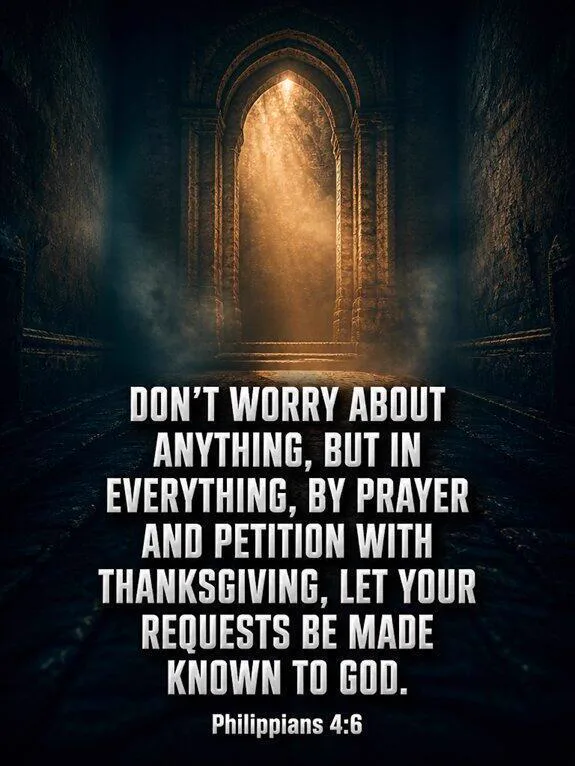
The verse everybody quotes, read properly. It is not an order to stop feeling anxious — nobody can obey that. The instruction is about what to do with the anxiety, and the peace at the end is described as a guard, a sentry posted over your thoughts, which is a job done repeatedly rather than a mood that arrives.
A prayer for the middle of one, if you want the words. Say your own name for it — “God, this is happening again”. Then Psalm 116: “LORD, I beg you, deliver my soul”. Then one line you already know, Psalm 56:3 will do: “when I am afraid, I will put my trust in you”. Repeat the last one until you can breathe. That is three short sentences and none of them requires you to be composed.
Afterwards, When You Are Wrung Out
The hours after are their own problem — shaky, exhausted, ashamed. Scripture is more practical here than we tend to expect.
1 Kings 19:4-8 — Food and Sleep First
“Then he requested for himself that he might die… He lay down and slept under a juniper tree; and behold, an angel touched him, and said to him, “Arise and eat!”… The LORD’s angel came again the second time, and touched him, and said, “Arise and eat, because the journey is too great for you.”” — 1 Kings 19:4-8 (WEBU)

Elijah has just had the greatest victory of his career and then asks God to let him die. What arrives is not a rebuke, not a sermon, not a question about his faith — it is food and sleep, twice, before anyone says anything else. And the reason given is physical: the journey is too great for you.
This is the most practical passage in Scripture about a body that has run out. God’s first response to a person in that state was to feed him and let him sleep, and the conversation waited until afterwards.
Psalm 4:8 — Lie Down and Sleep
“In peace I will both lay myself down and sleep, for you alone, LORD, make me live in safety.” — Psalm 4:8 (WEBU)
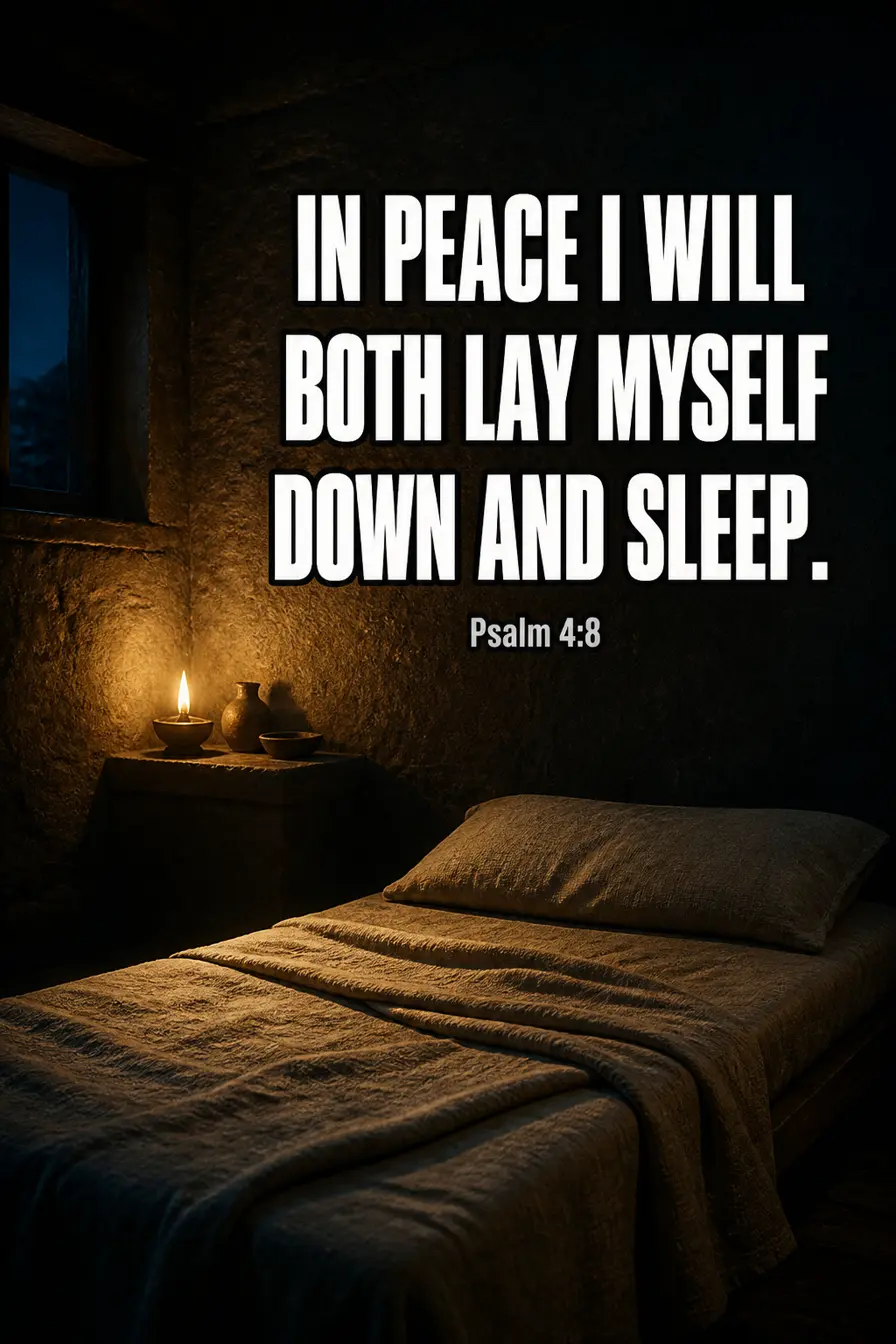
You alone is the load-bearing phrase. David is not saying the danger has gone; he is saying the safety does not depend on him staying awake to monitor it. For anyone whose worst hour is bedtime, this is the one to learn.
Psalm 23:2-3 — “He Restores My Soul”
“He makes me lie down in green pastures. He leads me beside still waters. He restores my soul.” — Psalm 23:2-3 (WEBU)
“Makes me lie down” is a striking phrase — sheep do not lie down while anxious, so a shepherd who gets them to do it has already dealt with whatever was keeping them up. And restores is a repair word, used of something brought back to a former state rather than replaced.
Psalm 23:4 — Rod and Staff
“Even though I walk through the valley of the shadow of death, I will fear no evil, for you are with me. Your rod and your staff, they comfort me.” — Psalm 23:4 (WEBU)
Two tools and the comfort comes from both. The staff is the crook that guides and retrieves; the rod is the club the shepherd carried for whatever came out of the dark. Being cared for and being defended are separate promises, and a body convinced it is under threat needs the second one named.
John 14:27 — Not as the World Gives
“Peace I leave with you. My peace I give to you; not as the world gives, I give to you. Don’t let your heart be troubled, neither let it be fearful.” — John 14:27 (WEBU)
Not as the world gives is a comparison of terms. Every other peace on offer is conditional on the trouble stopping. Jesus hands this one over hours before his arrest, which means it was never keyed to circumstances being calm — and that is the only kind of peace any use in the middle of an attack.
Matthew 11:28-30 — The Burden Is Light
““Come to me, all you who labor and are heavily burdened, and I will give you rest. Take my yoke upon you and learn from me, for I am gentle and humble in heart; and you will find rest for your souls. For my yoke is easy, and my burden is light.”” — Matthew 11:28-30 (WEBU)
Heavily burdened is the state, and the offer is not that the load disappears. A yoke is a beam across two animals: he offers to be the other half of it and to set the pace. Gentle and humble in heart is worth hearing if part of what you carry afterwards is shame about it happening again.
Psalm 94:19 — “In the Multitude of My Thoughts”
“In the multitude of my thoughts within me, your comforts delight my soul.” — Psalm 94:19 (WEBU)
The comfort arrives in the crowd of thoughts, not after they clear. That is a smaller promise than a quiet mind and a far more usable one at four in the morning, when clearing them is not on offer.
Getting Help Is Not a Failure of Faith
If these are happening regularly, or they are affecting your sleep, your work or your health, put yourself in the hands of a professional. Doing that is not incompatible with faith and never has been — Paul told Timothy to take something for his stomach rather than questioning his belief, and Luke, who wrote a quarter of the New Testament, was a physician.
What to Do Before the Next One
Learn one verse now, while you are calm. Psalm 56:3 is nine words and takes about four repetitions a day for three days. Fifteen verses read once are no use; one verse you can reach without thinking is everything. This is the single most valuable thing on this page.
Put it somewhere you will see it. A lock screen, a card in a wallet, the inside of a cupboard door. In the middle of one you will not go looking.
Tell one person that these happen. Not the internet — one person, so that somebody in your life already knows and you do not have to explain from scratch while it is happening.
Afterwards, do the Elijah thing. Eat something and sleep. It is not a spiritual shortcut, it is what God did first for a man who had run out, and the conversation waited.
Questions People Ask
What Bible verse helps with panic attacks?
Psalm 56:3 — “When I am afraid, I will put my trust in you” — because nine words fit in a mind that cannot hold a sentence. Isaiah 41:10 ends on “uphold”, which is the promise for when you cannot act at all. And Psalm 55:4-5 is worth knowing simply because it describes the experience: trembling, terror, being overwhelmed.
What should you pray during a panic attack?
Something short. Psalm 116:4 is six words: “LORD, I beg you, deliver my soul.” Psalm 61:2 gives the other half — “lead me to the rock that is higher than I”, which asks to be taken somewhere beyond your own resources rather than asking for the feeling to stop. Repeat one line rather than composing anything.
Does the Bible describe panic or anxiety attacks?
Psalm 55:4-5 comes closest: a pained heart, terrors of death, fearfulness and trembling, horror overwhelming. Jonah prayed from inside the worst of it rather than waiting for safety, and Elijah in 1 Kings 19 collapses after a triumph and asks to die. None of these are tidied up before being included.
What are short Bible verses for anxiety?
Psalm 56:3, Psalm 34:4, Psalm 4:8 and Psalm 94:19 are all a single line and all directly about fear or a racing mind. Pick one rather than several — the goal is something you can reach without looking, and one learned verse beats a list you have to search.
Why does anxiety come back even after praying?
Scripture does not treat recurrence as failure. David writes “when I am afraid”, not if. Elijah collapses immediately after a victory. Philippians 4:7 describes the peace as a guard doing a repeated job rather than a state that arrives once. What changes over time is how fast the verse reaches you, and that comes from repetition.
An attack ends, every time, and Scripture already contains the language for what it is like — we did not have to invent any of it. What these verses offer is one short sentence you can hold on to while it passes, and a God described as a very present help — already here, not on the way.
Learn one verse this week while you are calm. When you want more, Bible Verses for Anxiety That Will Calm Your Mind works through the longer stretches, Bible Verses for Fear and Worry That Won’t Stop covers the kind that keeps returning, the 49 verses explained one by one go slower through each, and the full Anxiety archive holds the rest.