
The loop has a shape and you already know it. A sentence someone said, replayed. A decision from four years ago, re-litigated. A conversation that has not happened yet, rehearsed in six versions, none of which will be the one that occurs. You are not solving anything. You are also completely unable to stop.
Most lists of bible verses for anxiety and overthinking answer the anxiety half and leave the overthinking half alone — the same handful of comfort verses, none of them about thinking. That is a gap worth filling, because Scripture has a great deal to say about the mind specifically: what happens in it, what to do with a thought once you have caught it, and what to put there instead.
We have arranged the verses below around that, not around reassurance. Some of them are the familiar ones. Several are almost never quoted for this, and those are the ones likely to be new to you.

Face your giants. Discover what makes someone truly brave.1 Samuel 17 · 11 min
That was just the opening. Open the app and search #002 to hear the full 11-minute story — free.
Keep listening free in the app Free on iOS & Android — no sample needed

Scripture Has a Name for This
Two writers describe the experience precisely enough that you can recognise your own three in the morning in it.
Psalm 94:19 — “In the Multitude of My Thoughts”
“In the multitude of my thoughts within me, your comforts delight my soul.” — Psalm 94:19 (WEBU)

The multitude of thoughts within is the best description of overthinking anywhere in the Bible, and it was written roughly three thousand years before anyone had a clinical word for it. Read where the comfort arrives, though: not after the thoughts are cleared, but in the middle of the crowd. That is a smaller promise than a quiet mind, and it is the one that is actually available at three in the morning.
Psalm 55:2 — Restless in the Complaint
“Attend to me, and answer me. I am restless in my complaint, and moan” — Psalm 55:2 (WEBU)
Overthinking is physical before it is verbal, and this line catches what most of us would struggle to describe. Restless is the body — the turning over, the getting up for water. Moan is the sound made before there are words for it. David is not composing a reasoned prayer here; he is making the noise a person makes at the end of a long night, and it is in the book anyway. Nobody has to arrive articulate.
The Two Psalms That Interrupt the Loop
Both do something more useful than offering comfort. They demonstrate a manoeuvre.
Psalm 42:5 — Talk to Yourself Instead of Listening
“Why are you in despair, my soul? Why are you disturbed within me? Hope in God! For I shall still praise him for the saving help of his presence.” — Psalm 42:5 (WEBU)
Notice who is speaking and who is being spoken to. David has split himself in two and is addressing his own soul in the second person, interrogating it — why are you in despair? — and then giving it an instruction. Overthinking works by putting you in the passenger seat of your own head, listening to a monologue as though it were news. This verse is the opposite move, and it is repeatable: you can ask the question out loud, tonight, and answer it.
Psalm 131:1-2 — Things Too Wonderful for Me
“LORD, my heart isn’t arrogant, nor my eyes lofty; nor do I concern myself with great matters, or things too wonderful for me. Surely I have stilled and quieted my soul, like a weaned child with his mother, like a weaned child is my soul within me.” — Psalm 131:1-2 (WEBU)

Three verses long, almost never quoted for overthinking, and it may be the most useful psalm on this page. David describes a deliberate refusal to engage with “great matters, or things too wonderful for me” — not incuriosity, but a decision about which questions are his to hold. And stilled and quieted is active: he did it, it did not happen to him. The image at the end is a weaned child, which is the point people miss. A nursing child is calm because it is being fed. A weaned one is calm without getting anything, simply because of who it is next to.
What to Do With a Thought Once You Catch It
2 Corinthians 10:4-5 — Throwing Down Imaginations
“for the weapons of our warfare are not of the flesh, but mighty before God to the throwing down of strongholds, throwing down imaginations and every high thing that is exalted against the knowledge of God and bringing every thought into captivity to the obedience of Christ,” — 2 Corinthians 10:4-5 (WEBU)
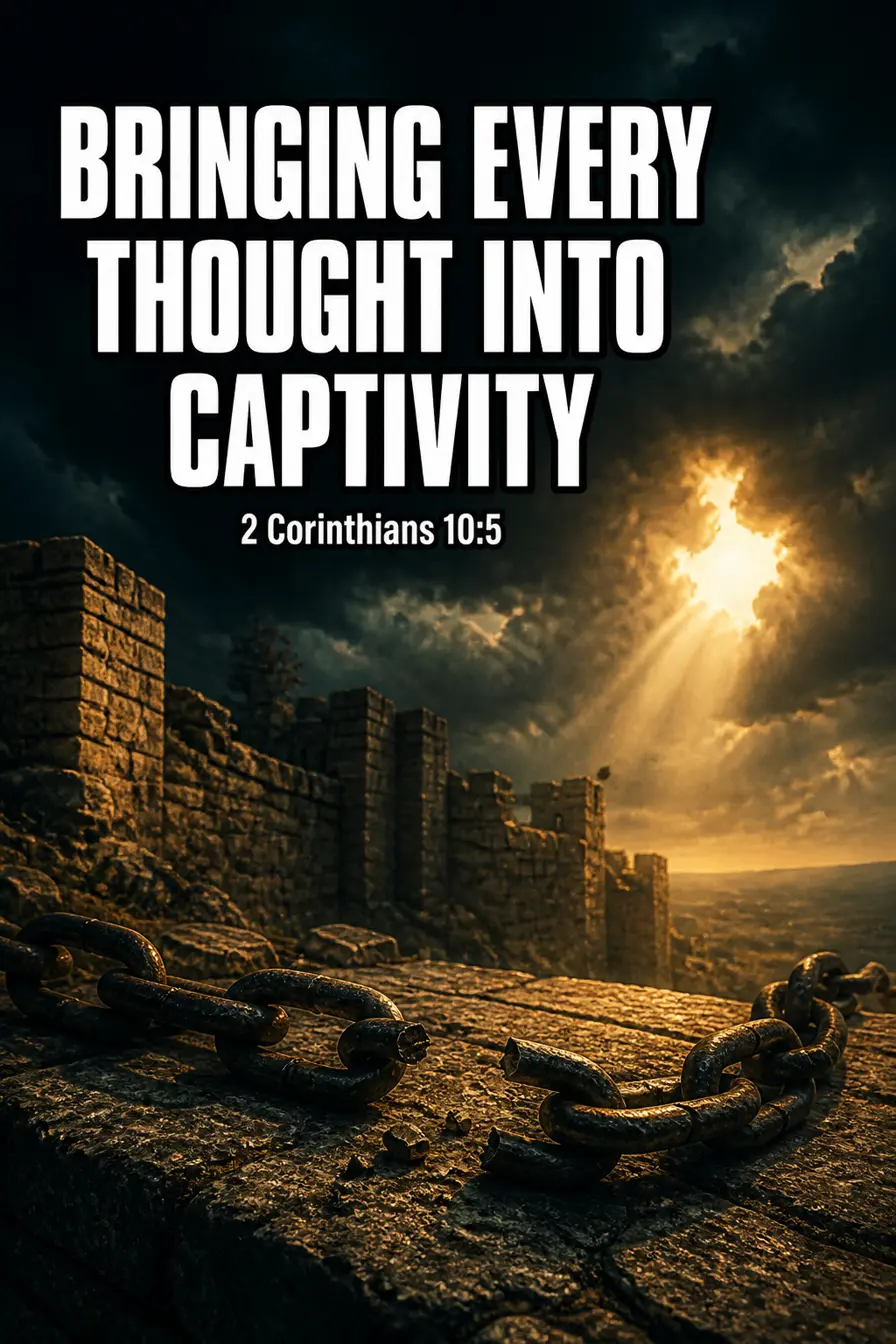
The word here is imaginations, and for an overthinker that lands harder than the abstract translations do. The thing keeping you awake is usually not a fact. It is a construction — a scenario built out of one real ingredient and a great deal of speculation, then defended as though it were evidence. Paul’s language is military: strongholds get thrown down, thoughts get taken prisoner one at a time. Nothing in it suggests the mind quiets down on its own.
Hebrews 4:12 — Something Sharper Than the Argument
“For the word of God is living and active, and sharper than any two-edged sword, piercing even to the dividing of soul and spirit, of both joints and marrow, and is able to discern the thoughts and intentions of the heart.” — Hebrews 4:12 (WEBU)
Able to discern the thoughts and intentions of the heart is the phrase to keep. Overthinking is very good at hiding the real question underneath forty fake ones — you spend an hour on logistics when the actual fear is about being left. This verse describes something that cuts to the layer you cannot reach by thinking harder, which is a relief rather than a threat, because the thinking was never going to get there.
Psalm 139:23-24 — Ask for the Search
“Search me, God, and know my heart. Try me, and know my thoughts. See if there is any wicked way in me, and lead me in the everlasting way.” — Psalm 139:23-24 (WEBU)
The move here is inviting the examination instead of running it yourself. Overthinking is already an audit — hostile, unqualified and never reaching a verdict. This is the same activity handed to somebody who has the full file, already knows the answer, and is not looking for a reason to reject you. The difference is not the searching. It is who is doing it.
What to Put There Instead
An empty mind is not the goal and is not achievable by any of us. Every verse in this section replaces rather than removes.
Philippians 4:8 — Think About These Things
“Finally, brothers, whatever things are true, whatever things are honorable, whatever things are just, whatever things are pure, whatever things are lovely, whatever things are of good report: if there is any virtue and if there is anything worthy of praise, think about these things.” — Philippians 4:8 (WEBU)

The first item on the list is the one that does the work: whatever things are true. Not whatever things are pleasant. Most overthinking fails this test before it gets anywhere near the others, because the scenario being rehearsed has not happened and may not. Paul does not ask you to think positively. He asks you to check whether the thing you are turning over is even true yet, and a great deal of the loop does not survive that question.
Colossians 3:1-2 — Set Your Mind
“If then you were raised together with Christ, seek the things that are above, where Christ is, seated on the right hand of God. Set your mind on the things that are above, not on the things that are on the earth.” — Colossians 3:1-2 (WEBU)

Set is a deliberate verb, the kind you use for a dial or a course. Paul writes as though the direction of attention is something a person operates rather than something that happens to them — which sounds impossible on a bad night and is still, technically, true. The setting does not hold, for any of us. That is why the instruction is given to people who will need it again in ten minutes.
Romans 12:2 — The Renewing of Your Mind
“Don’t be conformed to this world, but be transformed by the renewing of your mind, so that you may prove what is the good, well-pleasing, and perfect will of God.” — Romans 12:2 (WEBU)
Renewing is a process word, not an event, and the grammar is passive: be transformed. This is not a verse about trying harder to think differently. It describes something done to a mind over time, which matters if you have been treating each failed evening as evidence that you are bad at this. The timescale in view is months, not tonight.
Isaiah 26:3 — Steadfast, Not Empty
“You will keep whoever’s mind is steadfast in perfect peace, because he trusts in you.” — Isaiah 26:3 (WEBU)

Steadfast means fixed on something, not cleared of everything. That is the distinction most peace advice misses: the promise is not a blank mind but an anchored one. And notice who does the keeping — you will keep. The peace is described as something God holds you inside, rather than a state you reach and then have to maintain by concentration.
Where the Mind Actually Gets Guarded
Philippians 4:6-7 — A Guard Posted on Your Thoughts
“In nothing be anxious, but in everything, by prayer and petition with thanksgiving, let your requests be made known to God. And the peace of God, which surpasses all understanding, will guard your hearts and your thoughts in Christ Jesus.” — Philippians 4:6-7 (WEBU)

Most people quote the first half and stop. The end is where the overthinking answer is: the peace will guard your hearts and your thoughts. It is a garrison word — a sentry posted at a gate, deciding what gets in. Paul wrote it from prison awaiting a verdict, which is worth knowing before it reads as advice from a calm life. And the method in the middle is specific: prayer and petition, meaning named requests rather than a general unease offered up.
Proverbs 4:23 — Keep Your Heart
“Keep your heart with all diligence, for out of it is the wellspring of life.” — Proverbs 4:23 (WEBU)
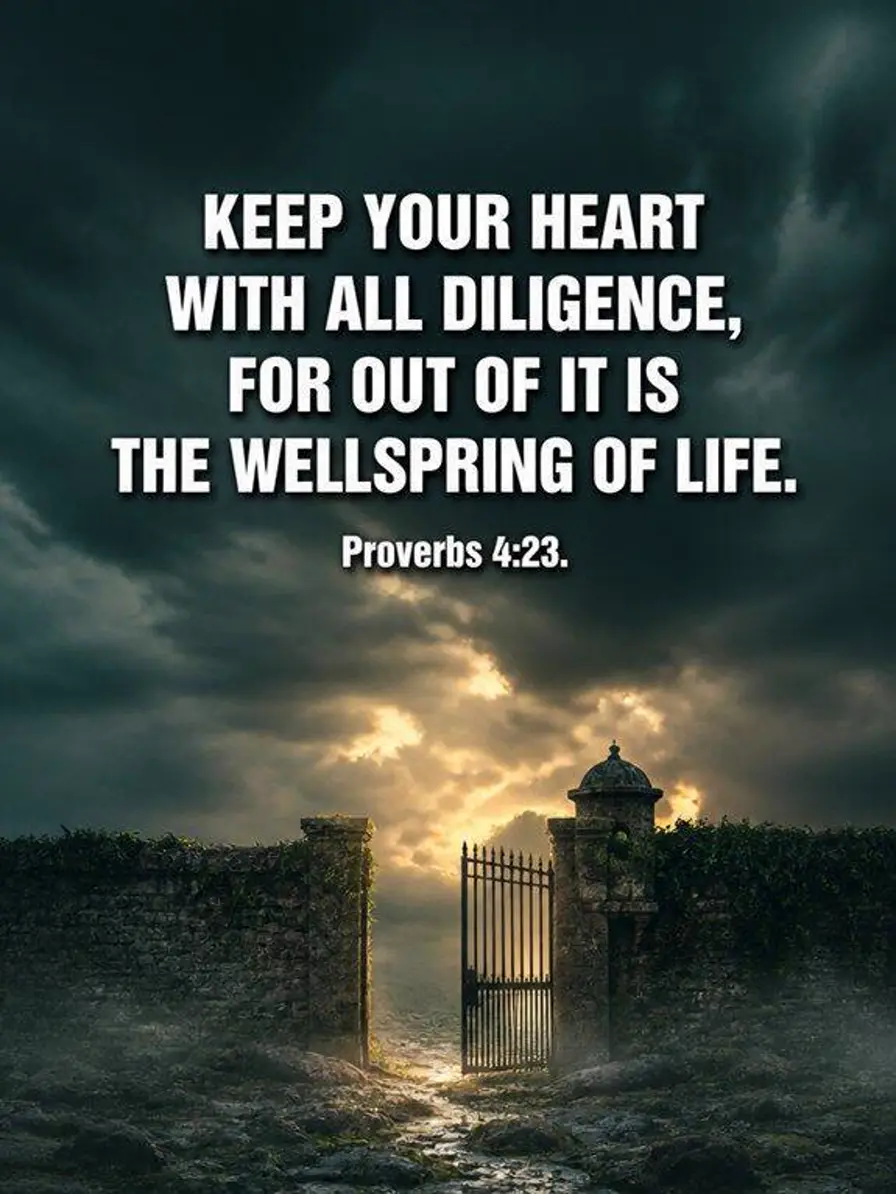
With all diligence implies effort and repetition, and wellspring explains why it is worth it: what is in there comes out, on its own, at the source. Overthinking is not a private activity with no consequences. It sets the temperature of how you speak to people the next morning, which is usually the first thing anyone else notices.
Proverbs 12:25 — Someone Else’s Kind Word
“Anxiety in a man’s heart weighs it down, but a kind word makes it glad.” — Proverbs 12:25 (WEBU)

The remedy in this verse does not come from the anxious person. It comes out of somebody else’s mouth. That is the one item on this page you can act on for another person tonight, and it explains why overthinking gets so much heavier alone — the prescribed treatment requires a second party, and the loop’s first move is to convince you not to bother anyone.
When You Cannot Think Your Way Out
Some nights the analysis is not going to be won. These are the verses we reach for then, and they are deliberately the plainest ones here.
Psalm 23:4 — Rod and Staff
“Even though I walk through the valley of the shadow of death, I will fear no evil, for you are with me. Your rod and your staff, they comfort me.” — Psalm 23:4 (WEBU)

Two tools, and the comfort comes from both. The staff is the crook that guides and retrieves a wandering animal; the rod is the club the shepherd carried to break the teeth of whatever came out of the dark. Being guided and being defended are separate promises, and a mind that has spent four hours constructing threats needs the second one named.
Joshua 1:9 — Strong and Courageous
“Haven’t I commanded you? Be strong and courageous. Don’t be afraid. Don’t be dismayed, for the LORD your God is with you wherever you go.”” — Joshua 1:9 (WEBU)

Courage arrives as an instruction, which only makes sense once you know the moment. Joshua has just buried Moses and inherited the job. An order can be obeyed by somebody who feels nothing of the sort, and that is the use of it here — you do not have to have finished thinking before you act. Wherever you go covers the places your mind has not stopped visiting.
Matthew 11:28-30 — Rest for Your Souls
““Come to me, all you who labor and are heavily burdened, and I will give you rest. Take my yoke upon you and learn from me, for I am gentle and humble in heart; and you will find rest for your souls. For my yoke is easy, and my burden is light.”” — Matthew 11:28-30 (WEBU)

A yoke is a beam across the shoulders of two animals, which is the detail the encouraging poster always leaves off. He does not offer to remove the load. He offers to be the other half of it, and to set the pace. Rest for your souls is not the absence of effort — it is the same weight with the pulling shared.
1 Peter 5:6-7 — Casting Is a Throwing Word
“Humble yourselves therefore under the mighty hand of God, that he may exalt you in due time, casting all your worries on him, because he cares for you.” — 1 Peter 5:6-7 (WEBU)
Casting is not gentle. The Greek is the verb for flinging a heavy load off your shoulders onto something built to carry it. And it is attached to humble yourselves — Peter treats keeping hold of the whole problem as a form of pride, which is uncomfortable and, for an overthinker, uncomfortably accurate.
Isaiah 55:8-9 — Higher Than Your Thoughts
““For my thoughts are not your thoughts, and your ways are not my ways,” says the LORD. “For as the heavens are higher than the earth, so are my ways higher than your ways, and my thoughts than your thoughts.” — Isaiah 55:8-9 (WEBU)
Overthinking runs on an unexamined assumption: that if you keep going you will eventually model the situation completely. This verse says the model has a ceiling and you are already at it. That is either deflating or a release, depending on the hour — but it does answer the question of when you are allowed to stop.
Psalm 62:5-6 — Wait in Silence
“My soul, wait in silence for God alone, for my expectation is from him. He alone is my rock and my salvation, my fortress. I will not be shaken.” — Psalm 62:5-6 (WEBU)
Another instruction addressed to his own soul, like Psalm 42. Wait in silence is the hardest sentence on this page for anyone whose mind fills every gap with commentary. It is worth noticing that David does not describe silence as a state he is in. He describes it as an order he is giving.
2 Timothy 1:7 — Self-Control Is a Gift
“For God didn’t give us a spirit of fear, but of power, love, and self-control.” — 2 Timothy 1:7 (WEBU)
The third item is the one that matters here. Self-control is the plain ability to choose your next action, and it is listed alongside power and love rather than beneath them — a gift rather than a personality trait some people were issued and you were not. Paul wrote it from a Roman prison to a younger man he suspected was losing his nerve.
How to Biblically Stop Overthinking
Reading twenty verses in one evening changes very little. Three habits, drawn from what is above, change quite a lot, and we have put them in the order that works. Take them in order and give the first one a fortnight before adding the second.
Answer the loop out loud, the way Psalm 42 does. Ask your own soul the question — why are you in despair? — and answer it with something true. Speaking aloud breaks the passenger-seat effect, because a monologue you are producing on purpose is not the same as one you are receiving.
Run the Philippians 4:8 test on the thought. One question, first item on the list: is this true yet? Not is it possible, not is it fair. Has it happened. Most of what keeps us up is a construction, and naming it as one is usually enough to loosen it.
Write down the things too wonderful for you. Psalm 131 is a decision about which questions are yours to hold. Put the ones that are not on paper, in a specific place, and stop carrying them in your head — the page holds them adequately and you do not have to.
If the loop is stopping you sleeping, or has run for months, say so to a doctor as well as to God. Scripture and clinical care are not rivals, and treating them as opponents costs people years.
Questions People Ask
What does God say about overthinking?
Scripture describes it before it addresses it. Psalm 94:19 names “the multitude of my thoughts within me”, and Psalm 55:2 the physical restlessness that comes with it. The instructions are consistent: catch the thought (2 Corinthians 10:5), test whether it is true (Philippians 4:8), and speak to yourself rather than listen (Psalm 42:5). Nowhere is a quiet mind promised — an anchored one is.
What Bible verse calms the mind?
Isaiah 26:3 is the most direct: God keeps a mind that is steadfast in perfect peace. Psalm 94:19 is the honest companion, promising comfort inside the racing thoughts rather than after they stop. Philippians 4:7 gives the mechanism — the peace of God posted as a guard over your hearts and your thoughts.
How do you take every thought captive?
2 Corinthians 10:4-5 describes it as a military operation, one thought at a time: strongholds thrown down, imaginations thrown down, each thought brought into captivity. In practice it means catching a specific thought rather than the general mood, and putting one true sentence next to it. The passage assumes repetition and gives no timeline.
Are there short Bible verses for overthinking that are easy to memorize?
Psalm 94:19, Psalm 131:2 and Isaiah 26:3 are all a single line and all directly about the mind. Psalm 42:5 is slightly longer and the most useful of the four, because it gives you a question to ask yourself rather than a statement to agree with.
How do you ask God to take away anxiety?
Philippians 4:6 gives the form: prayer and petition, with thanksgiving, making the requests known. Petition means a specific ask rather than a general unease. 1 Peter 5:7 adds the posture — casting, a throwing verb, done from humility rather than from having sorted yourself out first.
Overthinking that has run for years does not stop in an evening, and nothing here suggests otherwise. Take one verse — most likely the one that described something you had not managed to put into words — and give it two ordinary weeks in the place the loop actually starts.
When you want more, Bible Verses About Worry covers handing a worry over, Bible Verses for Anxiety That Will Calm Your Mind works through the physical side, and the full Anxiety archive holds the rest.