
Four words do most of the damage: do not be anxious. You read them at two in the morning, you fail to obey them, and now there are two problems — the worry and anxiety themselves, and the sense that a Christian with real faith would not feel anxious at all.
We are doing something to that sentence it never asked for. The best Bible verses for anxiety are built on a single Greek word, and the man who wrote the most famous of them uses that same word about himself, in a letter, in a list of things he suffers. He is not confessing a failure. He is describing his week.
Almost nobody reads Bible verses about anxiety this way. Follow one word through God’s word and the command stops sounding like an order to feel differently. It starts sounding like what it is: an instruction about where your care is fastened.

Face your giants. Discover what makes someone truly brave.1 Samuel 17 · 11 min
That was just the opening. Open the app and search #002 to hear the full 11-minute story — free.
Keep listening free in the app Free on iOS & Android — no sample needed

The Verse Nobody Prints Next to Philippians 4:6
Paul is defending himself to a church that has been told he is not a real apostle. So he lists what the job has cost him — beatings, shipwreck, a night and a day in open water, hunger, cold. Then he reaches the end of the list and adds one more item, and the last item is not physical.
“Besides those things that are outside, there is that which presses on me daily: anxiety for all the assemblies.” — 2 Corinthians 11:28 (WEBU)

The word translated anxiety there is merimna. The word in “in nothing be anxious” is its verb, merimnaō. Same root, same author, and the two letters were written within a few years of each other.
Put those two sentences side by side and one of them has to give for us. Either Paul commands something he openly does not do, or the command means something other than never feel this. The rest of the New Testament settles it, because the word turns up nineteen more times and it is not always a sin.
What Merimnaō Actually Describes
The root behind it carries the sense of being pulled apart — a mind divided between two places at once. English has no single word for it, which is why translators reach for anxious, worried, concerned and cares depending on the sentence — and why the connection between those verses disappears before it reaches us.
Jesus uses it once in a way that shows the shape exactly.
“Jesus answered her, “Martha, Martha, you are anxious and troubled about many things,” — Luke 10:41 (WEBU)

Martha is not doing anything wrong. She is cooking for a guest, which is the correct thing to do when a guest arrives. The problem is the number: many things. Her attention has been divided across a dozen jobs and there is nothing left over. The correction that follows is about arithmetic rather than morality.
“but one thing is needed. Mary has chosen the good part, which will not be taken away from her.”” — Luke 10:42 (WEBU)
Many things, one thing. Bible Verses About Worry takes the Martha scene on its own terms; here it matters because it defines the word. Merimnaō is what happens when care has too many objects.
The Same Word, Used as a Compliment
If the word meant sinful worry, Paul could not have used it the way he does about a friend. He does, twice, and both times it is praise.
“For I have no one else like-minded, who will truly care about you.” — Philippians 2:20 (WEBU)

That is Timothy, and truly care is merimnaō — the same verb Paul forbids two chapters later in the same letter. Paul is not contradicting himself across four pages. He is using a neutral word about attention, and the letter assumes you can tell the difference from the context.
He does it again when he describes what a healthy church looks like from the inside.
“that there should be no division in the body, but that the members should have the same care for one another.” — 1 Corinthians 12:25 (WEBU)

Care for one another is the verb again. A church where nobody is merimnaō about anybody is not a peaceful church. It is a dead one.
And when Paul does describe the trouble with divided attention, he does not moralize about it — he lays the two directions out flat and lets you see them.
“But I desire to have you to be free from cares. He who is unmarried is concerned for the things of the Lord, how he may please the Lord;” — 1 Corinthians 7:32 (WEBU)

“but he who is married is concerned about the things of the world, how he may please his wife.” — 1 Corinthians 7:33 (WEBU)

Some translations open the passage with “I want you to be free from anxieties”, which is the same root again. Concerned in verse 32 and concerned in verse 33 are the identical word, and Paul attaches no blame to either one. He is describing where a life’s attention goes, and both directions are legitimate. The word by itself is morally empty. What fills it is the object.
That is the whole hinge. The command is not hold no care. It is a question about what your care is currently holding.
The Longest Thing Jesus Ever Said About Anxiety
Matthew 6 uses the verb six times in ten verses, which is the densest cluster anywhere in Scripture. Read as a block instead of as separate wall-art quotes, it does something specific: it keeps widening the frame until the fear looks smaller than it did.
“Therefore I tell you, don’t be anxious for your life: what you will eat, or what you will drink; nor yet for your body, what you will wear. Isn’t life more than food, and the body more than clothing?” — Matthew 6:25 (WEBU)

The audience matters. These are Galilean day-labourers for whom “what you will eat” was a live question every evening, not a metaphor. Jesus is not telling comfortable people to relax about luxuries. He is talking to people with a genuine reason to be afraid, and his first move is to point out that the thing they are anxious about is smaller than the life it is supposed to sustain.
“See the birds of the sky, that they don’t sow, neither do they reap, nor gather into barns. Your heavenly Father feeds them. Aren’t you of much more value than they?” — Matthew 6:26 (WEBU)
Look at the birds of the air. Your heavenly Father feeds them, and you are more valuable than they are. Note what the argument is not: it is not that birds do not work. It is that they do not store. The comparison targets stockpiling against an imagined future, which is the exact mechanic of anxiety.
““Which of you by being anxious, can add one moment to his lifespan?” — Matthew 6:27 (WEBU)

This is the practical objection, and it is the only argument in the passage that appeals to results. Anxiety feels productive. It feels like preparation. Jesus asks for the output and there isn’t any — worrying cannot add a single hour to your life, or a cubit to your height, depending on how the Greek measurement is read. Some translations render it as an hour added to your span of life; the point survives either way.
“Why are you anxious about clothing? Consider the lilies of the field, how they grow. They don’t toil, neither do they spin,” — Matthew 6:28 (WEBU)

Consider is a looking word. The instruction is to go outside and study something, which is a strange prescription for a racing mind until you have tried it. It moves attention from an interior loop to an exterior object, and it takes a few minutes rather than a few seconds.
“yet I tell you that even Solomon in all his glory was not dressed like one of these.” — Matthew 6:29 (WEBU)

Solomon in all his glory is the richest reference point his listeners had — the king whose wealth was proverbial. A roadside weed outdresses him, and it did nothing to earn the wardrobe.
“But if God so clothes the grass of the field, which today exists and tomorrow is thrown into the oven, won’t he much more clothe you, you of little faith?” — Matthew 6:30 (WEBU)

You of little faith lands harder in English than it does in the Greek, where it works closer to a nudge than an insult. And the logic underneath it is generous: the grass is thrown into the oven tomorrow and still gets clothed today. God dresses things with no future. If he clothes the grass, much more will he clothe you.
““Therefore don’t be anxious, saying, ‘What will we eat?’, ‘What will we drink?’ or, ‘With what will we be clothed?’” — Matthew 6:31 (WEBU)

The verse quotes anxiety out loud, in its own voice, as a set of questions. That is worth noticing on a bad night: the passage treats worry as speech, something with words in it that can be written down and looked at.
“But seek first God’s Kingdom and his righteousness; and all these things will be given to you as well.” — Matthew 6:33 (WEBU)

And here the whole argument resolves into the definition. Jesus does not end the passage with stop feeling. He ends it with seek first — an instruction about ordering, which is precisely what a word meaning “divided attention” requires. The fix for a mind pulled six directions is a first direction, not an empty one.
“Therefore don’t be anxious for tomorrow, for tomorrow will be anxious for itself. Each day’s own evil is sufficient.” — Matthew 6:34 (WEBU)
Do not worry about tomorrow, for tomorrow will worry about itself. Being anxious about tomorrow is the one case Jesus rules out by name, and each day has enough trouble of its own. Luke tells the same teaching with the measurement made physical, and adds a second question underneath it.
“Which of you by being anxious can add a cubit to his height?” — Luke 12:25 (WEBU)

“If then you aren’t able to do even the least things, why are you anxious about the rest?” — Luke 12:26 (WEBU)

Luke’s version is the blunter one. If the smallest item on the list is outside your control, the argument runs, the size of the remaining list is not the relevant fact. A few verses earlier he adds that the very hairs of your head are all counted — the same God who cannot be lobbied for an extra inch of height is keeping a count nobody asked him to keep.
Where the Word Turns Dangerous
The New Testament does treat this as a real hazard, and when it does, the picture is never emotional. It is agricultural, and the verb is always the same one: choke.
“and the cares of this age, and the deceitfulness of riches, and the lusts of other things entering in choke the word, and it becomes unfruitful.” — Mark 4:19 (WEBU)
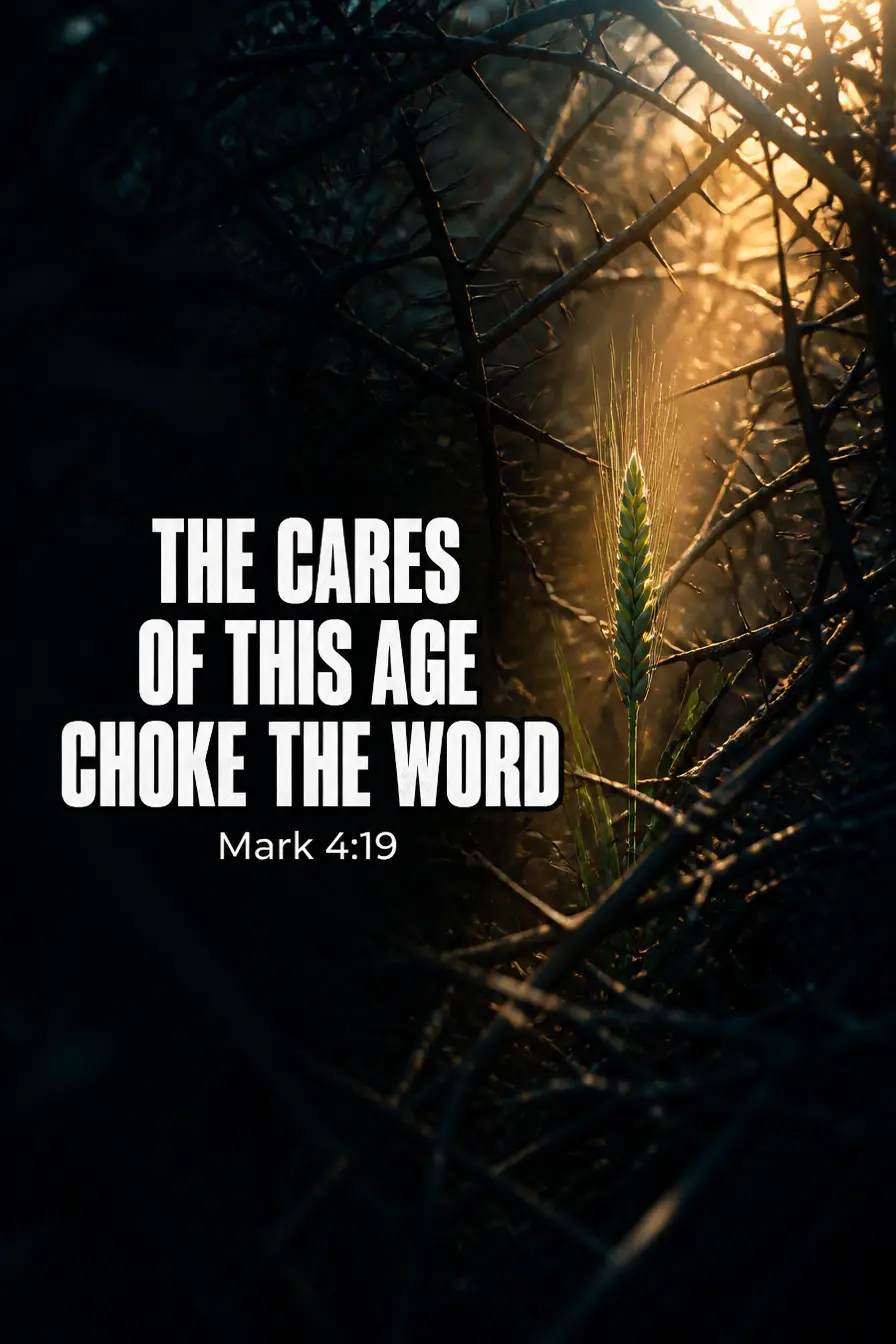
Cares is merimna — the noun from 2 Corinthians 11:28, the one Paul owned about himself. In the parable of the sower it is one of the three things growing in the same soil as the seed. Thorns do not attack the plant. They take the light and the water, and the plant simply never fruits. Matthew tells it identically: the cares of this age and the deceitfulness of riches choke the word.
“What fell among the thorns, these are those who have heard, and as they go on their way they are choked with cares, riches, and pleasures of life; and they bring no fruit to maturity.” — Luke 8:14 (WEBU)
Luke’s phrasing — as they go on their way — is the honest part. Nobody chooses the thorns. They arrive over the length of a life, one reasonable concern at a time.
““So be careful, or your hearts will be loaded down with carousing, drunkenness, and cares of this life, and that day will come on you suddenly.” — Luke 21:34 (WEBU)

Notice the company the word keeps in that sentence. Cares of this life is listed alongside carousing and drunkenness — three different ways of being unable to see what is in front of you. Anxiety is filed with the things that dull a person, not with the things that sharpen them.
So the danger is real, and it is specific. Care is not our problem. Care with no first object is, because it grows into everything.
The Command, Read Correctly
Which brings us back to the verse that started the trouble, and it reads differently once the word has a history.
“In nothing be anxious, but in everything, by prayer and petition with thanksgiving, let your requests be made known to God.” — Philippians 4:6 (WEBU)
Most of us meet this as “do not be anxious about anything” and hear a prohibition on a feeling. But look at the shape of the sentence: it is a but. In nothing be anxious — but in everything, by prayer, let your requests be made known. Paul is not asking for less care. He is redirecting the same care to a different address. The nothing and the everything are the same list.
The full pillar on anxiety works through the passage verse by verse. What matters here is the promise attached to it, which is not the absence of the feeling.
“And the peace of God, which surpasses all understanding, will guard your hearts and your thoughts in Christ Jesus.” — Philippians 4:7 (WEBU)

Guard is phroureō, a garrison word — soldiers posted at a city gate. A garrison does not remove the enemy from the region. It stands between the enemy and the gate. The peace of God, which surpasses all understanding, will guard your hearts and your minds in Christ Jesus, and the picture is of a watch being set rather than a threat being deleted. That is why the peace makes no sense on paper: it arrives while the situation is unchanged.
Peter uses the noun and gives it a throwing verb.
“casting all your worries on him, because he cares for you.” — 1 Peter 5:7 (WEBU)
Cast all your anxiety on him because he cares for you. Casting is a hurling word, used for slinging a load off a shoulder onto an animal. And the second half of the sentence contains the same root one more time — he cares for you — so the verse hands your merimna to someone whose merimna is you.
The rest of Scripture keeps pointing the care somewhere rather than deleting it.
“Even though I walk through the valley of the shadow of death, I will fear no evil, for you are with me. Your rod and your staff, they comfort me.” — Psalm 23:4 (WEBU)
“Even though I walk through the darkest valley, I will fear no evil, for you are with me; your rod and your staff, they comfort me.” David walks through rather than around, and the comfort is two pieces of shepherd’s equipment rather than a change in the terrain.
“A Psalm by David. The LORD is my shepherd; I shall lack nothing.” — Psalm 23:1 (WEBU)
“He makes me lie down in green pastures. He leads me beside still waters.” — Psalm 23:2 (WEBU)
“He restores my soul. He guides me in the paths of righteousness for his name’s sake.” — Psalm 23:3 (WEBU)
“The LORD is my shepherd, I shall not want. He makes me lie down in green pastures, he leads me beside still waters, he restores my soul and guides me in paths of righteousness for his name’s sake.” Three verses of rest before the valley arrives in the fourth — the psalm builds the ground before it needs it. Later it prepares a table in the presence of enemies, anoints the head with oil until the cup overflows, and ends with “goodness and loving kindness” following “all the days of my life”.
““Come to me, all you who labor and are heavily burdened, and I will give you rest.” — Matthew 11:28 (WEBU)
“Take my yoke upon you and learn from me, for I am gentle and humble in heart; and you will find rest for your souls.” — Matthew 11:29 (WEBU)
“Take my yoke upon you and learn from me, and you will find rest for your souls — for my yoke is easy and my burden is light.” A yoke is still a working harness. Jesus offers an exchange of loads, not an empty back.
“but those who wait for the LORD will renew their strength. They will mount up with wings like eagles. They will run, and not be weary. They will walk, and not faint.” — Isaiah 40:31 (WEBU)
Those who hope in the LORD will renew their strength; they will soar on wings like eagles, they will run and not grow weary, they will walk and not be faint.
“Now may the Lord of peace himself give you peace at all times in all ways. The Lord be with you all.” — 2 Thessalonians 3:16 (WEBU)
May the Lord of peace himself give you peace at all times and in every way.
“And let the peace of God rule in your hearts, to which also you were called in one body, and be thankful.” — Colossians 3:15 (WEBU)
Let the peace of Christ rule in your hearts, since as members of one body you were called to peace. The verb rule is an umpiring word — it settles disputes rather than preventing them.
“nor height, nor depth, nor any other created thing will be able to separate us from God’s love which is in Christ Jesus our Lord.” — Romans 8:39 (WEBU)
Neither death nor life, neither angels nor demons, neither height nor depth, nor anything else in all creation will be able to separate us from the love of God that is in Christ Jesus our Lord. Paul writes it as a list because he is trying to close every gap he can think of.
“Peace I leave with you. My peace I give to you; not as the world gives, I give to you. Don’t let your heart be troubled, neither let it be fearful.” — John 14:27 (WEBU)
“Peace I leave with you; my peace I give you. Do not let your hearts be troubled and do not be afraid.” Bible Verses About Peace works through the upper-room scene where those words were spoken.
The list of Bible verses on anxiety that people actually search for reaches well past Philippians 4, and most of them share the same shape: the care is redirected, never deleted.
“Don’t you be afraid, for I am with you. Don’t be dismayed, for I am your God. I will strengthen you. Yes, I will help you. Yes, I will uphold you with the right hand of my righteousness.” — Isaiah 41:10 (WEBU)
“Do not fear, for I am with you; do not be dismayed, for I am your God. I will strengthen you and help you; I will uphold you with my righteous right hand.” Isaiah is writing to people about to lose their country, and four verses later he names who is speaking — “your Redeemer is the Holy One of Israel.”
“Haven’t I commanded you? Be strong and courageous. Don’t be afraid. Don’t be dismayed, for the LORD your God is with you wherever you go.”” — Joshua 1:9 (WEBU)
“Be strong and courageous. Do not be afraid; do not be discouraged, for the LORD your God will be with you wherever you go.” It is an order with a location attached rather than a quality.
“Trust in the LORD with all your heart, and don’t lean on your own understanding.” — Proverbs 3:5 (WEBU)
Trust in the LORD with all your heart and lean not on your own understanding. The second half is the harder one when you are worried and anxious, because your own understanding is exactly what is running the loop.
“But the very hairs of your head are all numbered.” — Matthew 10:30 (WEBU)
The very hairs of your head are all numbered. Jesus said to his disciples that not one sparrow falls without the Father, then went smaller — to a count nobody asked to be kept.
“You prepare a table before me in the presence of my enemies. You anoint my head with oil. My cup runs over.” — Psalm 23:5 (WEBU)
“Surely goodness and loving kindness shall follow me all the days of my life, and I will dwell in the LORD’s house forever.” — Psalm 23:6 (WEBU)
“You prepare a table before me in the presence of my enemies. You anoint my head with oil; my cup overflows.” The enemies are still at the table when the meal is served. “Goodness and mercy shall follow me all the days of my life, and I will dwell in the house of the LORD forever” — the psalm ends with a destination, not a rescue.
“For the mind of the flesh is death, but the mind of the Spirit is life and peace;” — Romans 8:6 (WEBU)
The mind governed by the Spirit is life and peace. Paul puts the two words together as one outcome.
“Now may the God of hope fill you with all joy and peace in believing, that you may abound in hope in the power of the Holy Spirit.” — Romans 15:13 (WEBU)
May the God of hope fill you with all joy and peace as you trust in him, so that you may overflow with hope by the power of the Holy Spirit.
“I have told you these things, that in me you may have peace. In the world you have trouble; but cheer up! I have overcome the world.”” — John 16:33 (WEBU)
“In me you may have peace. In the world you have trouble.” Both halves are in the same sentence, and the last clause is “I have overcome the world” — spoken before anything had visibly been overcome. Bible Verses for Fear and Worry stays with that verse at length.
“There is no fear in love; but perfect love casts out fear, because fear has punishment. He who fears is not made perfect in love.” — 1 John 4:18 (WEBU)
There is no fear in love, and perfect love drives out fear. John attaches a reason — fear has to do with punishment — which narrows the claim to a specific kind of afraid.
“But even if you should suffer for righteousness’ sake, you are blessed. “Don’t fear what they fear, neither be troubled.”” — 1 Peter 3:14 (WEBU)
Even if you should suffer for what is right, you are blessed. Peter quotes Isaiah back at his readers and tells them not to borrow the fears of the people around them.
“Tell those who have a fearful heart, “Be strong! Don’t be afraid! Behold, your God will come with vengeance, God’s retribution. He will come and save you.” — Isaiah 35:4 (WEBU)
Say to those with a fearful heart, be strong, do not fear; your God will come with vengeance, he will come to save you. The sentence turns on the same verb twice — he comes for the wrong, and he comes for you.
“When I saw him, I fell at his feet like a dead man. He laid his right hand on me, saying, “Don’t be afraid. I am the first and the last,” — Revelation 1:17 (WEBU)
“Do not be afraid. I am the first and the last.” The hand lands before the words do.
“He will wipe away every tear from their eyes. Death will be no more; neither will there be mourning, nor crying, nor pain any more. The first things have passed away.”” — Revelation 21:4 (WEBU)
He will wipe every tear from their eyes, and there will be no more death or mourning or crying or pain. It is the last word the Bible has on the subject, and it is not advice.
A note on wording, because it trips people up. The quotations above are the World English Bible, which is in the public domain; most of these verses are better known in the NIV or another modern version. The sense is identical and only the English differs — if a line reads oddly against the one you memorized, that is the reason.
What This Changes Tonight
The word study is not the point. What it does is change the instruction from an impossible one to a possible one, and possible instructions are the only kind we can actually follow.
- Stop trying to feel nothing. That is not the command, Paul did not manage it, and the attempt adds a second layer of failure on top of the first. The bar is not an empty mind.
- Write the anxiety down as sentences. Matthew 6:31 quotes worry in its own words — What will we eat? What will we drink? Do the same. Care that has been written down has an object, and an object can be handed over. Care that stays a fog cannot.
- Name the first thing. Seek first only works if there is a second and a third. Decide tonight what the one thing is, in a sentence, and let the rest queue behind it. Martha’s problem was never the cooking.
- Go and look at something. Consider the lilies is a physical instruction. Ten minutes outdoors, attention on an actual object, is closer to what the verse asks than ten minutes of trying harder indoors.
- Hand it over out loud. Casting is a throwing word, and throwing is a single action with a moment of release. Say the thing to God in plain words rather than thinking it at him.
- Check what your care is fastened to, not how much of it there is. Timothy’s care was praised. The thorns in Mark 4 were ordinary concerns that had no first place to sit.
And one plain thing, because it needs saying: if anxiety is affecting your sleep, your work or your body, put yourself in the hands of a professional — that sits alongside faith rather than against it.
Common Questions About Bible Verses for Anxiety
What is the best Bible verse for anxiety?
Philippians 4:6-7 is the one most people reach for, and it earns the place — it names the problem, gives an action, and attaches a promise. Read it as a redirection rather than a prohibition: in nothing be anxious, but in everything, by prayer and petition with thanksgiving. The care is not cancelled. It is sent somewhere.
Is anxiety a sin in the Bible?
The Greek word behind “anxious” is used approvingly of Timothy in Philippians 2:20 and of church members caring for each other in 1 Corinthians 12:25, and Paul applies it to his own daily life in 2 Corinthians 11:28. The word describes divided attention rather than sin. What Scripture warns about is care with no first object, which grows over everything else.
Why do the verses not stop you feeling anxious?
Because they were not written to. Philippians 4:7 promises that peace will guard your heart — a garrison word about soldiers at a gate. A garrison stands between you and the threat while the threat is still there. The verse describes protection during the situation rather than removal of it.
How do you use these verses when your mind is racing?
Pick one, say it out loud, and give it an object. Reading a list silently at three in the morning tends to add to the noise. Matthew 6:28 asks you to consider something outside your own head, and Philippians 4:6 asks you to say the specific request. Both are actions, and both take longer than a glance.
What does the Bible say about worrying about the future?
Matthew 6:34 says not to be anxious for tomorrow, because tomorrow will be anxious for itself and each day’s own trouble is enough. Jesus argues it on practical grounds first: worry adds nothing — not one moment to your lifespan, not a cubit to your height. The instruction is to work with the day you actually have.
The One Thing
Paul carried a daily weight for every church he had planted, and he wrote about peace anyway. Those two facts sit in the same set of letters, and neither one cancels the other — which is the permission most of us are actually looking for.
So the question tonight is not whether you feel calm. It is where your care is pointed, and whether it has a first place to go. Pick one verse from this page, say it out loud, and name the one thing behind it. Then find the rest in the Anxiety Archive, or work through Bible Verses for Stress and Anxiety when the weight is the problem rather than the fear. If there is no one thing behind it at all, anxiety with no cause you can name has its own page.