You have already read the verses. That is the situation this page is for. You know Philippians 4:6 by heart, you have prayed it, and last Tuesday it worked for about forty minutes. Then it came back.
Nearly every list of bible verses for fear and worry is written for a first encounter — here is the fear, here is the answer, and we hand it over. That is a real need and it is not yours right now. Yours is the second problem: the fear that returns after being answered, on a loop, for months.
Scripture has more to say about that than the lists we usually see suggest. What it does not do is treat it as a sign you have failed. The clearest evidence is a psalmist who says the same sentence to himself three separate times, because twice was not enough.

Face your giants. Discover what makes someone truly brave.1 Samuel 17 · 11 min
That was just the opening. Open the app and search #002 to hear the full 11-minute story — free.
Keep listening free in the app Free on iOS & Android — no sample needed

The Repetition Is in the Bible Too
Psalm 42:5 — Said Once
“Why are you in despair, my soul? Why are you disturbed within me? Hope in God! For I shall still praise him for the saving help of his presence.” — Psalm 42:5 (WEBU)

David splits himself in two and speaks to his own soul, interrogating it and then giving it an instruction. That alone is a useful move — it is the opposite of lying there listening to your own commentary as though it were news.
Psalm 42:11 — Said Again, Six Verses Later
“Why are you in despair, my soul? Why are you disturbed within me? Hope in God! For I shall still praise him, the saving help of my countenance, and my God.” — Psalm 42:11 (WEBU)
Word for word the same opening. Between the two he has described tears as his food day and night and asked God why he has been forgotten. The first attempt did not settle it, so he says it again.
Psalm 43:5 — And Again, in the Next Psalm
“Why are you in despair, my soul? Why are you disturbed within me? Hope in God! For I shall still praise him: my Savior, my helper, and my God.” — Psalm 43:5 (WEBU)
Three times, across two psalms, identical each time. This is the most useful fact on this page: the Bible’s own model for fear that will not stop is repetition. Nobody in the text treats the second and third attempts as evidence of weak faith. They are simply what it took, and the psalm was kept in the book with all three in it.
Permission to Say How Bad It Is
Before the answers, the language Scripture gives us for the state itself. These verses are in the Bible on purpose.
Psalm 13:1-2 — How Long
“How long, LORD? Will you forget me forever? How long will you hide your face from me? How long shall I take counsel in my soul, having sorrow in my heart every day? How long shall my enemy triumph over me?” — Psalm 13:1-2 (WEBU)
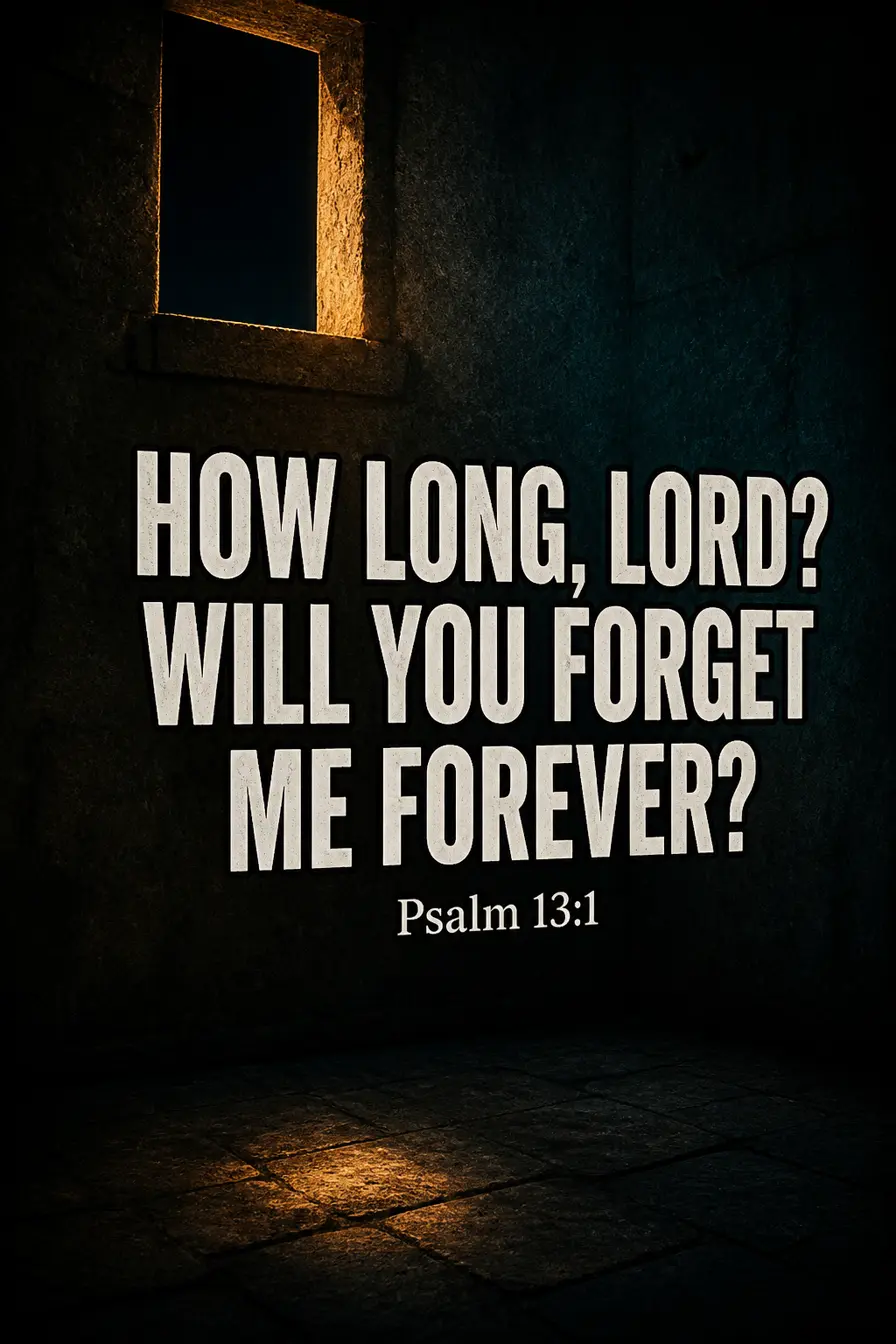
Four times in two verses. And “taking counsel in my soul, having sorrow in my heart every day” is a precise description of the loop — endless internal consultation that reaches no verdict, running daily. David does not apologise for the tone, and the psalm turns in verse 5 without pretending the first four verses were an overreaction.
Psalm 77:1-3 — “My Soul Refused to Be Comforted”
“My hand was stretched out in the night, and didn’t get tired. My soul refused to be comforted. I remember God, and I groan. I complain, and my spirit is overwhelmed.” — Psalm 77:1-3 (WEBU)
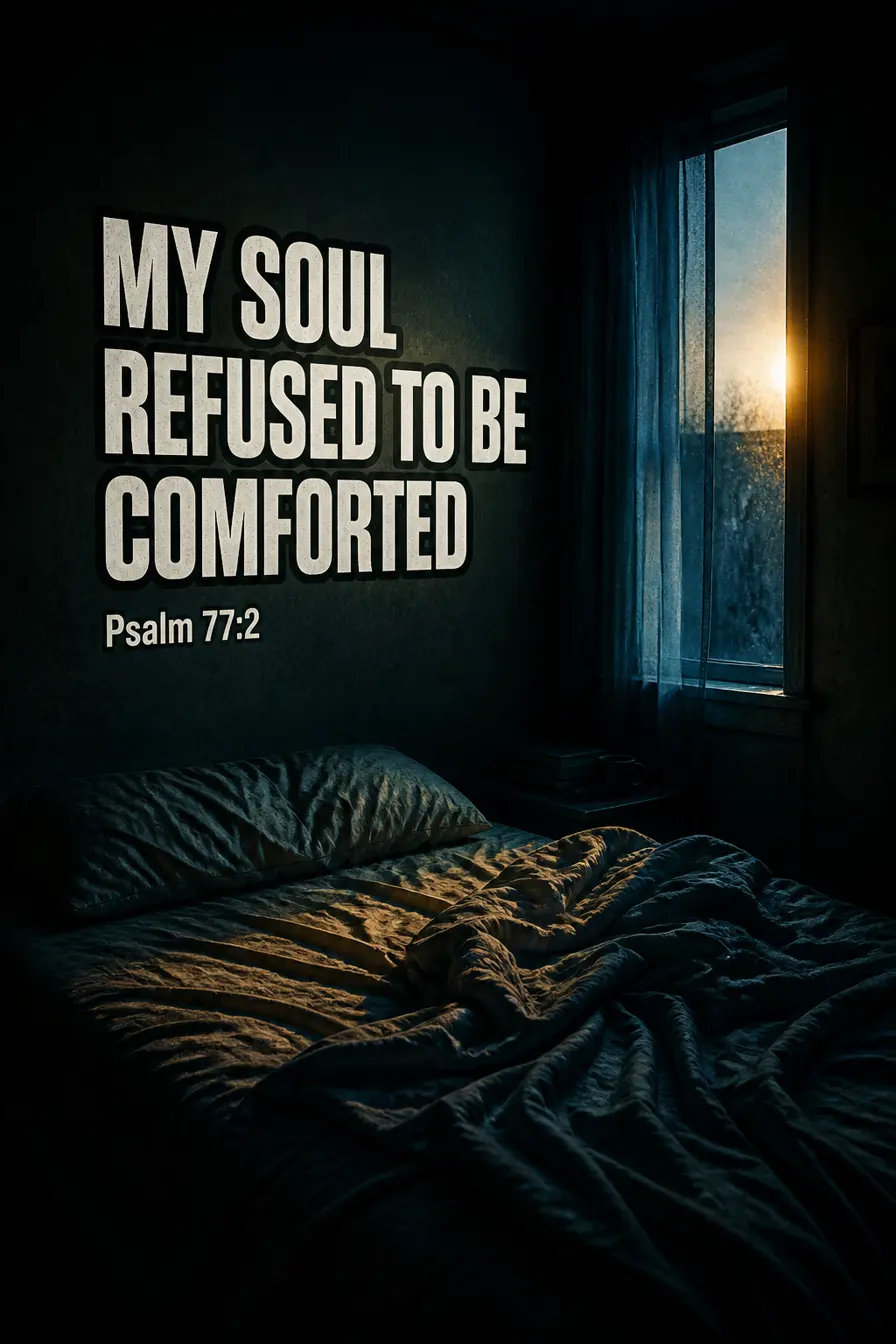
“My soul refused to be comforted” may be the most honest line in Scripture about persistent anxiety. Not could not — refused. Asaph is describing something almost nobody admits out loud: comfort was available, was offered, and something in him would not take it. And then, extraordinarily, the groaning comes from the remembering itself. Even that hurt.
Psalm 73:26 — When Flesh and Heart Fail
“My flesh and my heart fails, but God is the strength of my heart and my portion forever.” — Psalm 73:26 (WEBU)
The first half is a concession most encouragement will not make: the failing is admitted, present tense, no qualification. Then but — and the strength is relocated somewhere the failing does not reach. This is the verse for the day you cannot get up, because it does not require you to have got up.
What to Do on the Fortieth Night
Psalm 62:8 — Pour It Out
“Trust in him at all times, you people. Pour out your heart before him. God is a refuge for us. Selah.” — Psalm 62:8 (WEBU)

Pour out is a total-emptying word, the one used of a vessel turned fully over. Not a summary, not the presentable version. If your prayers have become a tidy list because the real content felt inappropriate, this verse is the correction, and at all times means the ugly hours count.
Philippians 4:6-7 — Prayer and Petition
“In nothing be anxious, but in everything, by prayer and petition with thanksgiving, let your requests be made known to God. And the peace of God, which surpasses all understanding, will guard your hearts and your thoughts in Christ Jesus.” — Philippians 4:6-7 (WEBU)
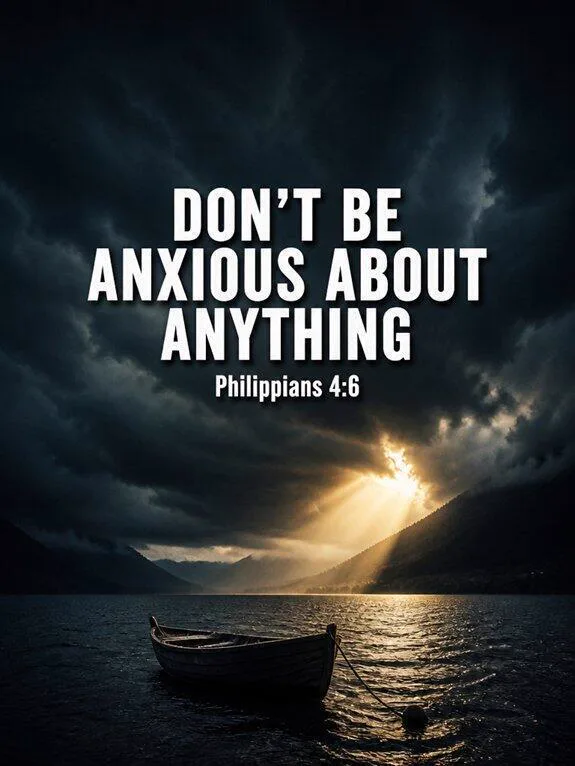
The verse you already know, read for the part that gets skipped. It is not an order to stop feeling anxious, which nobody can obey — the instruction is about what to do with the anxiety. And the peace at the end is a guard: a sentry posted at a gate, doing a job repeatedly, not a mood that arrives once and stays.
Psalm 56:3 — When, Not If
“When I am afraid, I will put my trust in you.” — Psalm 56:3 (WEBU)

Nine words, and when is the whole thing. David writes fear as a recurring condition, not a one-off crisis, and trust as what he does inside it rather than after it. Anyone who has felt like a fraud for praying with their heart still hammering is reading somebody who did exactly that.
Galatians 6:9 — In Due Season
“Let’s not be weary in doing good, for we will reap in due season if we don’t give up.” — Galatians 6:9 (WEBU)

Weary is the specific danger in a long fight — not defeat, exhaustion. And due season is a farming phrase that refuses to name a date. Paul is describing something with a real harvest and an unpublished timetable, which is exactly the shape of this and the reason people quit at month five.
When It Has Gone On for Months
Lamentations 3:22-23 — New Every Morning
“It is because of the LORD’s loving kindnesses that we are not consumed, because his mercies don’t fail. They are new every morning. Great is your faithfulness.” — Lamentations 3:22-23 (WEBU)

New every morning is usually read as a comfort and it is also a piece of information: a daily supply implies a daily need. Nobody is given a stockpile. And not consumed is a deliberately low bar — not thriving, not healed, just not finished off, which on some weeks is the accurate description of where you are.
Habakkuk 3:17-18 — Yet
“For even though the fig tree doesn’t flourish, nor fruit be in the vines, the labor of the olive fails, the fields yield no food, the flocks are cut off from the fold, and there is no herd in the stalls, yet I will rejoice in the LORD.” — Habakkuk 3:17-18 (WEBU)

Six failures listed one after another, everything a farming economy had, and none of them is minimised. The whole sentence hangs on yet, which is not a denial of the six but a decision made with all six standing. This is the verse for somebody whose circumstances have not improved and are not about to.
Psalm 40:1-2 — Out of the Pit
“I waited patiently for the LORD. He turned to me, and heard my cry. He brought me up also out of a horrible pit, out of the miry clay. He set my feet on a rock, and gave me a firm place to stand.” — Psalm 40:1-2 (WEBU)

Waited patiently is the first thing that happened and it took however long it took — the psalm is written afterwards, looking back. Miry clay is the detail that makes it accurate: the problem with a pit like that is not only being down there, it is that there is nothing solid to push against. What is given at the end is not rescue only but a firm place to stand.
Isaiah 40:31 — Walk and Not Faint
“but those who wait for the LORD will renew their strength. They will mount up with wings like eagles. They will run, and not be weary. They will walk, and not faint.” — Isaiah 40:31 (WEBU)

The images descend rather than climb — soaring, running, then walking — which reads as an anticlimax until you have had a year where walking was the achievement. Isaiah puts the least dramatic one last, where it carries the most weight, and the promise covers whichever of the three you are actually managing today.
Getting Help Is Not a Failure of Faith
If this has been going on for months, or it is affecting your sleep, your work or your health, put yourself in the hands of a professional. Doing that is not incompatible with faith and never has been — Paul told Timothy to take something for his stomach rather than questioning his belief, and Luke, who wrote a quarter of the New Testament, was a physician.
What to Actually Do This Week
Say it out loud, and expect to repeat it. Psalm 42 is the model: speak to your own soul rather than listen to it, and plan on doing it again. Three times is in the Bible. The second attempt is not a failure of the first.
Pour out the real version. Psalm 62:8 asks for the whole contents, not the presentable summary. If your prayers have got shorter and tidier as the fear got worse, that is the wrong direction.
Pick one verse, not fifteen. Learn it well enough to say without looking — four repetitions a day for three days will do it for something as short as Psalm 56:3. Fifteen verses read once are less use than one verse you can reach at three in the morning.
Tell one person. Not the internet, one person, this week. Persistent fear thrives on the arrangement where nobody knows, and the loop’s first move is always to convince you not to bother anybody.
Questions People Ask
What does the Bible say when fear and worry won’t stop?
It does not treat repetition as failure. The psalmist says the same sentence to himself three times across Psalm 42 and 43, and the psalms were kept with all three attempts in them. Psalm 77 goes further and admits “my soul refused to be comforted”. The pattern given is to keep speaking, not to get it right first time.
Which Bible verse is best for constant anxiety?
Psalm 56:3 — “When I am afraid, I will put my trust in you” — because when frames fear as recurring rather than as a one-off crisis, and it is short enough to memorize in a day. Lamentations 3:23 is the companion for the long stretch: the mercies are new every morning, which implies a daily need as well as a daily supply.
Why do the verses stop working after a while?
Because a verse is not a switch, and Scripture never presents it as one. Philippians 4:7 describes the peace as a guard — a sentry doing a repeated job — rather than as a state that arrives once. What changes over months is not the verse but how quickly it reaches you, and that comes from repetition under pressure.
Is it wrong to get professional help for this?
No. If it has gone on for months or is affecting your sleep, your work or your health, put yourself in the hands of a professional — that is not incompatible with faith and never has been. Paul prescribed a remedy for Timothy’s health rather than questioning his belief, and Luke, who wrote a quarter of the New Testament, was a physician.
Is it a lack of faith to keep being afraid?
No, and the text is direct about it. David wrote “when I am afraid”, not if. Paul asked three times about one affliction and was told no. Asaph refused comfort. None of these is presented as a failure — they are presented as what the life of faith actually looks like from the inside.
Fear that has run for months does not stop because of an article, and we are not going to pretend otherwise. What these verses offer is language for the state you are in, a model that expects repetition, and permission to say the true version out loud.
Take one verse into this week and tell one person you are struggling. If you want more, Bible Verses for Overcoming Fear works through the process, Bible Verses About Worry covers handing it over, and the full Fear archive holds the rest.