There is a scene in Exodus that almost never turns up in collections of Bible verses for stress and anxiety, and it is the most practical thing in Scripture on the subject. A man watches his son-in-law work, decides the situation is bad, and says so out loud.
The son-in-law is Moses. He has recently walked a nation out of Egypt through a sea. He speaks with God directly. And the man telling him he is doing it wrong is Jethro, a Midianite priest who has just arrived for a visit.
“On the next day, Moses sat to judge the people, and the people stood around Moses from the morning to the evening.” — Exodus 18:13 (WEBU)
Morning to evening, one man, a queue that does not end. Anybody who has worked a job with no bottom to it recognises that sentence.


Face your giants. Discover what makes someone truly brave.1 Samuel 17 · 11 min
That was just the opening. Open the app and search #002 to hear the full 11-minute story — free.
Keep listening free in the app Free on iOS & Android — no sample needed

The Question Nobody Had Asked Him
Jethro watches a full day of it before he speaks, and when he does he asks about the structure rather than the feelings.
“When Moses’ father-in-law saw all that he did to the people, he said, “What is this thing that you do for the people? Why do you sit alone, and all the people stand around you from morning to evening?”” — Exodus 18:14 (WEBU)
Why do you sit alone. Not why are you tired, not have you prayed about it. The question goes straight at the arrangement, because the arrangement is what is wrong.
Stress and anxiety get treated as the same problem, and they are not. Anxiety is fear about what might happen. Stress is the weight of what is already on you. You can pray a fear down; a workload has to be picked up by somebody, and if that somebody is only ever you, no amount of peace of mind changes the arithmetic.

He Tells the Prophet His Method Is Bad
What Jethro says next is startling given who he is saying it to.
“Moses’ father-in-law said to him, “The thing that you do is not good.” — Exodus 18:17 (WEBU)
Moses is not sinning. He is judging Israel honestly, all day, for free. Every hour of it is service. And a visiting relative looks at that and calls it not good, because a thing can be sincere, well-intentioned, God-honouring in every motive, and still be built in a way that destroys the person doing it.
That distinction is worth holding onto if you have been quietly assuming your exhaustion is a spiritual failure. Sometimes it is a design fault.

Then he names the outcome, and the phrasing is not gentle.
“You will surely wear away, both you, and this people that is with you; for the thing is too heavy for you. You are not able to perform it yourself alone.” — Exodus 18:18 (WEBU)
You will surely wear away. It is the language of erosion — something ground down slowly by repetition rather than broken in one blow. That is what long stress actually feels like, and Scripture had a phrase for it three thousand years before anyone had a clinical one.
Notice the second half: both you, and this people that is with you. Jethro is not only worried about Moses. An overloaded person degrades the thing they are carrying. The queue standing there all day is being failed too.
And the last line refuses the heroic reading. Not you should not do it alone. You are not able to. It is stated as a fact about human limits, not as a weakness in this particular man.

The Remedy Is an Org Chart
Here is where the passage stops being encouragement and starts being instructions. Jethro’s fix is not a prayer, a promise, or a change of attitude. It is a delegation structure with tiers.
“Let them judge the people at all times. It shall be that every great matter they shall bring to you, but every small matter they shall judge themselves. So shall it be easier for you, and they shall share the load with you.” — Exodus 18:22 (WEBU)
They shall share the load with you. Every small matter goes to somebody else. Only the great matters come up.
Most of us know exactly which of our daily items are small matters that we are handling personally out of habit, or because handing them over feels like admitting something. Jethro treats that instinct as the problem, not as conscientiousness.

“If you will do this thing, and God commands you so, then you will be able to endure, and all these people also will go to their place in peace.”” — Exodus 18:23 (WEBU)
Two results, and the order matters. You will be able to endure — endurance is presented as a consequence of a lighter arrangement rather than of greater willpower. And then the people go home in peace, which they were not doing while they stood in a queue from morning to evening.

The last verse of the episode is one sentence, and it is the one most of us fail.
“So Moses listened to the voice of his father-in-law, and did all that he had said.” — Exodus 18:24 (WEBU)
He took the advice. From a Midianite. About a job God had given him. Without arguing that his calling was different.

What It Sounds Like When Nobody Intervenes
Exodus 18 is what happens when somebody catches it in time. Numbers 11 is what it sounds like when the load goes on too long, and it is far darker than most people remember.
“I am not able to bear all this people alone, because it is too heavy for me.” — Numbers 11:14 (WEBU)
Same phrase as Jethro’s — too heavy — but now Moses is the one saying it, and he says it to God.

The next verse is one the devotional books tend to skip. Moses asks God to kill him rather than continue. Scripture prints it without commentary and without rebuking him for it, which is worth knowing if you have ever had a thought you assumed disqualified you.
God’s answer is not a lecture. It is more people.
“I will come down and talk with you there. I will take of the Spirit which is on you, and will put it on them; and they shall bear the burden of the people with you, that you don’t bear it yourself alone.” — Numbers 11:17 (WEBU)
Seventy elders. The same solution Jethro proposed, this time issued directly by God, with the same closing phrase: that you don’t bear it yourself alone. Twice in the Torah, the divine response to an overloaded servant is to reduce the load.

Jesus Cancels a Day of Ministry
The same instinct appears in Mark, and the detail Mark adds is the one that gives it away.
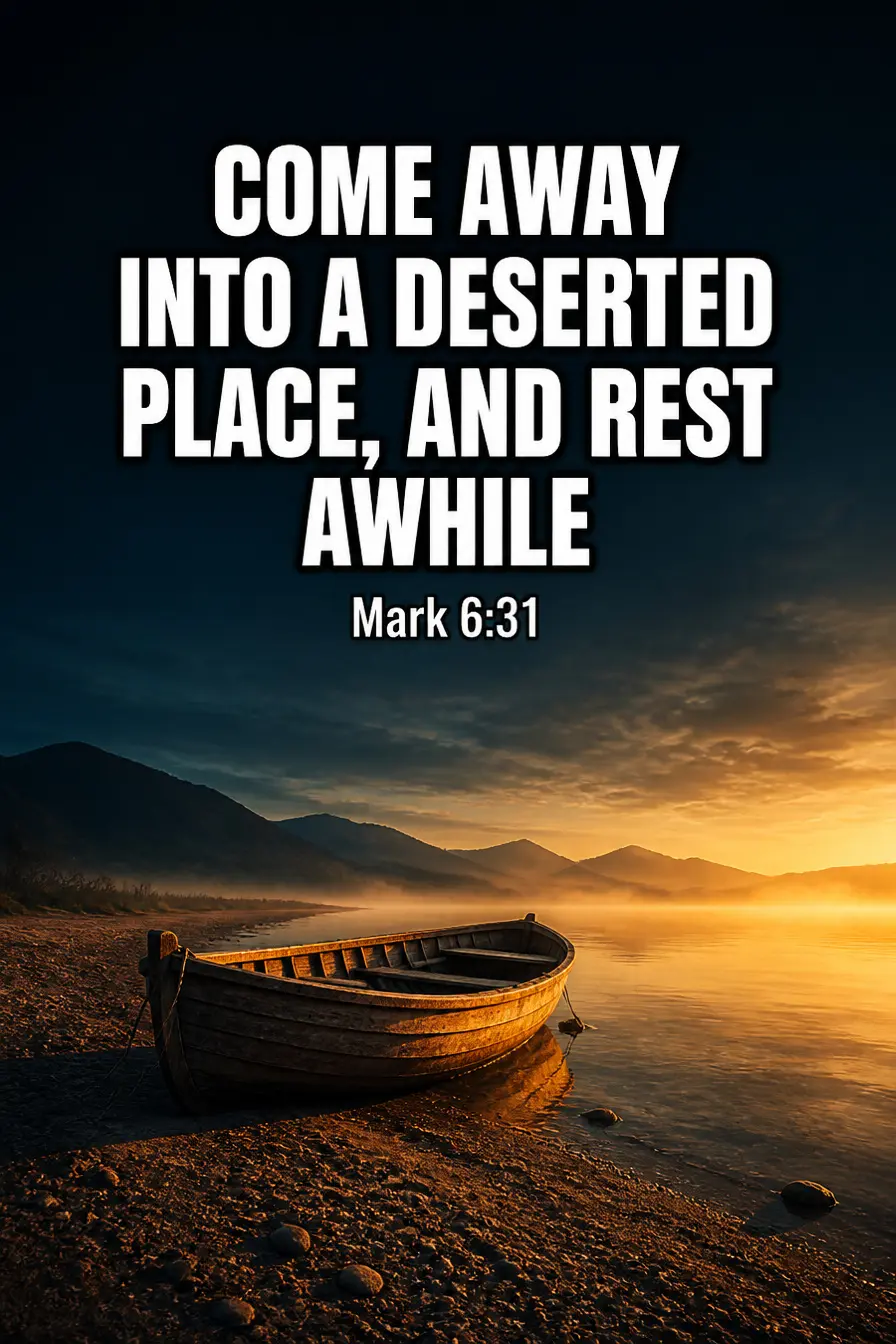
“He said to them, “Come away into a deserted place, and rest awhile.” For there were many coming and going, and they had no leisure so much as to eat.” — Mark 6:31 (WEBU)
The disciples have just come back from a successful mission. The crowds are enormous. Every metric is good. And Jesus pulls them out of it, because they had no leisure so much as to eat — the diagnostic is not that the work was failing but that meals were being skipped.
He does not tell them to push through a busy season. He removes them from it while it is still busy.
Rest Is Commanded in the Busiest Week of the Year
The Sabbath command is usually quoted in its general form. There is a version in Exodus 34 that closes the loophole everybody uses.
““Six days you shall work, but on the seventh day you shall rest: in plowing time and in harvest you shall rest.” — Exodus 34:21 (WEBU)
Plowing and harvest were the two weeks of the agricultural year when stopping cost the most. A day lost at harvest is crop left in the field. That is precisely where the command is aimed, because the exception people would have claimed is the busy season, and God names the busy season specifically.
Whatever your version of harvest is — the launch, the deadline, the quarter, the newborn — that is the week the verse is talking about.

The pattern was set before there was any work to recover from.
“On the seventh day God finished his work which he had done; and he rested on the seventh day from all his work which he had done.” — Genesis 2:2 (WEBU)
God was not tired. The rest is written into the shape of the week rather than earned at the end of it.

And when the rule itself started generating stress, Jesus put it back the right way round.
“He said to them, “The Sabbath was made for man, not man for the Sabbath.” — Mark 2:27 (WEBU)
Rest is a provision, not another performance to fail at. If your day off has become one more thing you are behind on, this sentence is aimed at you.

The Verse About Working Late
Solomon writes the sharpest line in the Bible about overwork, and he puts it in a song about building.
“A Song of Ascents. By Solomon. Unless the LORD builds the house, they who build it labor in vain. Unless the LORD watches over the city, the watchman guards it in vain.” — Psalm 127:1 (WEBU)

“It is vain for you to rise up early, to stay up late, eating the bread of toil, for he gives sleep to his loved ones.” — Psalm 127:2 (WEBU)
Eating the bread of toil. Meals taken standing up, at the desk, because there is no time. Solomon is not condemning hard work — the psalm is written by a man who built a temple. He is naming the specific behaviour of extending the day at both ends and calling the extension pointless.
The last clause is the reversal: sleep is described as something God gives, not as time you are stealing from productivity.

Two Verses About Burdens That Look Contradictory
Paul writes both of these within three sentences of each other, and holding them together is most of the practical wisdom on this subject.
“Bear one another’s burdens, and so fulfill the law of Christ.” — Galatians 6:2 (WEBU)
“For each man will bear his own burden.” — Galatians 6:5 (WEBU)
The Greek uses two different words. The first is a crushing weight — the kind Jethro saw. The second is closer to a soldier’s pack, the ordinary load that belongs to you. So: carry your own pack, and get help with what is crushing you. The failure mode in both directions is real. Some people hand over their pack; more people, in our experience of this subject, try to carry the crushing thing alone.

And the promise Moses himself was given, in the middle of the hardest stretch of his leadership:
“He said, “My presence will go with you, and I will give you rest.”” — Exodus 33:14 (WEBU)

The Bible Verses for Stress and Anxiety Everybody Quotes
These are the ones you will find on every list, and they are on every list because they work. Each is opened up properly elsewhere on this site rather than repeated here.
“Cast your burden on the LORD and he will sustain you. He will never allow the righteous to be moved.” — Psalm 55:22 (WEBU)
Cast your burden on the LORD, and he will sustain you. The verb is active — it is something you do with a weight, not something you feel.
“casting all your worries on him, because he cares for you.” — 1 Peter 5:7 (WEBU)
Casting all your anxiety on him because he cares for you. Peter’s word for casting is the one used for throwing a cloak over a donkey: a transfer, not a sharing.
“In nothing be anxious, but in everything, by prayer and petition with thanksgiving, let your requests be made known to God. And the peace of God, which surpasses all understanding, will guard your hearts and your thoughts in Christ Jesus.” — Philippians 4:6-7 (WEBU)
Do not be anxious about anything. Pray about everything — in every situation, with thanksgiving — and the peace of God, which transcends all understanding, will guard your hearts and minds in Christ Jesus. Bible Verses for Anxiety That Will Calm Your Mind takes this passage apart line by line.
““Come to me, all you who labor and are heavily burdened, and I will give you rest. Take my yoke upon you and learn from me, for I am gentle and humble in heart; and you will find rest for your souls. For my yoke is easy, and my burden is light.”” — Matthew 11:28-30 (WEBU)
“Come to me, all you who labor and are heavy laden, and I will give you rest.” A yoke is a working harness, so the offer is not the end of work but a different way of being attached to it.
“Don’t you be afraid, for I am with you. Don’t be dismayed, for I am your God. I will strengthen you. Yes, I will help you. Yes, I will uphold you with the right hand of my righteousness.” — Isaiah 41:10 (WEBU)
“Fear not, for I am with you; I will strengthen you and help you.” Fear Not: Bible Verses for Anxious Moments works through the fear verses in depth.
“Therefore don’t be anxious for tomorrow, for tomorrow will be anxious for itself. Each day’s own evil is sufficient.” — Matthew 6:34 (WEBU)
Do not worry about tomorrow, because tomorrow will worry about itself. Most of what we rehearse at 3am may never happen. Bible Verses About Worry covers the whole Sermon on the Mount passage this comes from.
“See the birds of the sky, that they don’t sow, neither do they reap, nor gather into barns. Your heavenly Father feeds them. Aren’t you of much more value than they?” — Matthew 6:26 (WEBU)
Look at the birds of the air. Your heavenly Father feeds them, and the argument is about value rather than effort — they do not work less anxiously than you, they simply are not carrying the outcome.
“Why are you anxious about clothing? Consider the lilies of the field, how they grow. They don’t toil, neither do they spin,” — Matthew 6:28 (WEBU)
Consider the lilies of the field. The next verse adds that Solomon in all his glory was not dressed like one of these, which is Jesus comparing wild flowers favourably to the richest man in Israel’s history.
“Trust in the LORD with all your heart, and don’t lean on your own understanding.” — Proverbs 3:5 (WEBU)
Trust in the LORD with all your heart and lean not on your own understanding. In a stressed week the second half is the harder one, because your own understanding is exactly what is generating the list.
“In all your ways acknowledge him, and he will make your paths straight.” — Proverbs 3:6 (WEBU)
“Peace I leave with you. My peace I give to you; not as the world gives, I give to you. Don’t let your heart be troubled, neither let it be fearful.” — John 14:27 (WEBU)
“Peace I leave with you, my peace I give to you, not as the world gives.” Do not let your hearts be troubled. The world’s version of peace depends on nothing going wrong; this one does not.
“Even though I walk through the valley of the shadow of death, I will fear no evil, for you are with me. Your rod and your staff, they comfort me.” — Psalm 23:4 (WEBU)
“Even though I walk through the valley of the shadow of death, I will fear no evil.” The rod and the staff are two shepherd’s tools, one for driving off what threatens the flock and one for steering it.
“Humble yourselves therefore under the mighty hand of God, that he may exalt you in due time,” — 1 Peter 5:6 (WEBU)
Humble yourselves under the mighty hand of God, that he may exalt you in due time. This is the sentence immediately before the one about casting your cares, and the order is deliberate: the handing over of weight is an act of humility before it is a relief.
“We are pressed on every side, yet not crushed; perplexed, yet not to despair;” — 2 Corinthians 4:8 (WEBU)
Pressed on every side, yet not crushed. Paul writes the most accurate description of sustained pressure in the New Testament as a series of near misses: afflicted in every way but not driven to despair, and 2 Corinthians never claims the pressure was absent.
“For I am persuaded that neither death, nor life, nor angels, nor principalities, nor things present, nor things to come, nor powers,” — Romans 8:38 (WEBU)
“nor height, nor depth, nor any other created thing will be able to separate us from God’s love which is in Christ Jesus our Lord.” — Romans 8:39 (WEBU)
Neither death nor life will be able to separate us from the love of God which is in Christ Jesus our Lord. The list is deliberately exhaustive, and a hard month is not on it.
“And let the peace of God rule in your hearts, to which also you were called in one body, and be thankful.” — Colossians 3:15 (WEBU)
Let the peace of God rule in your hearts. Paul adds in one body, which puts even this back into company rather than solitude. Calming Bible Verses for Anxiety opens this one up.
What to Actually Do This Week
The passages above point at practices rather than feelings, so here they are as practices. God’s peace tends to arrive through changed arrangements as often as through changed moods.
- Name the great matters. Jethro’s rule was that only great matters reach the top. Write down what genuinely needs you, and be honest about how short that list is.
- Find your seventy elders. Ask one person to take one recurring thing. Trusting God with your stress and asking a human being for help are the same move, not competing ones.
- Take the harvest-week rest anyway. The command names the busiest season on purpose. Whatever you were going to skip this week because things are heavy is probably the thing to keep.
- Stop extending the day at both ends. Rising early and staying up late is the exact behaviour Psalm 127 calls vain. Sleep is described there as a gift, so receive it.
- Cast the crushing thing. Cast your cares on him because he cares for you, and say the sentence out loud in prayer rather than carrying it silently through another week.
- Let somebody tell you the truth. Moses took correction from a relative with no official standing. Whoever in your life has been hinting that you are doing too much is possibly your Jethro.
Stress is not a sign that your faith has failed, and it does not measure how much God loves you. Chronic overload is a real thing with real effects on your body and mind, and if what you are carrying is affecting your health or your safety, put yourself in the hands of a professional. That is not a lack of trust in God and it has never been incompatible with faith.
For more scriptures on the mental side of this, read Calming Bible Verses for Anxiety or browse the full Anxiety Archive.
Questions About Bible Verses for Stress and Anxiety
What does the Bible say about stress and being overwhelmed?
More than most people expect, and much of it is practical. Exodus 18 has Jethro telling Moses his workload will wear him away and restructuring it. Numbers 11 has Moses saying the burden is too heavy and God’s answer being seventy more people. Mark 6:31 has Jesus removing his disciples from a busy season. Psalm 127:2 calls working from before dawn to after dark vain. The consistent answer is that the load gets shared or reduced.
Is stress the same as anxiety in the Bible?
They are treated differently. The anxiety passages — Philippians 4:6-7, Matthew 6:34, 1 Peter 5:7 — deal with fear about what might happen and answer it with prayer and trust. The stress passages deal with weight that is already there and answer it with delegation, rest and help. Knowing which one you are in changes which verse actually applies.
What is the best Bible verse for stress relief?
Exodus 18:18 is the one most people have never read and most need: “You will surely wear away… You are not able to perform it yourself alone.” For comfort rather than diagnosis, Matthew 11:28-30 and Psalm 55:22 are the classics, and Exodus 33:14 — “I will give you rest” — is the shortest.
Does the Bible say rest is a sin when there is work to do?
The opposite. Exodus 34:21 commands rest specifically during plowing and harvest, the two busiest weeks of the year, which is exactly when someone would argue they could not afford it. Genesis 2:2 puts rest in the structure of creation before anybody was tired, and Mark 2:27 says the Sabbath was made for man rather than the other way round.
How do you cast your cares on God practically?
Say the specific thing rather than a general request for peace. Peter’s image in 1 Peter 5:7 is a transfer of weight onto somebody else, so name what the weight is out loud. Then look at the Jethro question alongside it: which parts of this load are small matters that another person could carry? Prayer and delegation are both in Scripture’s answer, and neither one replaces the other.
Why did God let Moses get so overwhelmed?
Scripture does not say, and it does not defend the situation either. What it records is that when Moses said the burden was too heavy and asked to die (Numbers 11:14-15), God neither rebuked him nor told him to try harder. The response was to distribute the work across seventy people. The complaint was treated as accurate.