Four verses do most of the work in devotional writing for women. Proverbs 31. Psalm 46:5. The gentle and quiet spirit of 1 Peter 3. Martha in the kitchen.
They turn up on mugs, on phone backgrounds, on the front of journals. And three of the four say something noticeably different from what the caption usually says, which is easy to check, because the difference is not hidden in Hebrew or Greek. It is in the plain English of the verse, one line up or one line down from where the quotation stops.
What follows is a reading of those four, and of the women the Bible actually describes, taken from the WEBU text with nothing added. If you have had any of these quoted at you, you may find the originals easier to live with than the versions you were given.

Discover your unique purpose. You are God's masterpiece.Jeremiah 29:11 · 12 min
That was just the opening. Open the app and search #007 to hear the full 12-minute story — free.
Keep listening free in the app Free on iOS & Android — no sample needed

Psalm 46:5 Is About a City
Start with the one that appears on more women’s devotional graphics than any other verse in the Old Testament.
“God is within her. She shall not be moved. God will help her at dawn.” — Psalm 46:5 (WEBU)
It is a beautiful line and it is worth having. But read the verse immediately before it:
“There is a river, the streams of which make the city of God glad, the holy place of the tents of the Most High.” — Psalm 46:4 (WEBU)
The her in verse 5 is the city. Psalm 46 is a war psalm about Jerusalem under siege, and the whole poem is built on the contrast between a shaking earth and a city that does not move because God is inside its walls. The pronoun is grammatical, not personal.
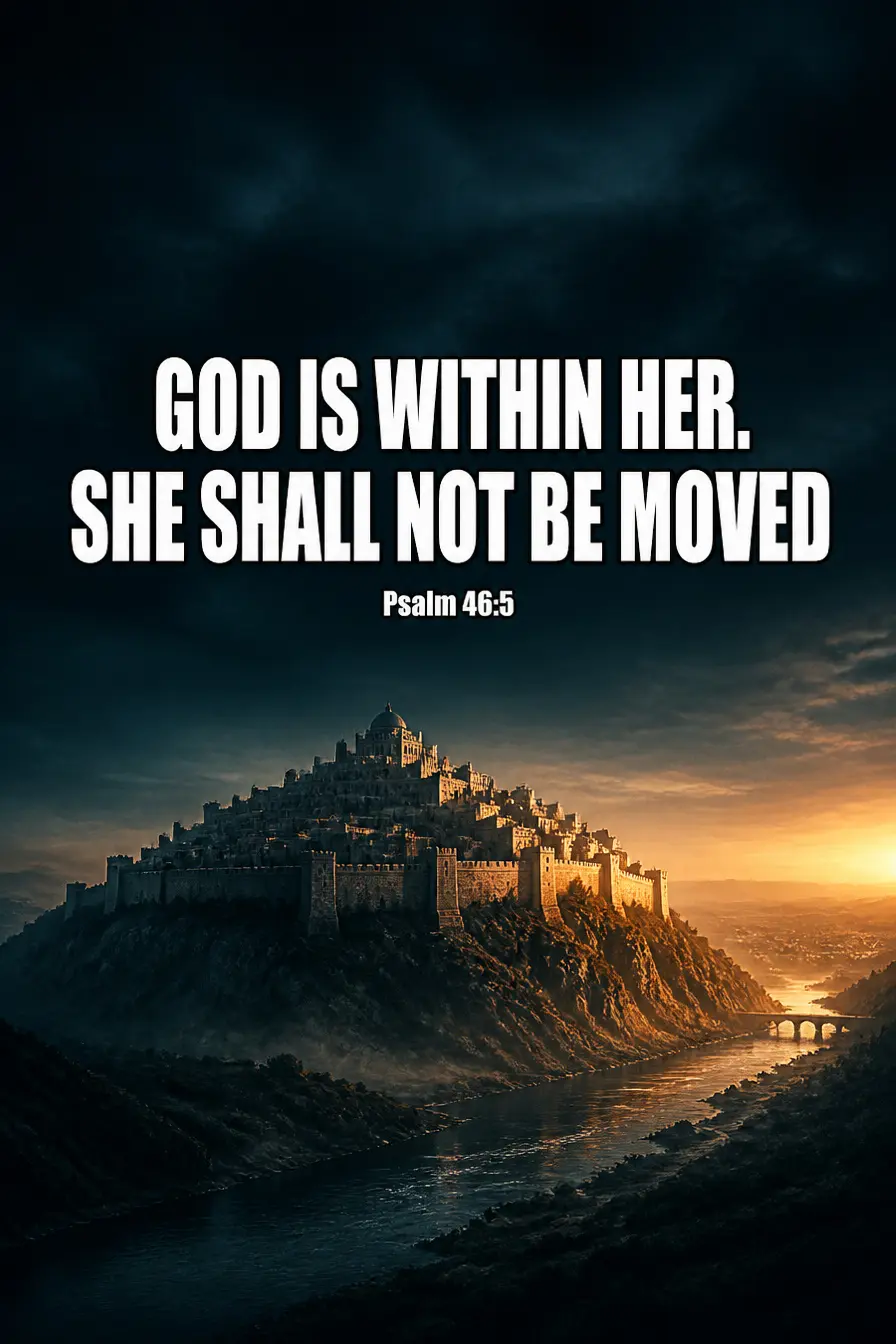
Does that ruin it? No — and this is worth saying carefully, because the honest reading is better than the caption, not worse. The psalm is not describing a woman’s inner resilience. It is describing what happens to a place when God lives in it: the siege comes, the ground shakes, and the walls hold, not because the stones are strong but because of who is inside them. Applied to you, that is a bigger promise than the one on the mug, and it does not depend on you being the sort of person who does not wobble.
The psalm’s own summary sits at the top, underneath a heading that WEBU prints as part of the text — this was a piece written for public worship, not private comfort:
“For the Chief Musician. By the sons of Korah. According to Alamoth. God is our refuge and strength, a very present help in trouble. Therefore we won’t be afraid, though the earth changes, though the mountains are shaken into the heart of the seas;” — Psalm 46:1-2 (WEBU)
Proverbs 31 Is a Poem About a Woman Who Runs a Business
The second one gets quoted at you more often than it gets read. Proverbs 31 is treated as a standard for domestic performance, and the passage is largely a commercial CV.
Here is what the woman in the poem does. She acquires land, with her own money:
“She considers a field, and buys it. With the fruit of her hands, she plants a vineyard.” — Proverbs 31:16 (WEBU)
Two verbs, and both of them are hers. She surveys, then she buys — and notice that nobody hands her the field. The vineyard is planted from her own earnings — the fruit of her hands is the profit of her work, and she puts it back into a capital asset rather than spending it.

She is physically strong, and the poem says so directly:
“She arms her waist with strength, and makes her arms strong.” — Proverbs 31:17 (WEBU)
Arms her waist is military language — the same picture as a soldier belting on for work. Nothing in that line is decorative.

She reads her own numbers:
“She perceives that her merchandise is profitable. Her lamp doesn’t go out by night.” — Proverbs 31:18 (WEBU)
Merchandise and profitable are trading words. She is not being praised for keeping a tidy house; she is being praised for knowing her margins. The lamp burning late is a detail about a working business, not a devotional metaphor.

And she sells into a wholesale market:
“She makes linen garments and sells them, and delivers sashes to the merchant.” — Proverbs 31:24 (WEBU)
Not selling one thing to a neighbour. Manufacturing a product and delivering to a merchant, which is a supply chain.

She is also, explicitly, not silent:
“She opens her mouth with wisdom. Kind instruction is on her tongue.” — Proverbs 31:26 (WEBU)
Opens her mouth with wisdom is the standard Old Testament phrase for teaching. Whatever “quiet” is supposed to mean elsewhere, this poem puts instruction in her mouth as a thing to be praised for.

Then the famous line, which reads differently once the previous twenty verses are in view:
“Strength and dignity are her clothing. She laughs at the time to come.” — Proverbs 31:25 (WEBU)
She laughs at the future because she has a field, a vineyard, a trade, a market and a household that is provisioned. The confidence in that line is not a mood she worked up. It is what a woman who has built something can afford to feel about next year, and if you are already carrying that kind of load, the verse is describing you rather than scolding you.

And the poem ends by dismissing the category most of its modern uses are about:
“Charm is deceitful, and beauty is vain; but a woman who fears the LORD, she shall be praised.” — Proverbs 31:30 (WEBU)
The chapter’s own closing verdict rules out appearance as the measure. It is a strange passage to use for a beauty standard when it says that in its last line.

Two more things about this chapter are worth knowing. It is an acrostic — twenty-two verses, one for each letter of the Hebrew alphabet, which is a form used for completeness rather than for a checklist. And it closes with a demand rather than a description:
“Give her of the fruit of her hands! Let her works praise her in the gates!” — Proverbs 31:31 (WEBU)
In the gates meant the public square where business and legal matters were settled. The poem’s last instruction is that her work should be recognised in public.
“A Gentle and Quiet Spirit” and the Women Who Were Neither
The third of the four:
“Let your beauty come not from the outward adorning of braiding your hair, and of wearing gold ornaments or of putting on fine clothing, but from the hidden person of the heart, in the incorruptible adornment of a gentle and quiet spirit, which is very precious in God’s sight.” — 1 Peter 3:3-4 (WEBU)
Read what the sentence is contrasting. On one side: hair, gold, clothing. On the other: the hidden person of the heart. Peter is comparing an exterior that can be bought with an interior that cannot, and the word incorruptible is the hinge — one perishes, one does not. It is a sentence about durability, not about volume.
That matters for how we read the rest, because the women Scripture actually praises are not quiet in the everyday sense of the word.
Deborah held national office:
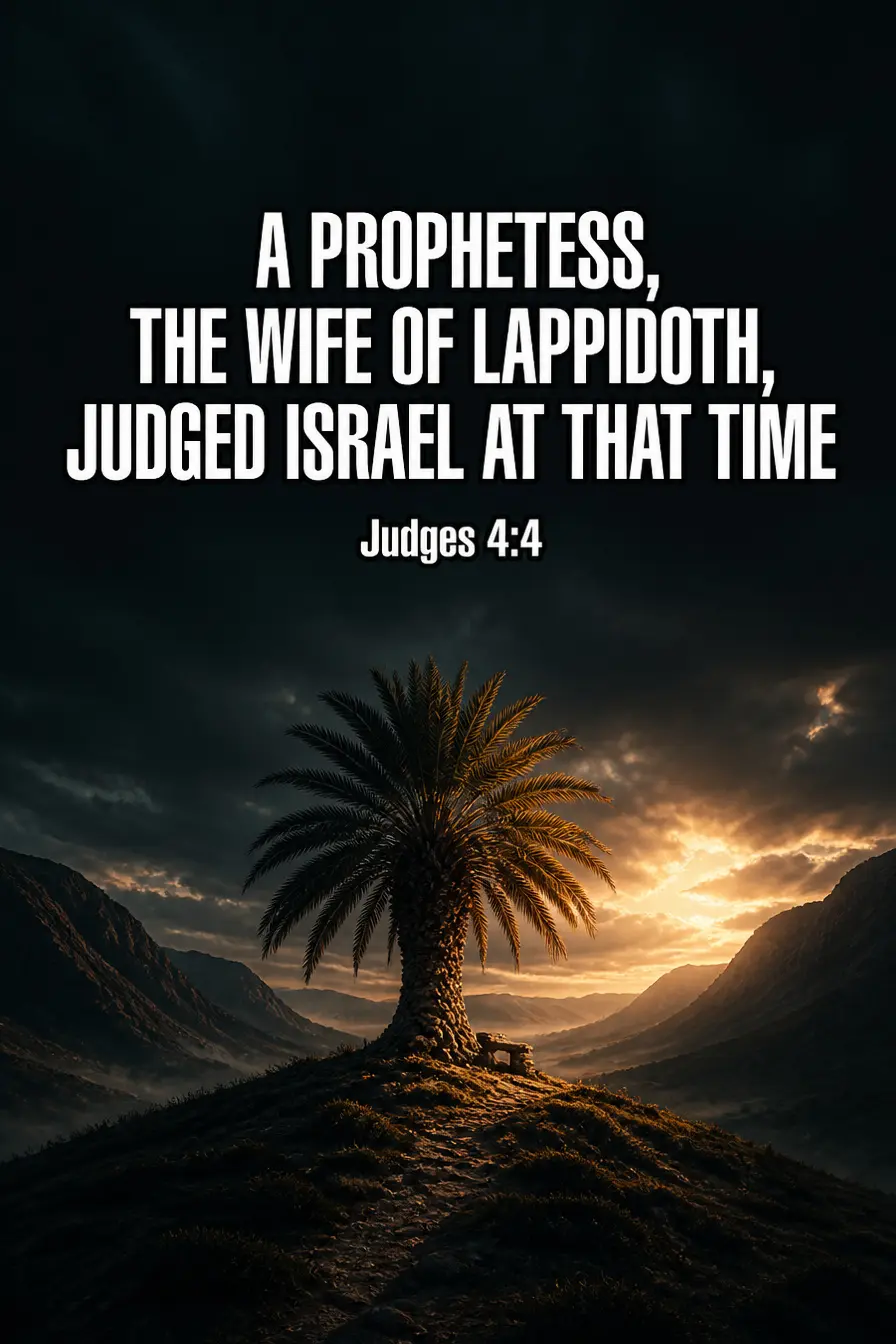
“Now Deborah, a prophetess, the wife of Lappidoth, judged Israel at that time. She lived under Deborah’s palm tree between Ramah and Bethel in the hill country of Ephraim; and the children of Israel came up to her for judgment.” — Judges 4:4-5 (WEBU)
The men of Israel came up to her for judgment. She is a judge and a prophetess in the same sentence, and the tree is named after her.
Hannah prayed so hard the priest assumed she was drunk:
“Now Hannah spoke in her heart. Only her lips moved, but her voice was not heard. Therefore Eli thought she was drunk. Eli said to her, “How long will you be drunk? Get rid of your wine!” Hannah answered, “No, my lord, I am a woman of a sorrowful spirit. I have not been drinking wine or strong drink, but I poured out my soul before the LORD.” — 1 Samuel 1:13-15 (WEBU)
She is silent — her voice was not heard — and it still looks like drunkenness from the outside. Then she corrects the priest to his face. The most intense prayer recorded from a woman in the Old Testament was misread by a professional, and she said so.

Abigail rode out to intercept an armed column, overruled her own husband’s decision, and stopped a massacre. David’s verdict on her:
“David said to Abigail, “Blessed is the LORD, the God of Israel, who sent you today to meet me! Blessed is your discretion, and blessed are you, who have kept me today from blood guiltiness, and from avenging myself with my own hand.” — 1 Samuel 25:32-33 (WEBU)
He blesses her discretion — her judgment — and credits her with stopping him. She acted without permission and Scripture calls it wisdom.

And one woman argued with Jesus and was commended for it:
“But she answered him, “Yes, Lord. Yet even the dogs under the table eat the children’s crumbs.” He said to her, “For this saying, go your way. The demon has gone out of your daughter.”” — Mark 7:28-29 (WEBU)
For this saying. Not for her humility, not for her tears — for what she said. She took his own image and turned it, and he granted the request on the strength of the argument.

Martha Was Not Rebuked for Working
The fourth verse, and the one most often used to make women feel guilty about being busy.
“Jesus answered her, “Martha, Martha, you are anxious and troubled about many things, but one thing is needed. Mary has chosen the good part, which will not be taken away from her.”” — Luke 10:41-42 (WEBU)
Read the two verses before it, because they contain the actual complaint:
“As they went on their way, he entered into a certain village, and a certain woman named Martha received him into her house. She had a sister called Mary, who also sat at Jesus’ feet and heard his word. But Martha was distracted with much serving, and she came up to him, and said, “Lord, don’t you care that my sister left me to serve alone? Ask her therefore to help me.”” — Luke 10:38-40 (WEBU)
Three details change the scene. It is Martha’s house — she is the host, and hosting was real work with real obligations. Jesus does not tell her to stop serving; the word he uses is distracted, and what he names is being anxious and troubled about many things. And Martha’s actual request was for him to take her side against her sister, which is what he declines to do.
The contrast in the passage is not work against prayer. It is a woman being pulled apart by many things against a woman who has settled on one. Martha’s serving is never called wrong. Her anxiety is — and if you have ever read this passage as a rebuke for being busy, that is the caption talking, not the text.

The Women Who Funded It, and the Woman Who Taught the Teacher
Two more details rarely make the devotional lists, and we should put them back, because both are plain in the text.
Jesus’ travelling ministry was paid for by women:
“Soon afterwards, he went about through cities and villages, preaching and bringing the good news of God’s Kingdom. With him were the twelve, and certain women who had been healed of evil spirits and infirmities: Mary who was called Magdalene, from whom seven demons had gone out; and Joanna, the wife of Chuzas, Herod’s steward; Susanna; and many others who served them from their possessions.” — Luke 8:1-3 (WEBU)
From their possessions. Luke names three of them and says there were many more. One is married to a senior official in Herod’s household, which means she had money of her own and spent it on this.

And when a gifted, educated preacher had gaps in his theology, a woman fixed them:
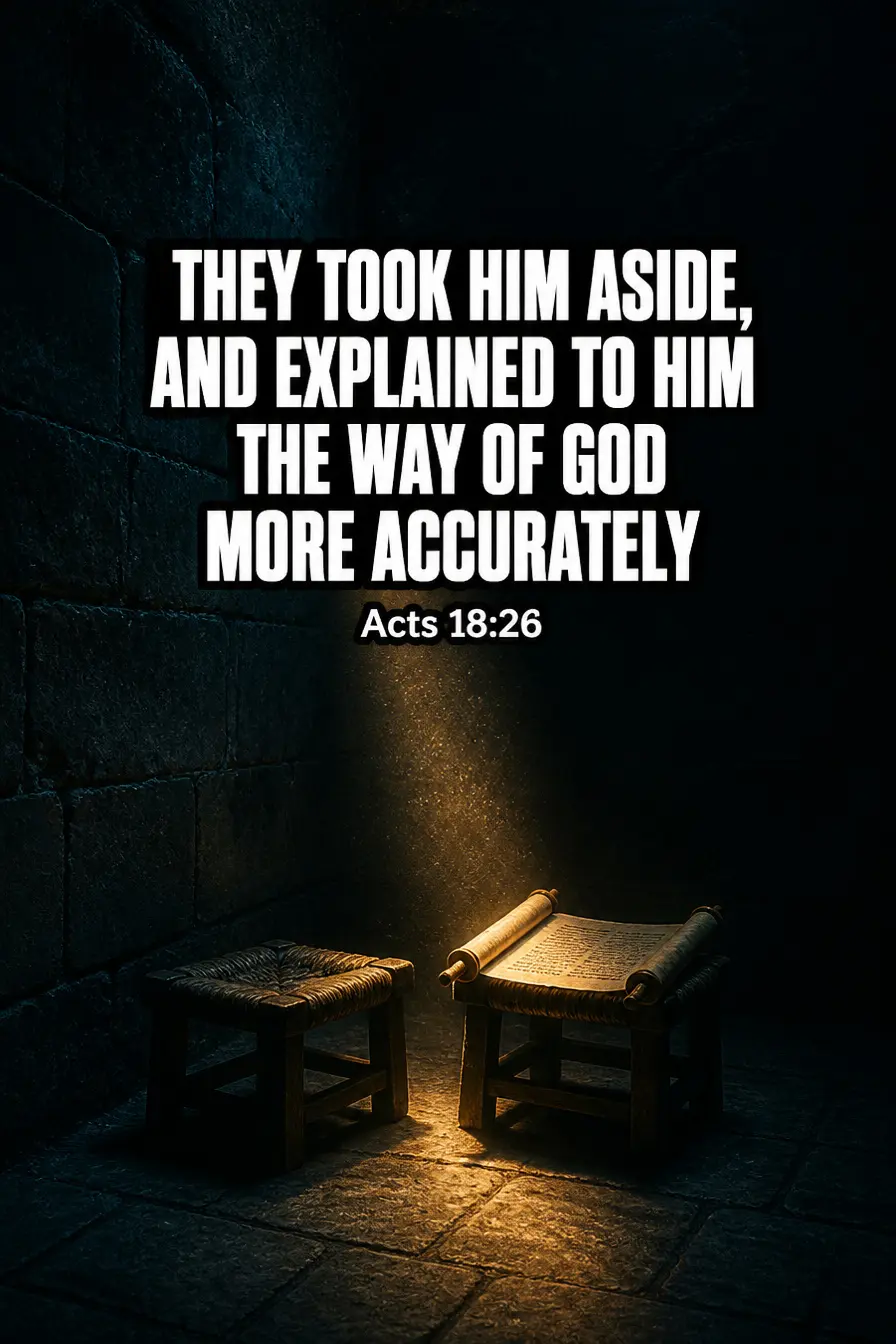
“He began to speak boldly in the synagogue. But when Priscilla and Aquila heard him, they took him aside, and explained to him the way of God more accurately.” — Acts 18:26 (WEBU)
The preacher is Apollos, described a few verses earlier as eloquent and mighty in the Scriptures. Priscilla is named before her husband here, which in the writing conventions of the time is a signal, and the verb is explained.
Lydia, meanwhile, is introduced by her trade before anything else:
“A certain woman named Lydia, a seller of purple, of the city of Thyatira, one who worshiped God, heard us. The Lord opened her heart to listen to the things which were spoken by Paul.” — Acts 16:14 (WEBU)
Purple dye was the luxury end of the ancient textile market. Luke gives her occupation, her home city and her faith, in that order, and the first church in Europe met in her house.
The Verses You Already Know, and Which Moment Each One Is For
These are the ones that turn up on every list. All of them are worth having by heart, and each is doing a specific job.
When you are worn down by being needed — Psalm 139:14, for the fact that the value was set before anyone started asking things of you:
“I will give thanks to you, for I am fearfully and wonderfully made. Your works are wonderful. My soul knows that very well.” — Psalm 139:14 (WEBU)

When you have to decide something frightening — Esther 4:16, which is not a triumphant verse but a resolved one:
““Go, gather together all the Jews who are present in Susa, and fast for me, and neither eat nor drink three days, night or day. I and my maidens will also fast the same way. Then I will go in to the king, which is against the law; and if I perish, I perish.”” — Esther 4:16 (WEBU)
When you have chosen a hard loyalty — Ruth 1:16, spoken by a widow to a widow with no security on either side:
“Ruth said, “Don’t urge me to leave you, and to return from following you, for where you go, I will go; and where you stay, I will stay. Your people will be my people, and your God my God.” — Ruth 1:16 (WEBU)
When you need comfort in the plainest terms — Isaiah 66:13, where God picks a mother as the comparison:
“As one whom his mother comforts, so I will comfort you. You will be comforted in Jerusalem.”” — Isaiah 66:13 (WEBU)
When your own status feels uncertain — Galatians 3:28, which settles the question of standing, and is worked through at length in our study on what Scripture says your identity in Christ is:
“There is neither Jew nor Greek, there is neither slave nor free man, there is neither male nor female; for you are all one in Christ Jesus.” — Galatians 3:28 (WEBU)
And Mary’s song, which begins with her own smallness and ends with generations:
“Mary said, “My soul magnifies the Lord. My spirit has rejoiced in God my Savior, for he has looked at the humble state of his servant. For behold, from now on, all generations will call me blessed.” — Luke 1:46-48 (WEBU)
What These Passages Are For on an Ordinary Bad Day
Precision is not the point on its own. The reason to read these accurately is that the accurate version is more use to you when something is genuinely hard.
A struggle does not usually announce itself. It arrives as a week where the diary is full, someone is ill, the money is tight and there is no obvious moment to draw closer to God. Devotions for women get written as though the reader has a quiet hour; most days there is not one. So here is what each of these passages gives you in everyday life, in the ordinary vocabulary rather than the exegetical one.
- Grace, when you have not earned anything today. Proverbs 31:30 removes appearance and charm from the scoring. Galatians 3:28 removes rank. Neither verse asks how the week went.
- Encouragement that survives being checked. The encouraging word that falls apart when you look it up is worth less than the plain one that holds. Psalm 46 holds: the earth changes, the mountains shake, and the refuge is still there.
- Trust for the part you cannot see. Esther’s decision in 4:16 is made without any promise of the outcome. She fasts, she goes in, and the verse ends “if I perish, I perish.” That is trust described honestly, not confidence dressed up.
- Joy that is not the same as cheerfulness. Mary’s song in Luke 1:46-48 begins with her own small standing and ends with generations. Nothing in her circumstances at that moment was easy.
- Healing, and the fact that it is named plainly. Luke 8:2 says these women had been healed of evil spirits and infirmities before they funded anything. God’s word does not hide what they were carrying beforehand.
- A reminder for tough times that is not advice. 1 Samuel 1:15 gives you permission to pray badly. Hannah’s prayer looked like drunkenness from outside, and it was answered.
That is the practical shape of a daily devotional for women that stays biblical: fewer verses, read properly, each one attached to a moment you will actually have.
How to Use These in a Daily Quiet Time
A short, honest routine will serve you better than an ambitious one that collapses in week two. Our study on choosing a devotional that lasts works through the habit itself; here is what to do with these particular passages.
- Read the verse with the one before and the one after. That single change is what turns Psalm 46:5 and Luke 10:42 into what they actually say. It costs about eight seconds.
- Pick one passage for a whole week rather than a new verse each morning. Proverbs 31 rewards this more than most, because the picture only assembles across the whole poem.
- Keep three references for bad days, not thirty. Psalm 46:1 for the day something shakes, 1 Samuel 1:15 for the prayer that comes out as a mess, and Luke 10:42 for the day you are pulled in nine directions. If anxiety is the recurring one, our calming verses for anxiety go further into it.
- Write down what the verse says God did, not what you should do about it. Almost every passage above is a record of action already taken.
Questions People Ask
What are the best daily devotional Bible verses for a Christian woman?
Psalm 139:14, Proverbs 31:25, Psalm 46:1, Ruth 1:16, Isaiah 66:13 and Luke 10:42 cover most of what a hard day needs — worth, grace, refuge, loyalty, comfort and focus. They will start your day better than a longer list you skim — Read each one with the verse either side of it, because several of the best-known ones say something more specific in context than the version on the graphic.
Is Psalm 46:5 written about women?
The her in Psalm 46:5 is the city of God, named in verse 4 as “the holy place of the tents of the Most High.” Psalm 46 is about Jerusalem standing while the earth shakes. The verse still applies, and it applies more strongly this way: the point is that a place holds because God is inside it, not because it is inherently unshakable.
What does “a gentle and quiet spirit” mean in 1 Peter 3:4?
The sentence contrasts hair, gold and clothing with “the hidden person of the heart,” and the operative word is incorruptible — one kind of adornment perishes and the other does not. It is a statement about what lasts. It sits alongside Proverbs 31:26, which praises a woman who “opens her mouth with wisdom,” and Judges 4:4, where Deborah judges the nation.
Was Martha wrong to be busy?
Jesus never tells Martha to stop serving. Luke 10:40 says she was “distracted with much serving,” and Jesus names her being “anxious and troubled about many things.” Her request was that he order her sister to help her, which is what he declines. The contrast in the passage is between many things and one thing, not between work and prayer.
Where does the Bible show women teaching or leading?
Deborah judged Israel and gave rulings to the nation (Judges 4:4-5). Priscilla took Apollos aside and “explained to him the way of God more accurately” (Acts 18:26). Women funded the travelling ministry “from their possessions” (Luke 8:3). Lydia, a dealer in purple, hosted the first church in Europe (Acts 16:14-15). All of it is in the plain text.
More studies like this one sit in the faith collection.
How do you keep a daily devotional going through a busy season?
Shorten it rather than skipping it. One passage for a whole week, read with the verse either side, is a faith journey that survives a bad month; a thirty-day plan usually does not. Our study on choosing a devotional that lasts goes through what makes the habit hold. The aim is to seek God in the time you actually have, not the time you wish you had.
Read the Line Before and the Line After
There is no need to defend these passages or to soften them. The women in them buy fields, run trades, hold court, argue theology, fund ministries and correct priests, and Scripture reports it without embarrassment.
What we tend to lose in the captions is not accuracy so much as scale. A woman who does not move because God lives inside her walls, a poem that asks for a woman’s work to be honoured in the public square, a Saviour who grants a request because of what a woman said — those are larger than the lines they got trimmed into.
Reading one verse further in either direction is usually all it takes to get them back, and you can do it in the time it takes to finish a cup of tea.