Identity verses usually arrive as a pile of adjectives. Chosen. Redeemed. Righteous. Accepted. Sealed. The adjectives are true and the lists are not wrong, but they quietly drop the part of the sentence that carries the weight, and that part is not an adjective at all.
It is a preposition. In him.
Read Ephesians 1 slowly and the pattern is impossible to miss. Between verse 3 and verse 14, in the WEBU text, the words in Christ, in him, in whom and in the Beloved appear eleven times in twelve verses. Not once does Paul say you are righteous the way a person is tall. He says you are righteous somewhere. Identity in Scripture is positional before it is descriptive, which is why the question “who am I?” gets answered in the Bible by pointing away from you.
That single grammatical fact changes what the verses are for. If your identity is a description of your qualities, then a bad week is evidence against it. If your identity is an address, a bad week does not move you an inch.

Discover your unique purpose. You are God's masterpiece.Jeremiah 29:11 · 12 min
That was just the opening. Open the app and search #007 to hear the full 12-minute story — free.
Keep listening free in the app Free on iOS & Android — no sample needed

Eleven Times in Twelve Verses: Reading Ephesians 1 the Way It Was Written
In Greek, Ephesians 1:3-14 is famously one unbroken sentence. English translations, WEBU included, break it into readable pieces, and something is lost in the break: the passage was built to be read without stopping, so the repetitions land like hammer blows. Read it as one run and count the phrase.
“Blessed be the God and Father of our Lord Jesus Christ, who has blessed us with every spiritual blessing in the heavenly places in Christ,” — Ephesians 1:3 (WEBU)
Start with what this does not say. It does not say God will bless you with every spiritual blessing, and it does not say the blessings are stored somewhere waiting for you to qualify. It says he has blessed — completed action — and it names the location twice in one line: in the heavenly places, in Christ. The blessings are not in your account. They are in a person, and you are in the person.

Then comes the choosing, which is the one line of this passage handled at length in our companion study on who you are in Christ and who says so:
“even as he chose us in him before the foundation of the world, that we would be holy and without defect before him in love, having predestined us for adoption as children through Jesus Christ to himself, according to the good pleasure of his desire,” — Ephesians 1:4-5 (WEBU)
Note the date. Before the foundation of the world. Whatever went into that decision, none of it was your track record, because there was no world yet for you to have one in.
“to the praise of the glory of his grace, by which he freely gave us favor in the Beloved.” — Ephesians 1:6 (WEBU)
In the Beloved. Not “because you became lovely.” The favour is real and it is located, and the location is somebody else who was already loved.
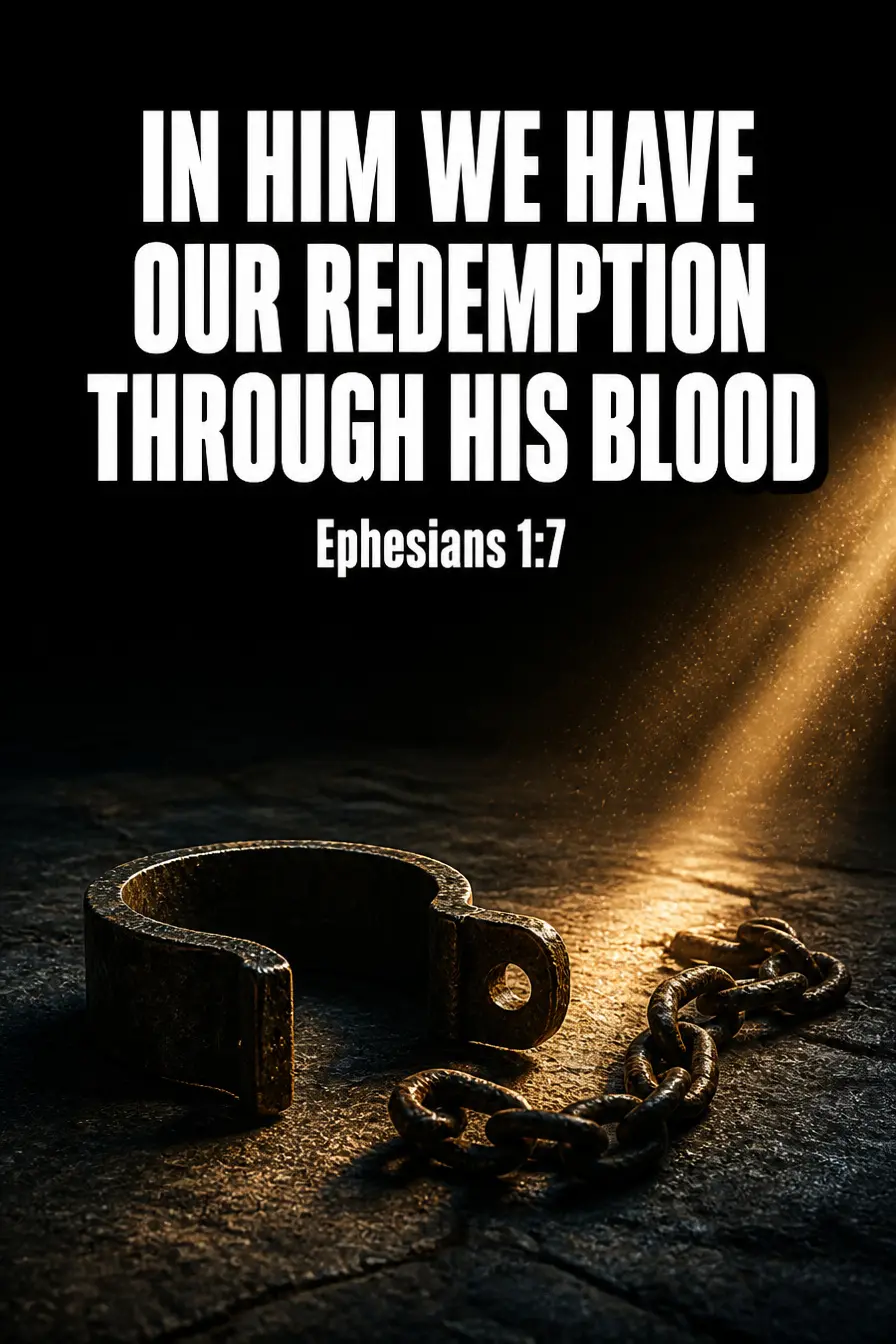
“In him we have our redemption through his blood, the forgiveness of our trespasses, according to the riches of his grace” — Ephesians 1:7 (WEBU)
Redemption is a purchase word. In the ancient world it meant money changing hands to get a person out of a debt or a slavery they could not get out of themselves. The measure Paul gives is not the size of the debt but the riches of the grace, which is why nobody in Scripture is ever told their sin was too expensive.
“We were also assigned an inheritance in him, having been foreordained according to the purpose of him who does all things after the counsel of his will,” — Ephesians 1:11 (WEBU)
An inheritance is the one form of wealth nobody earns. It arrives because of a relationship, and it arrives on somebody else’s timetable. Paul uses the word deliberately, because it is the only category that makes sense of a gift this size given to people this unqualified.

And the sentence closes with the seal:
“In him you also, having heard the word of the truth, the Good News of your salvation—in whom, having also believed, you were sealed with the promised Holy Spirit, who is a pledge of our inheritance, to the redemption of God’s own possession, to the praise of his glory.” — Ephesians 1:13-14 (WEBU)
A seal in the first century did three jobs at once. It marked ownership, so everyone knew whose the thing was. It guaranteed authenticity, so nobody could pass off a forgery. And it secured the contents, because breaking it left visible damage. Paul says the seal on you is not wax. It is the Holy Spirit, given as a pledge — a down payment, the first instalment of something the payer fully intends to complete.

Blessed, chosen, adopted, favoured, redeemed, forgiven, given an inheritance, sealed. Eight things, and the same two words under every one of them.
Union With Christ: Why “In Him” Is the Load-Bearing Phrase
Theologians have a name for what Ephesians 1 is doing, and it is worth knowing because it explains why these verses hold when feelings do not. The name is union with Christ. It means that what is true of Jesus before God is now reckoned true of the people joined to him, not because they resemble him yet, but because they are in him.
Paul states it as flatly as it can be stated:
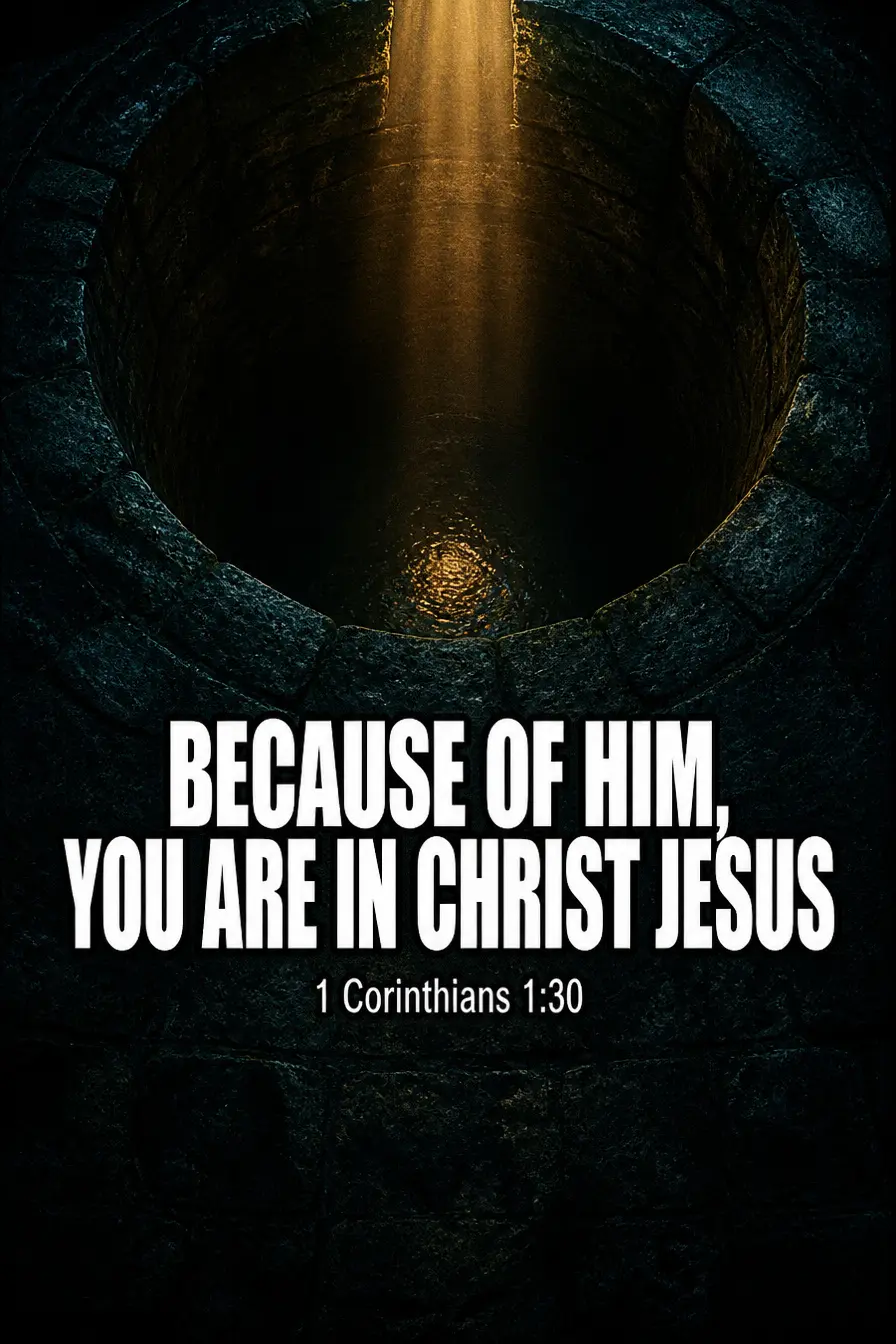
“Because of him, you are in Christ Jesus, who was made to us wisdom from God, and righteousness and sanctification, and redemption,” — 1 Corinthians 1:30 (WEBU)
Four nouns, and every one of them is a thing Christ was made to us. Not a thing you generate and offer up. Wisdom, righteousness, sanctification, redemption — the whole set arrives in one person, and you receive them the way you receive the climate of a country by living in it.
The same grammar runs through the letters. Justification is in Christ:
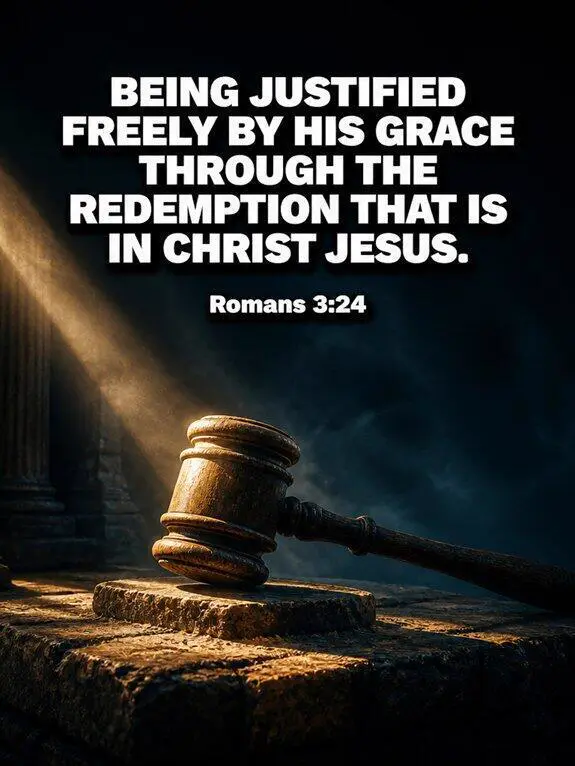
“being justified freely by his grace through the redemption that is in Christ Jesus,” — Romans 3:24 (WEBU)
And the result of it is not a mood. It is a settled state between two parties who were previously at odds:
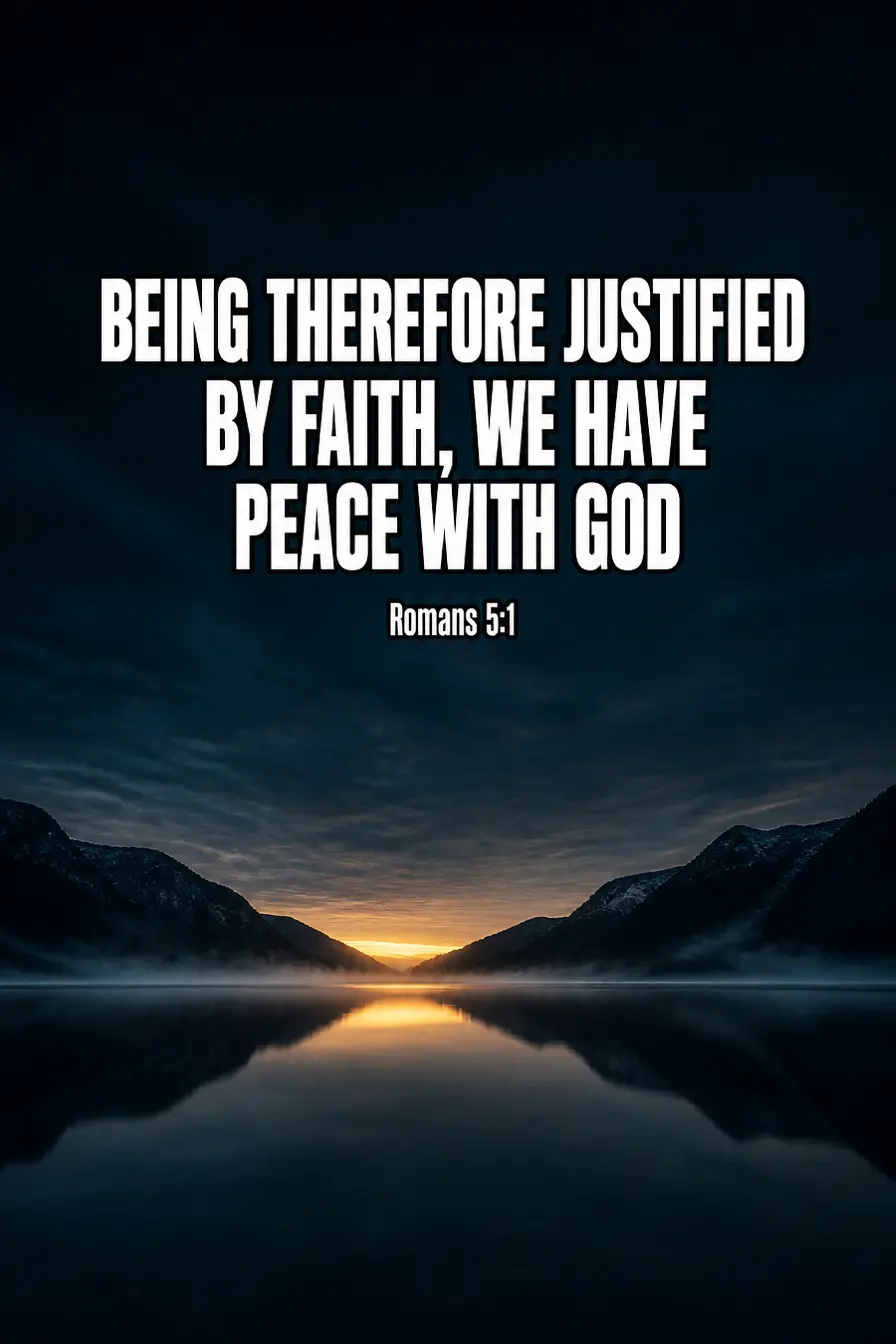
“Being therefore justified by faith, we have peace with God through our Lord Jesus Christ;” — Romans 5:1 (WEBU)
Peace here is not calmness. It is the end of hostilities. The word describes what happens when a war stops, and Paul puts it in the present tense: we have peace with God. Not we are working toward it.
Colossians pushes the point as far as it will go:
“For in him all the fullness of the Deity dwells bodily, and in him you are made full, who is the head of all principality and power.” — Colossians 2:9-10 (WEBU)
Two sentences, same preposition, and the second one only makes sense because of the first. Everything of God is in Christ; you are in Christ; so nothing is missing. That is a strange thing to read on a day when a great deal feels missing, which is exactly why it was written down rather than left to be felt.

Two more that belong to this family are handled in depth elsewhere on this site, so they are quoted here without repeating the study. Paul’s own summary of the union:
“I have been crucified with Christ, and it is no longer I who live, but Christ lives in me. That life which I now live in the flesh, I live by faith in the Son of God, who loved me and gave himself up for me.” — Galatians 2:20 (WEBU)
And where the whole thing is stored:
“For you died, and your life is hidden with Christ in God.” — Colossians 3:3 (WEBU)
Hidden is a security word, not a sad one. Something hidden with Christ in God is behind two doors, and neither of them is yours to leave open.
Paul Had the Best Identity Papers in the Room
Here is where the Bible does something the memes never do. It puts a genuinely impressive identity résumé on the page — not a straw man, a real one — and then tells you what its owner did with it.
“though I myself might have confidence even in the flesh. If any other man thinks that he has confidence in the flesh, I yet more: circumcised the eighth day, of the stock of Israel, of the tribe of Benjamin, a Hebrew of Hebrews; concerning the law, a Pharisee; concerning zeal, persecuting the assembly; concerning the righteousness which is in the law, found blameless.” — Philippians 3:4-6 (WEBU)
Read that as what it was: a complete identity file, and an excellent one. Ritual credentials, ethnic pedigree, tribal ancestry, linguistic and cultural purity, professional standing, demonstrated commitment, and a clean record. Every category a first-century person could be measured in, and Paul tops the table in all seven. Nobody in the room had better papers.

Then the accounting:
“However, I consider those things that were gain to me as a loss for Christ. Yes most certainly, and I count all things to be a loss for the excellency of the knowledge of Christ Jesus, my Lord, for whom I suffered the loss of all things, and count them nothing but refuse, that I may gain Christ” — Philippians 3:7-8 (WEBU)
Refuse is the polite English for a blunt Greek word — kitchen scraps, the stuff scraped off the plate and thrown to the dogs. Paul is not saying his heritage was worthless in itself. He is saying that as a foundation for standing before God it belongs in the bin, and he moved it there on purpose.

And the reason, in the next breath:
“and be found in him, not having a righteousness of my own, that which is of the law, but that which is through faith in Christ, the righteousness which is from God by faith,” — Philippians 3:9 (WEBU)
There is the preposition again. Found in him. Paul threw away a righteousness he actually had, and it was a good one by every visible measure, because the one that comes with the address is of a different order entirely.

This passage is the answer to the mirror. When you look at yourself and see a file of failures, the Bible does not tell you to look harder for the good bits. It shows you a man with a spotless file who binned the whole thing, and it tells you why: because the file was never what he was going to be judged on.
Far Off, Made Near, and Then Given a Citizenship
The geography language keeps going, and it moves in a direction — from outside to inside, then from visitor to citizen.
“But now in Christ Jesus you who once were far off are made near in the blood of Christ.” — Ephesians 2:13 (WEBU)
Once were. Past tense, and made near is passive: the distance was closed from the other end. Nobody in this sentence walked toward God and arrived.

Six verses later, the status is formalised:
“So then you are no longer strangers and foreigners, but you are fellow citizens with the saints and of the household of God,” — Ephesians 2:19 (WEBU)
Both nouns Paul discards had precise legal meaning. A stranger had no standing at all. A foreigner was a resident alien — allowed to live there, taxed, and permanently without the rights of the place. Paul says neither word applies to you now. The word that does is citizen, and he adds a second one that outranks it: household. Citizens have rights; family has a place at the table.

And the passport is issued somewhere you have not been yet:
“For our citizenship is in heaven, from where we also wait for a Savior, the Lord Jesus Christ,” — Philippians 3:20 (WEBU)
That is why the pull you feel toward home is not a defect. Paul writes it as the normal condition of a citizen living abroad.

A Child of God, and the Word 1 John Uses for It
Paul argues; John exclaims. When the same truth reaches the elderly writer of 1 John, the sentence breaks into astonishment:
“See how great a love the Father has given to us, that we should be called children of God! For this cause the world doesn’t know us, because it didn’t know him.” — 1 John 3:1 (WEBU)
Two things sit in that verse. First, the love is described as given — a thing handed over, not a feeling directed at you from a distance. Second, John explains why being a child of God so often feels invisible: the world does not recognise the family because it did not recognise the Father. Your identity failing to show up on other people’s radar is not evidence that it is not there.

The mechanism is spelled out twice more. In John’s Gospel it is a right that is conferred:
“But as many as received him, to them he gave the right to become God’s children, to those who believe in his name:” — John 1:12 (WEBU)
And in Romans it is a spirit that changes how you address him:
“For you didn’t receive the spirit of bondage again to fear, but you received the Spirit of adoption, by whom we cry, “Abba! Father!”” — Romans 8:15 (WEBU)
Bondage speaks in careful, correct language, because bondage is worried about getting it wrong. Adoption shouts a household word across a room. The difference between those two vocabularies is most of what the Bible means by identity.
Every Verb Is in the Past Tense, and Somebody Else Did the Verb
Go back over everything quoted so far and watch the grammar rather than the content. Has blessed. Chose. Freely gave. Were assigned. Were sealed. Are made near. Are made full. Being justified. Completed action, and almost all of it passive — done to you, by someone else.
Paul makes this explicit to a church with an ugly past:
“Some of you were such, but you were washed. You were sanctified. You were justified in the name of the Lord Jesus, and in the Spirit of our God.” — 1 Corinthians 6:11 (WEBU)
Three verbs, three passives, no exceptions listed. He had just finished naming the specific things these people used to do, and the sentence still lands the same way.
Colossians describes it as a transfer performed on you:
“who delivered us out of the power of darkness, and translated us into the Kingdom of the Son of his love,” — Colossians 1:13 (WEBU)
Translated is a relocation word — carried across, the way a defeated population was moved from one empire to another. It is not a description of self-improvement.
And Titus closes the door on the alternative reading:
“not by works of righteousness which we did ourselves, but according to his mercy, he saved us through the washing of regeneration and renewing by the Holy Spirit,” — Titus 3:5 (WEBU)
This is the practical difference between reading these verses as declarations to psych yourself up with and reading them as a record of things that happened. A declaration depends on how convincingly you say it. A record does not care how you feel on the morning you read it.
The One Thing Jesus Told Them Not to Rejoice In
The seventy came back from a mission thrilled with what they had been able to do. Jesus agreed the power was real, and then redirected them:
“Nevertheless, don’t rejoice in this, that the spirits are subject to you, but rejoice that your names are written in heaven.” — Luke 10:20 (WEBU)
That is the sharpest identity instruction in the Gospels, and notice what it is not. He does not tell them their ministry was worthless or their joy misplaced. He tells them they are celebrating the wrong item — the one that depends on how the day went — instead of the one that was true before they left and would still be true if the day had gone badly.
Anything you can do is a moving figure. A name written somewhere else is not.
The Verses You Already Know: New Creation, Royal Priesthood, Crucified With Christ
Any list of identity Scriptures arrives at the same short canon. All of them are true, all of them are worth memorising, and each one is doing a specific job. Our companion studies on who you are in Christ, and who says so and on identity and purpose work through them at length, alongside the rest of the identity archive; here is which one is for which moment.
When the past will not stay in the past — 2 Corinthians 5:17, for the fact that the old status is gone rather than improved:
“Therefore if anyone is in Christ, he is a new creation. The old things have passed away. Behold, all things have become new.” — 2 Corinthians 5:17 (WEBU)
When you feel like nobody in particular — 1 Peter 2:9, which stacks four collective titles on people who had none:
“But you are a chosen race, a royal priesthood, a holy nation, a people for God’s own possession, that you may proclaim the excellence of him who called you out of darkness into his marvelous light.” — 1 Peter 2:9 (WEBU)
When you are being accused, by anyone including yourself — Romans 8:1, which is a verdict, not an encouragement:
“There is therefore now no condemnation to those who are in Christ Jesus, who don’t walk according to the flesh, but according to the Spirit.” — Romans 8:1 (WEBU)
When your life looks pointless — Ephesians 2:10, for the fact that the work was arranged before you got here:
“For we are his workmanship, created in Christ Jesus for good works, which God prepared before that we would walk in them.” — Ephesians 2:10 (WEBU)
When you need to hear your own name — Isaiah 43:1, where God speaks to a nation in exile as an individual:
“But now the LORD who created you, Jacob, and he who formed you, Israel, says: “Don’t be afraid, for I have redeemed you. I have called you by your name. You are mine.” — Isaiah 43:1 (WEBU)
Which Ones to Memorize First, and Why
Memorising thirty verses at once produces thirty half-remembered verses. Learning four properly gives you something that arrives on its own at three in the morning. If you are building a short list to know your identity in Christ by heart, these four cover the ground between them.
- Ephesians 1:13-14 — the seal and the down payment. This one answers “is it permanent?”
- Romans 8:1 — no condemnation. This one answers “what about the things I did?”
- Colossians 3:3 — hidden with Christ in God. This one answers “where is it kept when I can’t feel it?”
- Philippians 3:9 — “found in him, not having a righteousness of my own.” This one answers “whose record am I standing on?”
Learn the reference with the words. A verse you can find is worth more at midnight than a verse you can half-quote, and the four questions above are the ones that actually turn up.
Questions People Ask About Identity in Christ
What does the Bible say your identity in Christ is?
That you are blessed, chosen, adopted, favoured, redeemed, forgiven, given an inheritance and sealed with the Holy Spirit — Ephesians 1:3-14 lists all eight in a single run. The controlling phrase in that passage is in him, which appears eleven times in twelve verses. Every item on the list is yours because of where you are, not because of what you have managed.
How is identity in Christ different from self-esteem?
Self-esteem is an assessment of yourself, so it moves when the evidence moves. Everything Ephesians 1 and Philippians 3 describe was decided elsewhere and completed already, in the past tense and mostly in the passive voice. That is why Paul can say in Philippians 3:8 that he counts his own excellent credentials as refuse — he is not raising his opinion of himself, he is changing what the verdict rests on.
What does “union with Christ” mean?
It is the phrase theologians use for what in him is doing across the letters. Being joined to Christ means what is true of him before God is reckoned true of you: 1 Corinthians 1:30 says he “was made to us wisdom from God, and righteousness and sanctification, and redemption,” and Colossians 2:10 says “in him you are made full.” Not that you have become like him yet, but that you are located in him now.
Which Bible verses about identity should you memorize first?
Ephesians 1:13-14 for security, Romans 8:1 for accusation, Colossians 3:3 for the days it does not feel true, and Philippians 3:9 for whose record you are standing on. Four verses with the references attached will serve you better than a list of thirty you can only half recall.
Why does identity in Christ not feel true?
Because none of it was established by feeling in the first place. The verbs in these passages are completed and passive — you were sealed, you are made near, you were washed. Colossians 3:3 says the life in question is hidden with Christ in God, which means it is not stored where your emotions can inspect it. Feeling is a poor witness here, and Scripture never asks it to testify.
What the Bible Says You Are
Strip the poster captions away and the Bible’s answer to “who am I?” is disappointingly grammatical and enormously stable. You are not a set of qualities God is grading. You are a person who has been moved — out of darkness, across a distance, into a household, in Christ — and every good thing said about you in these verses is true because of the address, not because of the tenant.
Which means the mirror was never the right place to look. Paul had the best reflection in the room and threw it out, because he had found something the mirror could not show him: he was in Christ, and everything that was true of Christ before God was now reckoned true of him.
It is reckoned true of you on the same terms, and it was settled before the foundation of the world.