Somewhere on the internet you have read that the Bible says “fear not” 365 times, once for every day of the year. It is a lovely idea. Nobody who repeats it ever says where the number came from, and when you go looking for the source, there isn’t one.
So we counted. Across the World English Bible, the translation we quote in every fear not bible verses list below, the direct command — “Don’t be afraid”, “Don’t fear”, “Fear not” — appears 112 times in 34 of the 66 books. First in Genesis 15, last in Revelation 2. Not 365. Still, 112 times, God or an angel or Jesus turns to a specific frightened person and tells them to stop.
That is the part worth sitting with. These are not general reassurances floating in the air. Almost every one of them was spoken to somebody standing in front of something awful, which is why we have kept the context with each verse below rather than stacking them into a list.

Face your giants. Discover what makes someone truly brave.1 Samuel 17 · 11 min
That was just the opening. Open the app and search #002 to hear the full 11-minute story — free.
Keep listening free in the app Free on iOS & Android — no sample needed

How Often the Bible Actually Says “Fear Not”
The 112 count is for one translation and one way of counting: the imperative, addressed to a person. Widen the net to include “don’t be dismayed”, “don’t let your heart be troubled” and the rest, and the figure climbs. Narrow it to only the words God speaks about Himself, and it falls. That is why every source you find gives a different number, and why the pages promising 365 verses give us no method at all.
The distribution says more than the total. Isaiah alone carries 16, more than any other book. Jeremiah has 9. Genesis, Matthew and Luke have 8 each. These are books written during exile, invasion, occupation and execution. The command clusters exactly where the danger was worst, which is not what you would expect if it were filler.
Who says it matters as much as how often. Throughout the Bible the line comes from God directly, from angels sent to deliver it, and from Jesus said to be quoting his Father. Three different speakers, one instruction, and in almost every case a reason attached.
Genesis 15:1 — The First Time God Says It
“After these things the LORD’s word came to Abram in a vision, saying, “Don’t be afraid, Abram. I am your shield, your exceedingly great reward.”” — Genesis 15:1 (WEBU)
The first “don’t be afraid” in the Bible arrives immediately after a battle. Abram has just rescued his nephew from four kings and refused the plunder, which means he is now a man with powerful enemies and no wealth to show for it. God does not tell him the kings are gone. He says “I am your shield” — protection as a person, not a circumstance. Every later “fear not” runs on the same logic: the danger is not always removed, but you are not standing in it alone.
Luke 2:10 — The Version an Angel Delivers
“The angel said to them, “Don’t be afraid, for behold, I bring you good news of great joy which will be to all the people.” — Luke 2:10 (WEBU)
Every angel in Scripture opens the same way, and it is worth asking why. The shepherds are not in danger — they are terrified because something enormous has just appeared over a field at night. The angel does not explain itself first. It removes the fear first, then gives the news, in that order. Whatever else this is, it is a pattern: the message cannot land while the person receiving it is still bracing.
The One Fear You Are Supposed to Keep
Before the comfort verses, one distinction that most lists skip entirely. It changes how we read all the others.
Proverbs 9:10 — Fear That Makes You Braver, Not Smaller
“The fear of the LORD is the beginning of wisdom. The knowledge of the Holy One is understanding.” — Proverbs 9:10 (WEBU)
The Bible tells you to stop fearing and to start fearing in the same breath, and it is not a contradiction. To fear God, in this sense, is not to be afraid of him. The Hebrew word covers a range English splits into separate words: terror at one end, awe and reverence at the other. When Proverbs says to fear the LORD it means the second — the settled sense that God is real and enormous and not to be handled casually. That kind of fear does not shrink you. It reorders everything else so the mortgage and the diagnosis stop being the largest things in the room.
Matthew 10:28 — Two Fears, Only One Worth Your Energy
“Don’t be afraid of those who kill the body, but are not able to kill the soul. Rather, fear him who is able to destroy both soul and body in Gehenna.” — Matthew 10:28 (WEBU)
Jesus is sending twelve men into places where some of them will be killed, and this is his pep talk. It sounds harsh until you notice the arithmetic he is doing: he is not saying your fears are small, he is saying they have a ceiling. The worst thing in front of you can reach your body. It cannot reach further than that. Fear is not being deleted here — it is being pointed somewhere it belongs.
When You Are Walking Through Something Dark
Psalm 23:4 — Through, Not Around
“Even though I walk through the valley of the shadow of death, I will fear no evil, for you are with me. Your rod and your staff, they comfort me.” — Psalm 23:4 (WEBU)

The preposition is the whole verse. David does not write if, and he does not write around the valley — he writes through, and the sentence keeps moving. Shepherds in that landscape drove flocks along ravines so narrow and deep that the sun never reached the floor, because that was the only route to the next pasture. The valley was on the way to somewhere. The promise is not that you will be spared the dark stretch; it is that it has an exit and you are not walking it by yourself.
Isaiah 43:1-2 — Called by Name
““Don’t be afraid, for I have redeemed you. I have called you by your name. You are mine. When you pass through the waters, I will be with you, and through the rivers, they will not overflow you. When you walk through the fire, you will not be burned, and flame will not scorch you.” — Isaiah 43:1-2 (WEBU)

Read the small word again: when. Not if you pass through the waters. Isaiah wrote to people who were about to lose their country, and he did not promise them dry ground. He promised that the river would not close over their heads. “I have redeemed you” is a purchase word — it belonged to the marketplace, where somebody paid a price to get a person back. You are not being encouraged here. You are being claimed.
Psalm 27:1 — Light and Salvation
“The LORD is my light and my salvation. Whom shall I fear? The LORD is the strength of my life. Of whom shall I be afraid?” — Psalm 27:1 (WEBU)
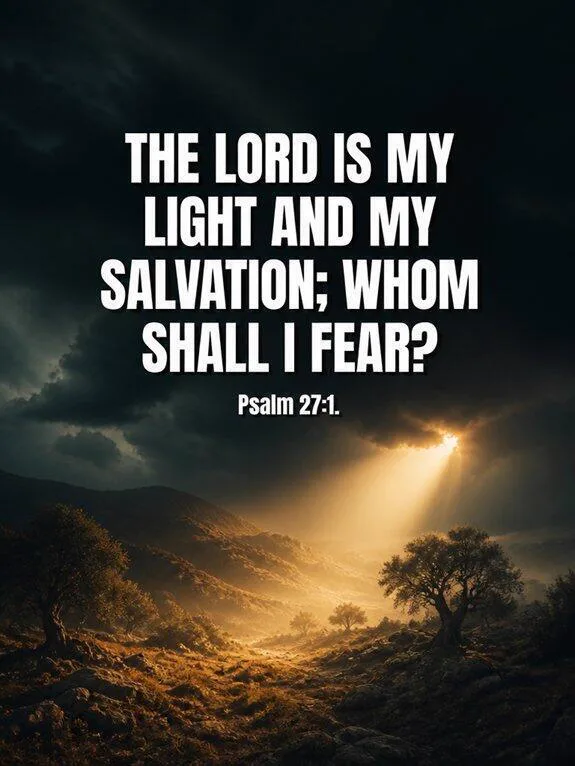
Two questions, no answers given, because the answers are obvious once the first line lands. Notice that David does not argue himself out of fear by insisting the threat is imaginary — the next verses are full of armies and enemies who are entirely real. He handles fear by making it answer a question: whom, exactly? Naming the thing you are afraid of, out loud, next to who God is, does more than telling yourself to calm down ever has.
Psalm 27:3 — Confidence With the Army Still There
“Though an army should encamp against me, my heart shall not fear. Though war should rise against me, even then I will be confident.” — Psalm 27:3 (WEBU)
The army does not leave. That is the point, and it is why this verse survives contact with a bad week better than most. David writes though, twice — a word that concedes the situation and refuses its conclusion. Confidence here is not a forecast that things will go well. It is a decision about where to stand while they are going badly.
When You Feel Too Small for God to Notice
Matthew 10:29-31 — The Sparrow Arithmetic
““Aren’t two sparrows sold for an assarion coin? Not one of them falls to the ground apart from your Father’s will. But the very hairs of your head are all numbered. Therefore don’t be afraid. You are of more value than many sparrows.” — Matthew 10:29-31 (WEBU)

An assarion was the smallest copper coin in circulation, worth a fraction of an hour’s work, and it bought you two birds. Sparrows were what you ate when you could not afford anything else. Jesus picks the cheapest item in the market deliberately: even that, he says, does not fall without the Father. Then the hairs on your head — not counted once, but numbered, each with a place in an order. The argument runs from the least valuable thing upward, and you are at the top of it.
Luke 12:32 — Little Flock
““Don’t be afraid, little flock, for it is your Father’s good pleasure to give you the Kingdom.” — Luke 12:32 (WEBU)
Jesus calls them little to their faces. He is not flattering a frightened group into feeling strong; he agrees with their assessment of their own size and then makes it irrelevant. “Good pleasure” is the phrase to slow down on. The Kingdom is not extracted from a reluctant God by people who behaved well enough. Giving it is the thing He actually wants to do.
When You Have to Do the Hard Thing Anyway
Some fear is not asking to be soothed. It is standing between you and something you have to do tomorrow morning.
Joshua 1:9 — Courage as an Order
“Haven’t I commanded you? Be strong and courageous. Don’t be afraid. Don’t be dismayed, for the LORD your God is with you wherever you go.”” — Joshua 1:9 (WEBU)

Courage arrives here as a command, which is strange until you consider who is receiving it. Joshua has just buried Moses and inherited his job. God does not wait for him to feel ready — He issues an instruction, and instructions can be obeyed by people who feel nothing of the sort. Courage in this verse is not a temperature you wait to reach. It is something you do while still afraid, on the strength of the clause at the end.
Deuteronomy 31:6 — He Will Not Forsake You
“Be strong and courageous. Don’t be afraid or scared of them, for the LORD your God himself is who goes with you. He will not fail you nor forsake you.”” — Deuteronomy 31:6 (WEBU)

This is a farewell speech. Moses is 120 years old, he has been told he will not cross the river, and these are among the last words he gives the nation he spent forty years dragging through a desert. He is not offering them optimism about the fortified cities ahead. He is handing over the one thing that carried him: himself is who goes with you. The comfort is not that it will be easy. It is that the arrangement does not depend on Moses being there.
Isaiah 41:10 — Five Promises in One Breath
“Don’t you be afraid, for I am with you. Don’t be dismayed, for I am your God. I will strengthen you. Yes, I will help you. Yes, I will uphold you with the right hand of my righteousness.” — Isaiah 41:10 (WEBU)

Count the verbs: with, am, strengthen, help, uphold. They escalate. With you is presence, strengthen adds something to you, and uphold takes your weight when what was added still is not enough. The order matters on the days you cannot manufacture any strength at all — the verse has already anticipated that and put a hand under you.
Isaiah 41:13 — He Takes the Hand
“For I, the LORD your God, will hold your right hand, saying to you, ‘Don’t be afraid. I will help you.’” — Isaiah 41:13 (WEBU)
Three verses later, the same passage gets physical. Somebody holding your right hand is standing beside you, not in front of you — close enough to speak at normal volume. It is a small image and it does a specific job: fear tends to feel like being alone with a problem, and this is the sentence that contradicts the aloneness rather than the problem.
When Fear Arrives at Night and Will Not Leave
Fear that keeps you from sleeping, eating or leaving the house is not a spiritual failure, and Scripture does not replace a doctor or a therapist. The verses below sit alongside that care; they were never meant to stand in for it.
Psalm 56:3 — What to Do With the Fear You Still Feel
“When I am afraid, I will put my trust in you.” — Psalm 56:3 (WEBU)

Nine words, and the most useful thing in them is the word when. David does not write “if I am afraid” and he does not promise the fear will pass first. Trust is what he does while afraid, not instead of it. If you have ever felt like a fraud for praying with your heart still hammering, this verse was written by somebody doing exactly that — on the run, in enemy territory, according to the psalm’s own heading.
Psalm 34:4 — Answered, Then Delivered
“I sought the LORD, and he answered me, and delivered me from all my fears.” — Psalm 34:4 (WEBU)
Read what he was delivered from. Not his enemies, not his circumstances — his fears. The situation and the terror are treated as two separate problems, and this verse only claims the second one. That is a smaller promise than the one people usually read here, and a far more useful one, because it is available tonight whether or not anything outside your head has changed.
2 Timothy 1:7 — Not the Spirit You Were Given
“For God didn’t give us a spirit of fear, but of power, love, and self-control.” — 2 Timothy 1:7 (WEBU)

Paul wrote this from a Roman prison to a young man he suspected was losing his nerve, which is worth knowing before the verse gets used as a rebuke. It is not “you should not be afraid”. It is a reminder about origin: whatever this fear is, it did not come from God, so it does not get to speak with His authority. The third item is the surprising one — self-control, the ordinary ability to choose your next action, listed as a gift rather than a virtue.
Romans 8:15 — Not a Slave, a Son
“For you didn’t receive the spirit of bondage again to fear, but you received the Spirit of adoption, by whom we cry, “Abba! Father!”” — Romans 8:15 (WEBU)
Paul reaches for the word bondage on purpose, and anyone who has lain awake at three in the morning will recognise why. Chronic fear behaves like ownership: it decides what you do, where you go, what you say yes to. Against that he sets adoption — a legal act in Roman law, irreversible, that made a stranger an heir with the same standing as a birth child. The contrast is not brave feelings against frightened ones. It is one status against another.
1 John 4:18 — Love Pushes It Out
“There is no fear in love; but perfect love casts out fear, because fear has punishment.” — 1 John 4:18 (WEBU)

Casts out is a forceful verb — the same kind of word used for driving something from a house. John is not describing fear politely fading. He is describing it being displaced by something that will not share the room. And the reason he gives is precise: the fear in question is the fear of punishment, of being found out and rejected. Love does not argue with that fear. It removes the thing it was afraid of.
When You Are Tired of Being Afraid
John 14:27 — A Different Kind of Peace
“Peace I leave with you. My peace I give to you; not as the world gives, I give to you. Don’t let your heart be troubled, neither let it be fearful.” — John 14:27 (WEBU)
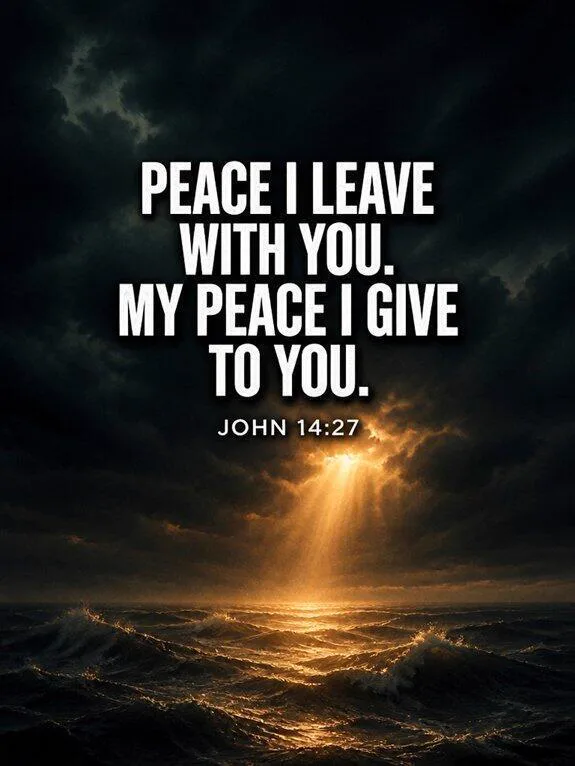
Jesus says this hours before his arrest, at a dinner table, to men who will scatter before morning. Not as the world gives is the clause doing the work. The peace on offer everywhere else is conditional on the trouble stopping — it is the calm of a solved problem. This one is handed over in advance of the worst night of their lives, which means it was never keyed to the circumstances at all.
Matthew 11:28-30 — Rest for the Ones Carrying It
““Come to me, all you who labor and are heavily burdened, and I will give you rest. Take my yoke upon you and learn from me, for I am gentle and humble in heart; and you will find rest for your souls. For my yoke is easy, and my burden is light.”” — Matthew 11:28-30 (WEBU)
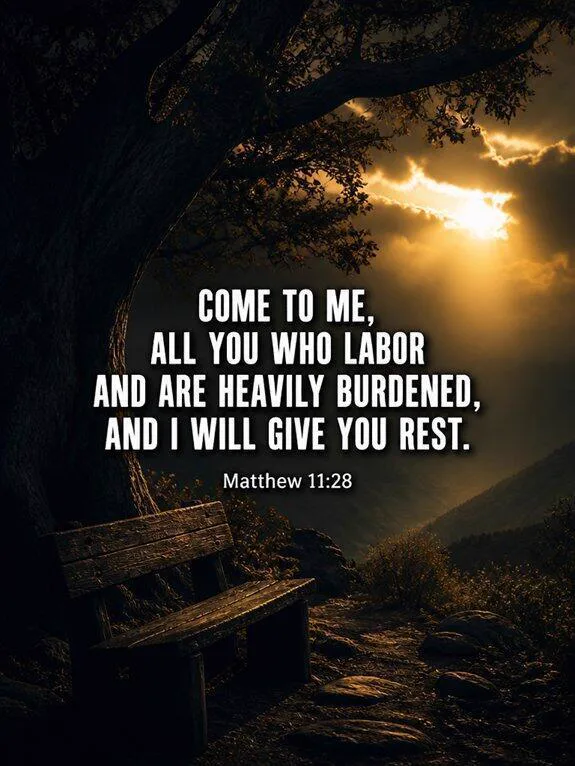
A yoke is a wooden beam across the shoulders of two animals, and that detail is usually left out of the encouraging poster. Jesus does not offer to take the load off. He offers to be the other half of it. Rest, in this sentence, is not the absence of work — it is the same work with somebody pulling beside you who is stronger and setting the pace.
Isaiah 35:4 — For the Ones With a Fearful Heart
“Tell those who have a fearful heart, “Be strong! Don’t be afraid! Behold, your God will come with vengeance, God’s retribution. He will come and save you.” — Isaiah 35:4 (WEBU)
Notice who the instruction is aimed at. It is not addressed to the frightened person — it is addressed to whoever is standing near them, which puts most of us on the sending side more often than the receiving one. Tell those who have a fearful heart. Somebody is meant to say this out loud to somebody else. Fear is treated here as a thing you are not expected to talk yourself out of alone, which is why sending one of these verses to a friend at the right moment is closer to the original design than reading it silently ever is.
How to Use One of These When You Are Actually Afraid
Reading twenty verses in one sitting does very little. Carrying one does a great deal, and the difference is repetition under pressure rather than comprehension. We have watched this go wrong the same way every time: people finish a list like this one feeling better for an hour, and reach for nothing at all on the night it matters.
Pick a single verse from this page — the one that made you stop, not the one that seems most correct. Memorize it, properly: well enough to say it without looking, which for a short verse like Psalm 56:3 takes about four repetitions a day for three days. Then attach it to the moment fear actually arrives: the first minute after waking, the walk to the meeting, the hour after the house goes quiet. Say it there, out loud if you can.
The point is not for us to feel calm on demand, and it is not to reach a state where there is nothing to fear. It is to have one sentence that reaches you faster than the fear does, so that the first voice in the room is not the worst one. Do that with one verse for a fortnight before adding a second.
Questions People Ask About “Fear Not” Verses
How many times does the Bible say “fear not”?
The direct command appears 112 times across 34 books in the World English Bible, counting “Don’t be afraid”, “Don’t fear” and “Fear not” spoken to a person. The popular claim of 365 verses — one for each day of the year — has no traceable source, and the number changes with the translation and with what you choose to count.
What Bible verse says “fear not”?
Genesis 15:1 is the first, spoken to Abram after a battle: “Don’t be afraid, Abram. I am your shield.” The most quoted is Isaiah 41:10, which pairs the command with five promises. Joshua 1:9, Psalm 23:4, Matthew 10:31 and Luke 12:32 are the other verses people return to most.
Where does Jesus say “fear not”?
In several places, usually in the middle of the danger rather than after it. On the water at night he says, “Cheer up! It is I! Don’t be afraid” (Matthew 14:27). Sending out the twelve, he tells them “don’t be afraid. You are of more value than many sparrows” (Matthew 10:31), and to followers worried about food and clothing, “Don’t be afraid, little flock” (Luke 12:32). Each time the command arrives with its reason attached.
Why does God say “fear not” so often?
Because of what follows it. In nearly every case the command comes attached to a reason, and the reason is presence rather than safety — “for I am with you”, “for the LORD your God is with you wherever you go”. The instruction is repeated so often because the situations that produce fear keep recurring, and the answer given is always the same one.
Does God promise a life without fear or trouble?
No. Jesus told his followers plainly that they would have trouble in the world, and Psalm 23 sends the reader through the valley rather than around it. What Scripture promises is company inside the trouble and an exit from it — not exemption. Any list that suggests otherwise is quoting selectively.
What does the Bible say about fear and anxiety?
It distinguishes two kinds. Fear of God — reverence, awe — is commended as the beginning of wisdom in Proverbs 9:10. Fear of people, circumstances and the future is the kind repeatedly forbidden, and the remedy offered is never willpower but the presence of God. For the anxious-thought side of this, our guide to Bible verses for anxiety goes further.
Twenty verses is more than anyone needs at once. Take one — the sentence you were still thinking about three paragraphs later — and give it a fortnight of ordinary Tuesdays before you look for another. That is how these words stop being a list and start being something you reach for.
When you are ready for more, Bible Verses About Courage covers the verses about acting while afraid, Bible Verses for Overcoming Fear works through the fears that repeat, and the full Fear archive holds the rest.