The most quoted strength verse in the Bible has a sentence in front of it that almost nobody quotes.
Isaiah 40:31 goes on gym walls, race numbers, graduation cards. Isaiah 40:30 says that the youngest and fittest people in the picture fall over. Put them back in order and the famous line stops being a slogan about willpower and becomes something stranger: a promise addressed to the people who have already collapsed.
That order repeats. The Bible verses for strength and hope collected here were not handed to anyone at full battery. They were spoken to a prophet asking to die, to a crowd standing in the street crying, to a man whose request had just been refused for the third time, to exiles who had watched their city burn. Every one of them arrives after the strength has run out, not before.
Which means we can read them on the worst day. That is exactly the day they were written for.

Renew your strength. Learn to soar instead of flap.Isaiah 40 · 12 min
That was just the opening. Open the app and search #003 to hear the full 12-minute story — free.
Keep listening free in the app Free on iOS & Android — no sample needed

Strength Is Issued to the Empty, Never Added to the Strong
Isaiah 40:30-31 — The Sentence Before the Famous One
“Even the youths faint and get weary, and the young men utterly fall; but those who wait for the LORD will renew their strength. They will mount up with wings like eagles. They will run, and not be weary. They will walk, and not faint.” — Isaiah 40:30-31 (WEBU)

Look at the order of the three promises at the end. Flying, then running, then walking. As a piece of motivational writing that is backwards — a list built to impress would finish with the eagle. This one finishes with a man putting one foot in front of the other.
The order is deliberate, and it is a gift. Isaiah is speaking to people whose exile in Babylon had decades left to run. Most of what was ahead of them was not flying and not sprinting. It was walking, for years, without collapsing. So the passage saves its smallest-sounding promise for last, because that is the one they were going to need every single day.
Isaiah 40:29 — Arithmetic That Should Not Work
“He gives power to the weak. He increases the strength of him who has no might.” — Isaiah 40:29 (WEBU)

Read the second half slowly. God increases the strength of a man who has none. Increasing zero is not a mathematical operation — you cannot add a percentage to nothing. The sentence only works if what is being described is not a top-up.
The distinction matters to us at four in the afternoon on a bad week, when the honest answer to how are you holding up is that there is nothing left to top up. The verse does not require a reserve. It describes a supply arriving where there was none, which is the only kind of help that is any use to somebody genuinely empty.
2 Corinthians 12:9 — Strength That Arrived as a Refusal
“Concerning this thing, I begged the Lord three times that it might depart from me. He has said to me, “My grace is sufficient for you, for my power is made perfect in weakness.”” — 2 Corinthians 12:8-9 (WEBU)

Paul asked three times. He was told no three times. The most quoted line about God’s power in the New Testament is the transcript of a refused prayer.
He never says what the thorn was, which has frustrated us for nineteen centuries and is probably the point — the blank space fits whatever you brought to the passage. What he does record is the exchange rate. He asked for the problem to leave. He was given power to carry it instead. Those are not the same answer, and the verse is honest enough to let you notice that Paul would rather have had the first one.
Psalm 73:26 — Present Tense, Not Hypothetical
“My flesh and my heart fails, but God is the strength of my heart and my portion forever.” — Psalm 73:26 (WEBU)

Not may fail. Not will fail one day. Fails. Asaph writes this in the present tense, as a fact currently in progress, and then puts the word but in the middle of it rather than at the end.
Both halves of the sentence are true at once. His body and his nerve are giving out, and God is the strength of his heart, and neither statement cancels the other. Most encouragement asks us to swap the first half for the second. This verse lets you keep both, which is the only version an exhausted person can say out loud without lying.
Philippians 4:12-13 — The Verse That Is Half a Sentence
“In any and all circumstances I have learned the secret both to be filled and to be hungry, both to abound and to be in need. I can do all things through Christ who strengthens me.” — Philippians 4:12-13 (WEBU)

Verse 13 gets printed on sports gear. Verse 12 tells you what the secret actually covers, and half of it is hunger.
Paul names four states, and two of them are shortage. Whatever he learned works while being filled and while being hungry, in abundance and in need — a strength that does not depend on which of those you woke up in. He is writing under house arrest in Rome, waiting on a verdict, thanking a church for a food parcel. The most famous line about doing all things was written by a man whose circumstances had shrunk to one room.
What God Actually Does for Someone Who Has Run Out
1 Kings 19:7 — Food, Sleep, and No Argument
“Then he requested for himself that he might die, and said, “It is enough. Now, O LORD, take away my life; for I am not better than my fathers.”” — 1 Kings 19:4 (WEBU)
Elijah had just won the largest public victory of his career on Mount Carmel. Days later he is sitting alone under a desert bush asking God to end his life. Note what does not happen next. No rebuke, no reminder of the miracle he had just performed, no lecture about the sin of despair.
“The LORD’s angel came again the second time, and touched him, and said, “Arise and eat, because the journey is too great for you.”” — 1 Kings 19:7 (WEBU)

God agrees with him. The journey is too great — that is not Elijah’s depression talking, it is the angel’s own diagnosis. And the first prescription is bread, water, and a second sleep, delivered twice before a single word of theology.
The famous still small voice in that chapter comes forty days later, after the wind and the earthquake and the fire, and it is the subject of its own quiet passage. It does not come first. What comes first is a meal.
That has a plain application. Sleep, food, sunlight and rest are not the spiritual consolation prize; in this chapter they are what God sends before anything else. And if the exhaustion has been running for months, or it is affecting your sleep, your work or your health, put yourself in the hands of a professional. Doing that sits alongside faith and always has.
Nehemiah 8:10 — Spoken to a Crowd That Was Crying
“For all the people wept when they heard the words of the law. Then he said to them, “Go your way. Eat the fat, drink the sweet, and send portions to him for whom nothing is prepared, for today is holy to our Lord. Don’t be grieved, for the joy of the LORD is your strength.”” — Nehemiah 8:9-10 (WEBU)
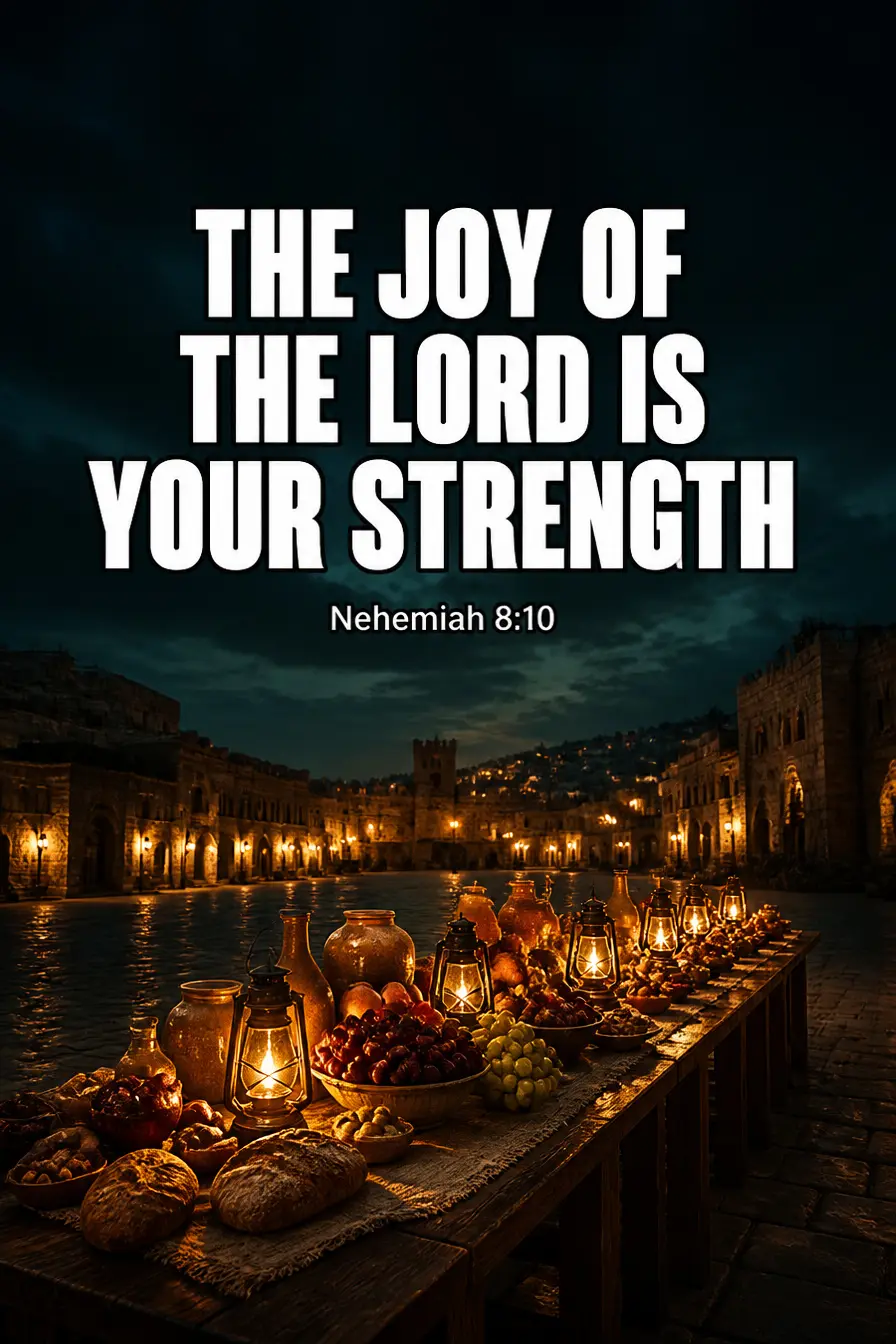
The joy of the LORD is your strength gets quoted as though it were addressed to a happy room. Verse 9 says the opposite: the whole crowd was weeping. This is a line spoken over people already in tears.
And look at what they are told to do about it. Eat well. Drink something sweet. Then send a portion to somebody who has nothing prepared. The instruction is not feel joy, which nobody can obey on command. It is a meal, and a share of that meal carried to a poorer neighbour. Strength here is physical, organised, and pointed at somebody else — three things a person in tears can actually do.
Hope, in the Bible, Is Something You Do
The English word suggests a mood to us: hope arrives, or it does not. The Hebrew and Greek writers treat it as an action with steps, and they are unusually specific about the order.
Lamentations 3:21-23 — Hope Arrives After an Act of Memory
“This I recall to my mind; therefore I have hope. It is because of the LORD’s loving kindnesses that we are not consumed, because his mercies don’t fail. They are new every morning.” — Lamentations 3:21-23 (WEBU)

Read the sequence in verse 21. “This I recall to my mind” comes first. The hope comes second, as a consequence. It is not a feeling that showed up and made memory possible; it is memory, performed deliberately, and hope as the result.
The setting makes it harder and better. Lamentations is written by somebody looking at the ruins of Jerusalem — burnt walls, an emptied temple, a deported population. The most quoted line about new mercies every morning was composed in the worst week in that city’s history, by a man who had to work to get there. The wider case for hope in ruined circumstances runs through the same chapter.
Psalm 42:5 — The Psalmist Gives Himself an Order
“Why are you in despair, my soul? Why are you disturbed within me? Hope in God! For I shall still praise him for the saving help of his presence.” — Psalm 42:5 (WEBU)

He does not describe hope. He commands it, and the person he commands is himself.
There are two moves in one verse. First a question — why are you in despair — which is an interrogation, not a diagnosis; he is asking his own soul to give an account. Then an imperative: Hope in God. Those of us who have lain awake arguing with our own head recognise the shape. The psalm’s answer to a mind that has run away is to speak to it out loud, firmly, the way you would speak to somebody you love who is spiralling.
Psalm 27:14 — Waiting Is the Strong Action
“Wait for the LORD. Be strong, and let your heart take courage. Yes, wait for the LORD.” — Psalm 27:14 (WEBU)

Strength and waiting sit inside the same sentence, which cuts against every instinct that says strength means moving. Then the verse repeats itself: Yes, wait for the LORD. David says it, adds the courage line, and says it again.
Repetition in Hebrew poetry is emphasis, and here it also reads like somebody who knows the first instruction did not land. Waiting is the part nobody wants. The psalm treats it as the demanding assignment it is, and hands you courage specifically for that, not for action.
Zechariah 9:12 — Prisoners of Hope
“Turn to the stronghold, you prisoners of hope! Even today I declare that I will restore double to you.” — Zechariah 9:12 (WEBU)

Prisoners of hope is the strangest phrase in this whole article, and it rewards sitting with. Zechariah is addressing people who had recently been literal prisoners, returned from Babylon to a half-built city.
He calls them captives of the thing that saved them. A prisoner cannot simply walk out; the condition holds you whether or not you are in the mood for it. That is a very different picture from hope as an attitude you have to keep generating. And the place he sends them is a stronghold — the same walls that make a prison make a fortress. What holds you in is what keeps the rest out.
Romans 5:3-5 — Hope Is the Last Item on the Line
“we also rejoice in our sufferings, knowing that suffering produces perseverance; and perseverance, proven character; and proven character, hope; and hope doesn’t disappoint us” — Romans 5:3-5 (WEBU)
Paul lays out a production line, and hope is at the end of it — the output, never the raw material. Suffering, then perseverance, then proven character, then hope. Nobody in that sequence starts hopeful. They arrive there, in that order, having gone through the earlier stages. It is the same argument the article on hope and faith in difficult seasons works through at length.
Strength for a Long Walk, Not a Sprint
2 Corinthians 4:16 — Two Things True on the Same Day
“Therefore we don’t faint, but though our outward person is decaying, yet our inward person is renewed day by day.” — 2 Corinthians 4:16 (WEBU)
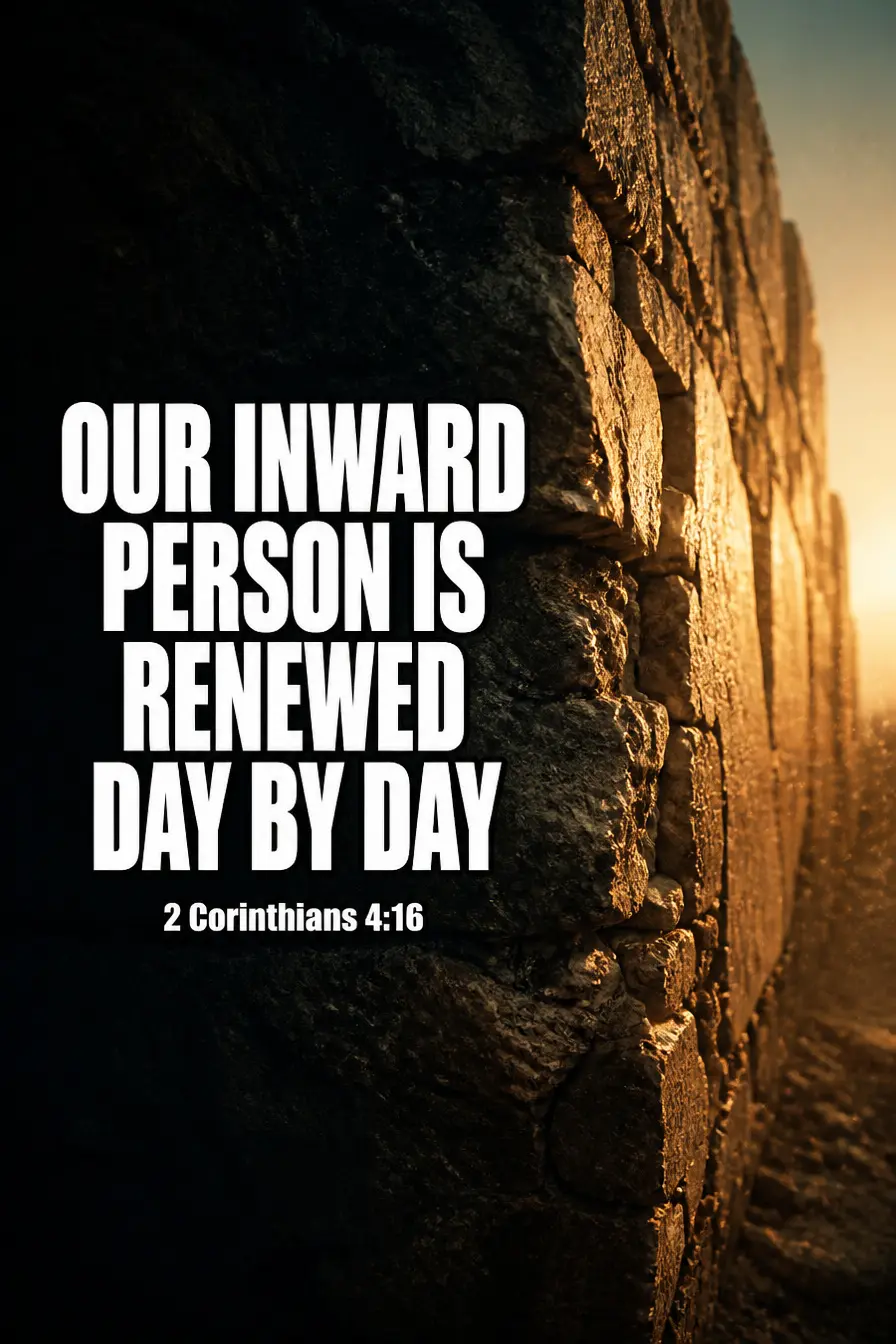
Two processes, running at once, in opposite directions. The outward person decaying is not denied or minimised — Paul states it as plainly as he states the renewal. He is not claiming the body wins.
The phrase that carries the weight is day by day. Renewal here is not a single event you can date; it is a daily issue, like bread. It also explains why our strength from yesterday is gone this morning, and why that is not a sign of failure. It was never meant to be stockpiled.
Habakkuk 3:19 — A Deer’s Strength Is Footing
“GOD, the Lord, is my strength. He makes my feet like deer’s feet, and enables me to go in high places.” — Habakkuk 3:19 (WEBU)

Of all the animals available to a Hebrew poet, he picks a deer. Not a lion, not an ox, not an eagle. A deer’s advantage on a mountain is not power — it is grip on ground that would kill anything heavier.
Notice too where this sits. Two verses earlier Habakkuk lists a total agricultural collapse: no figs, no grapes, no olives, no crops, no flocks, no herd. Then comes the deer. The full weight of that “yet” is worth reading in place. Strength in this chapter is not the harvest coming back. It is the ability to stay upright on a steep slope while it is still gone.
Psalm 28:7 — Helped First, Singing After
“The LORD is my strength and my shield. My heart has trusted in him, and I am helped. Therefore my heart greatly rejoices. With my song I will thank him.” — Psalm 28:7 (WEBU)
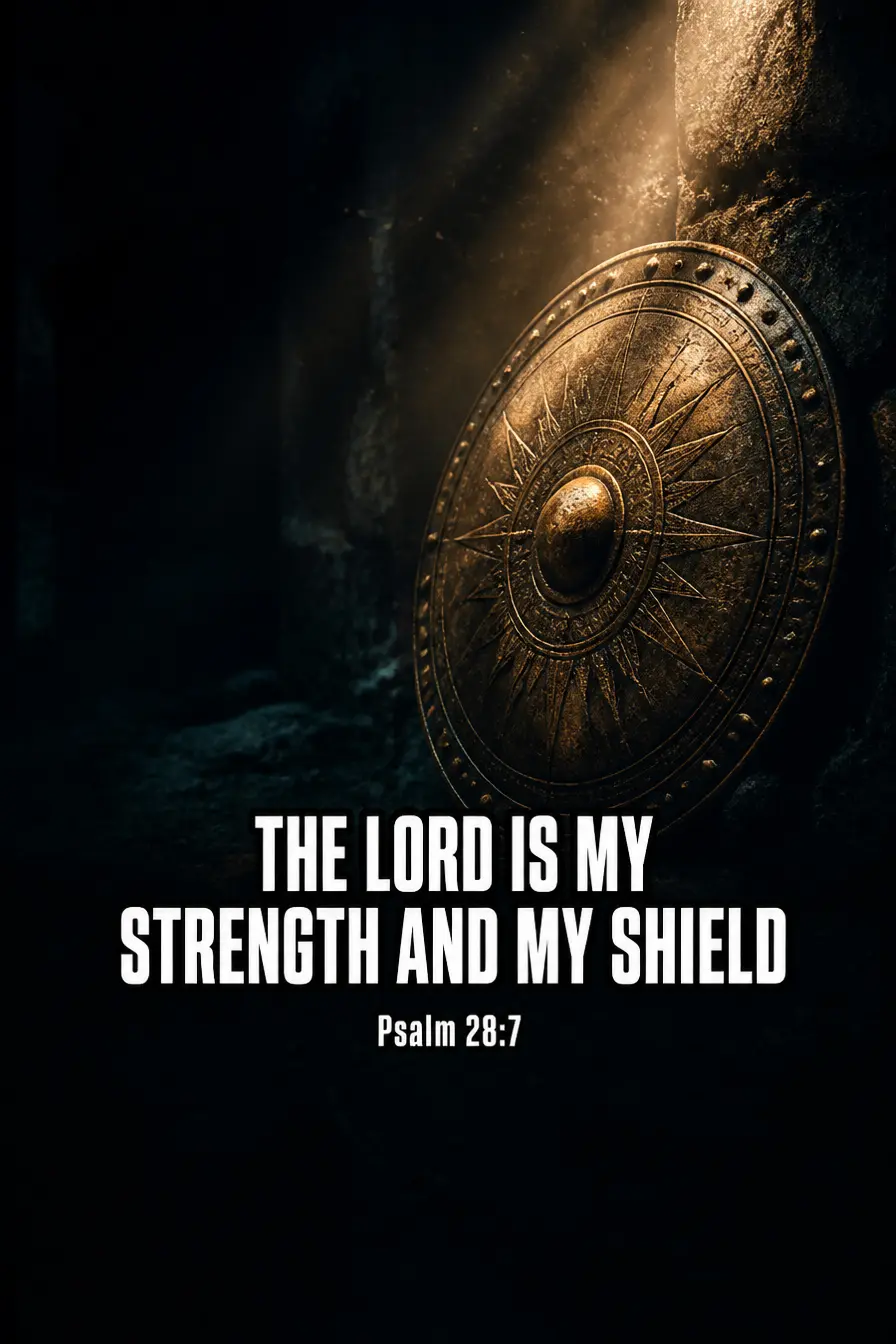
Follow the order of the four clauses: trusted, helped, rejoices, sings. The singing is last. It is a response to help that has already arrived, not the entry fee for getting it.
That order is worth defending, because we hear the reverse preached often — worship your way into feeling better, and if the feeling does not come, try harder. David’s sequence gives you permission to be silent for a while. The song is what happens after, and the verse is in no hurry about it.
Ephesians 3:16 — Strengthened Where Nobody Can See
“that he would grant you, according to the riches of his glory, that you may be strengthened with power through his Spirit in the inner person,” — Ephesians 3:16 (WEBU)

This is Paul praying for a church he loves, and what he asks for is not one change of circumstance. Not release, not health, not an easier city. Interior strength, in the part of a person nobody else can see.
The measure is the other half of it: according to the riches of his glory. Not according to how much you need, which would be a ceiling. According to how much God has, which is not one. A prayer sized by the supply rather than the shortage.
The Verses You Already Know, and What Each One Is For
Four passages turn up on every list of Bible verses for strength and hope, so often that we can stop hearing them. Each one answers a different question. Knowing which is which is what makes them usable at the moment you need one.
“Haven’t I commanded you? Be strong and courageous. Don’t be afraid. Don’t be dismayed, for the LORD your God is with you wherever you go.” — Joshua 1:9 (WEBU)
For the moment before you start. Joshua is about to take a job that killed his predecessor’s whole generation. The verse is a command with a reason attached, and the reason is company, not capability.
“Don’t you be afraid, for I am with you. Don’t be dismayed, for I am your God. I will strengthen you. Yes, I will help you. Yes, I will uphold you with the right hand of my righteousness.” — Isaiah 41:10 (WEBU)
For the moment you are already afraid. Three verbs stack up — strengthen, help, uphold — and the third is the one that covers you after the first two have failed. Its place in the wider argument runs through what God says when you are afraid.
“God is our refuge and strength, a very present help in trouble.” — Psalm 46:1 (WEBU)
For the moment everything is moving. The load-bearing word is present. Not a distant help, not a future one — help that is already in the room while the trouble is still happening.
“Now may the God of hope fill you with all joy and peace in believing, that you may abound in hope in the power of the Holy Spirit.” — Romans 15:13 (WEBU)
For the moment you have none of it left to generate. Read it as a prayer rather than a target. The joy, the peace and the hope are all things being poured in, and the last phrase names who is doing the pouring.
One Practice: Keep a Recall List
Lamentations 3:21 describes a technique, not a mood. “This I recall to my mind” — hope followed because he did something first.
So build the thing he was recalling from. Take a page, physical or on your phone, and write down specific occasions God has already come through. Dates, names, the actual detail. Not “God is faithful”, which is a doctrine you already agree with and which will not help at 3 a.m. Write “March, the week the money did not add up, and it did.” One line each.
Add to it whenever something lands. Read it on the days when nothing does. A recall list works precisely because feelings cannot be summoned but reading can, and the verses above put the reading first and the hope second, every time.
Questions People Ask About Bible Verses for Strength and Hope
What is a powerful Bible verse for strength?
Isaiah 40:31 is the one most people reach for: “those who wait for the LORD will renew their strength.” Its power comes from the verse before it, which says the young and fit collapse first. The promise is not a reward for being strong — it is what happens after strength has gone.
What are some short Bible verses about strength?
Four that fit on one line: “He gives power to the weak” (Isaiah 40:29), “I can do all things through Christ who strengthens me” (Philippians 4:13), “The LORD is my strength and my shield” (Psalm 28:7), and “God is the strength of my heart” (Psalm 73:26). Short enough to keep in mind, and each one is a complete promise.
What are some uplifting Bible verses for hope?
Lamentations 3:22-23 on mercies that are new every morning, Romans 15:13 on the God of hope filling you, Zechariah 9:12 on prisoners of hope, and Psalm 42:5 where the psalmist orders his own soul to hope. Each treats hope as something arriving from outside rather than a mood you must produce.
How can Bible verses provide strength and hope in hard times?
By giving you something to recall rather than something to feel. Lamentations 3:21 puts memory before hope: he recalls, and hope follows. Read in context, these verses supply concrete facts about what God has done, which is what a tired mind can hold on to when feelings supply nothing.
What is the most encouraging verse in the Bible?
There is no single answer, but 2 Corinthians 12:9 does unusual work: “My grace is sufficient for you, for my power is made perfect in weakness.” It is the reply to a prayer God refused three times. It encourages without pretending the hard thing was removed, which is why it survives contact with a genuinely bad week.
Where to Start Tonight
Pick one verse from this page — not all of them. If you are running on empty, take Isaiah 40:29 and the fact that increasing zero is not arithmetic. If you cannot feel anything, take Lamentations 3:21 and start the recall list instead. If someone else is the one struggling, Nehemiah 8:10 has the instruction: send a portion to somebody with nothing prepared.
More of these passages, worked through slowly, are collected in the hope archive.