
There is a difference between fear you want soothed and fear standing between you and something you have to do on Monday. The conversation you have been putting off. The scan results. The job you have to walk away from, or the one you have to walk into.
Most bible verses about courage get collected as if they were for the first kind — comfort for a frightened heart, and there is plenty of that in Scripture. The ones below are the second kind. Almost every one of them was spoken to a specific person with a specific task in front of them, usually one they did not want, and the command comes attached to the job rather than to the feeling.
That changes what the verses are for, and it is why we have grouped them by the situation rather than by the emotion. Not “you should feel calmer about this” but “go and do it, and here is who is going with you”.

Face your giants. Discover what makes someone truly brave.1 Samuel 17 · 11 min
That was just the opening. Open the app and search #002 to hear the full 11-minute story — free.
Keep listening free in the app Free on iOS & Android — no sample needed

The Commissionings
Joshua 1:9 — “Haven’t I Commanded You?”
“Haven’t I commanded you? Be strong and courageous. Don’t be afraid. Don’t be dismayed, for the LORD your God is with you wherever you go.”” — Joshua 1:9 (WEBU)

The opening question is the part that gets skipped. God is not encouraging Joshua, he is repeating an order already given — three times in this chapter, and the third time with a note of impatience. Joshua has just buried Moses and inherited a job nobody could want. What is being asked is not a feeling, because feelings cannot be commanded; it is behaviour, which can be, by somebody who is not ready.
Deuteronomy 31:6 — To Everybody
“Be strong and courageous. Don’t be afraid or scared of them, for the LORD your God himself is who goes with you. He will not fail you nor forsake you.”” — Deuteronomy 31:6 (WEBU)

Moses is 120 years old, has been told he will not cross the river, and this is close to his last public act. He says it to the whole nation — the general version, addressed to a crowd who will all have to go.
Deuteronomy 31:7-8 — And Then to One Man, by Name
“Moses called to Joshua, and said to him in the sight of all Israel, “Be strong and courageous, for you shall go with this people into the land which the LORD has sworn to their fathers to give them; and you shall cause them to inherit it. The LORD himself is who goes before you. He will be with you. He will not fail you nor forsake you. Don’t be afraid. Don’t be discouraged.”” — Deuteronomy 31:7-8 (WEBU)

Read these two together, because the repetition is the point. Moses says almost the same words twice within three verses — once to everyone, then in the sight of all Israel to the one man who has to lead them. The general encouragement was not enough for the person carrying the specific weight, so he said it again, using his name, in front of witnesses. If you have ever sat through a talk aimed at everybody and needed somebody to turn and say it to you, Moses knew.
1 Chronicles 28:20 — “And Do It”
“David said to Solomon his son, “Be strong and courageous, and do it. Don’t be afraid, nor be dismayed, for the LORD God, even my God, is with you. He will not fail you nor forsake you, until all the work for the service of the LORD’s house is finished.” — 1 Chronicles 28:20 (WEBU)

Three small words nobody quotes: and do it. David has handed his son the plans for a temple Solomon has never built, for a God he has to trust on his father’s word, and the courage in this sentence is entirely operational. Notice the end date too — the presence is promised until all the work is finished, which is a specific commitment rather than a general one. It runs as long as the task does.
When the Thing in Front of You Is Bigger Than You
2 Chronicles 20:15 — The Battle Is Not Yours
“and he said, “Listen, all Judah, and you inhabitants of Jerusalem, and you, King Jehoshaphat. The LORD says to you, ‘Don’t be afraid, and don’t be dismayed because of this great multitude; for the battle is not yours, but God’s.” — 2 Chronicles 20:15 (WEBU)
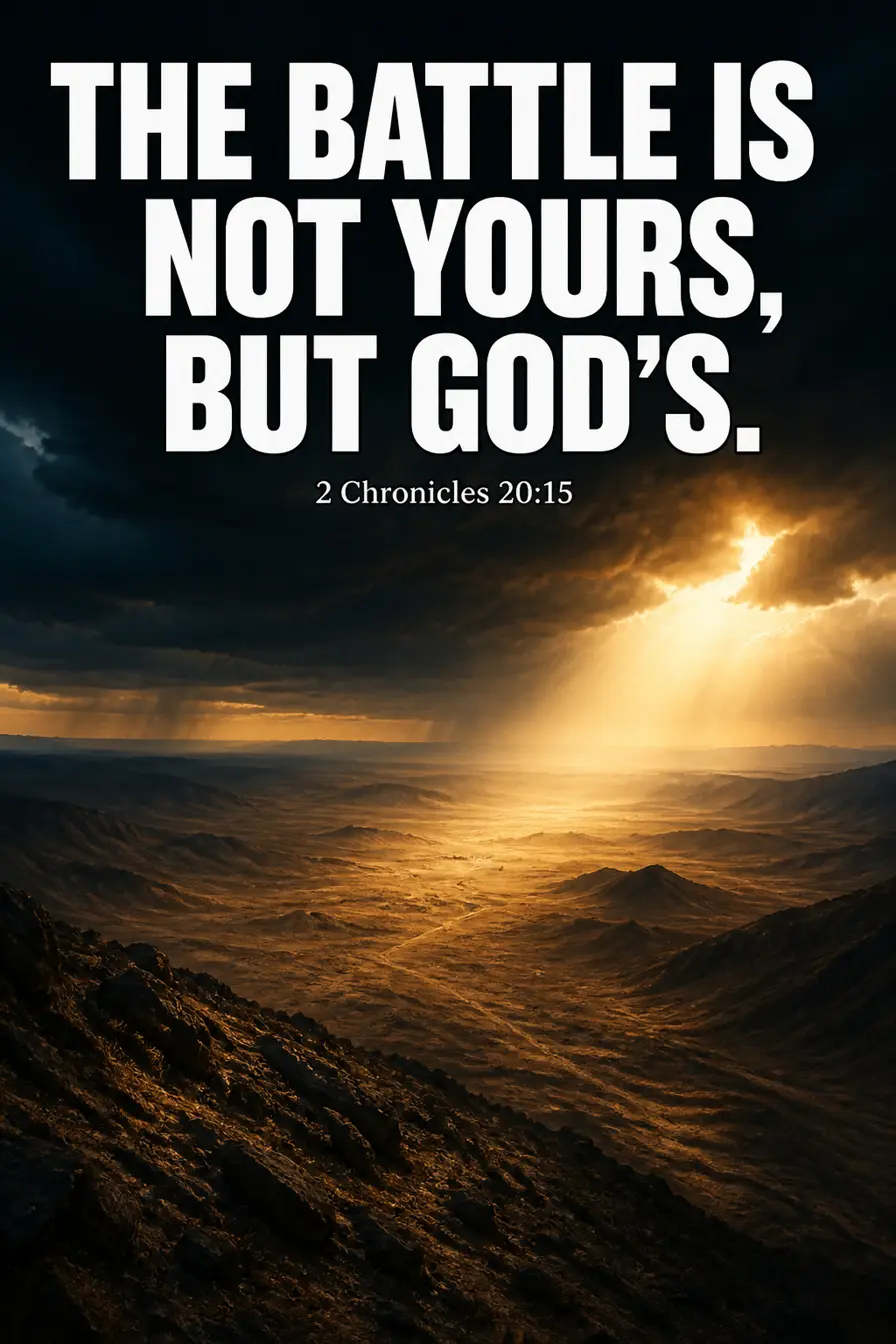
Jehoshaphat has three armies marching on him and has just prayed one of the most honest prayers in Scripture: we have no might against this great company, neither know we what to do. He states his own helplessness as the opening argument. The answer does not dispute the size of the problem — this great multitude is acknowledged — it disputes whose problem it is.
2 Chronicles 20:17 — Stand Still, and Go Out
“You will not need to fight this battle. Set yourselves, stand still, and see the salvation of the LORD with you, O Judah and Jerusalem. Don’t be afraid, nor be dismayed. Go out against them tomorrow, for the LORD is with you.’”” — 2 Chronicles 20:17 (WEBU)
Two instructions that appear to contradict each other, in one breath: stand still and go out against them tomorrow. Both are meant. They are told not to fight and also to show up on the field — which is the shape of a great deal of obedience. You go, you turn up, you take the position. The outcome is not the part you are carrying.
Exodus 14:13-14 — The LORD Will Fight for You
“Moses said to the people, “Don’t be afraid. Stand still, and see the salvation of the LORD, which he will work for you today; for you will never again see the Egyptians whom you have seen today. The LORD will fight for you, and you shall be still.”” — Exodus 14:13-14 (WEBU)
The sea in front, an army behind, no route in either direction. And this is where the original stand still comes from — Jehoshaphat’s prophet is quoting it centuries later, which tells you the people hearing it would have recognised the reference. Being told to stand still with cavalry approaching is not a soothing instruction. It is the hardest possible order.
Nehemiah 4:14 — Remember the Lord
“I looked, and rose up, and said to the nobles, to the rulers, and to the rest of the people, “Don’t be afraid of them! Remember the Lord, who is great and awesome, and fight for your brothers, your sons, your daughters, your wives, and your houses.” — Nehemiah 4:14 (WEBU)
The setting is a building site under threat, and what makes this verse land is how ordinary the motivation is. Not a vision, not a doctrine — your sons, your daughters, your wives, and your houses. Nehemiah points at the concrete things behind them. Courage here is not summoned by feeling braver; it is summoned by remembering what the fear is actually protecting.
The Ones Who Were Not Sure It Would Work
These are the hardest and the most useful to us, because in each case the outcome was not promised.
Daniel 3:17-18 — “But If Not”
“If it happens, our God whom we serve is able to deliver us from the burning fiery furnace; and he will deliver us out of your hand, O king. But if not, let it be known to you, O king, that we will not serve your gods or worship the golden image which you have set up.”” — Daniel 3:17-18 (WEBU)
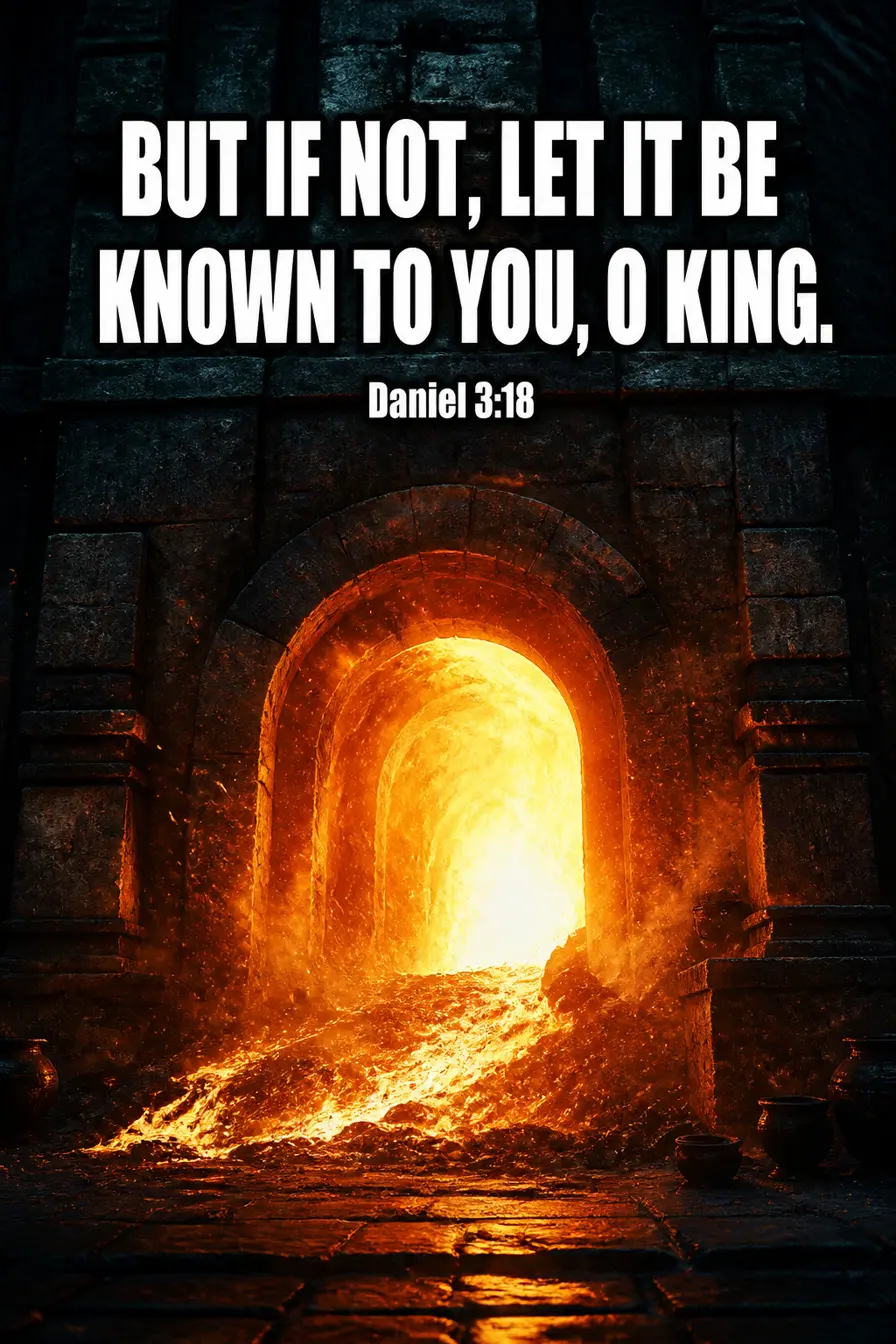
Two words carry the whole thing: but if not. Three men in front of a furnace say God is able to rescue them, and then, without pausing, say their answer is the same if he does not. That is the deepest statement about courage in the Bible and it is almost never on the posters, because it refuses the bargain everybody wants. Their obedience is not conditional on the rescue. Most of what passes for faith collapses precisely at that clause.
Esther 4:16 — “If I Perish, I Perish”
““Go, gather together all the Jews who are present in Susa, and fast for me, and neither eat nor drink three days, night or day. I and my maidens will also fast the same way. Then I will go in to the king, which is against the law; and if I perish, I perish.”” — Esther 4:16 (WEBU)

Approaching the Persian king uncalled carried a death sentence, and Esther names that fact before she goes. What she does not do is claim a promise she has not been given — nobody has told her she will survive. She asks for three days of fasting first, which is worth noticing: the courage is prepared for, not summoned on the spot. Then she names the worst case out loud and walks toward it anyway.
Judges 6:12-14 — Go in This Your Might
“The LORD’s angel appeared to him, and said to him, “The LORD is with you, you mighty man of valor!” Gideon said to him, “Oh, my lord, if the LORD is with us, why then has all this happened to us?” — Judges 6:12-14 (WEBU)

Gideon is hiding in a winepress threshing wheat so the Midianites will not find it, and he is greeted as a mighty man of valour. He does not accept the title — he argues, and the argument is a good one. What God says next is the striking part: Go in this your might. Not the might he will be given later. The one he already has and cannot see, which at that moment amounts to hiding successfully and being angry about the state of things.
The Short Commands
1 Corinthians 16:13 — Four in a Row
“Watch! Stand firm in the faith! Be courageous! Be strong!” — 1 Corinthians 16:13 (WEBU)

Four imperatives, eight words, no explanation attached. Paul is closing a long and difficult letter to a church he has spent chapters correcting, and this is what he leaves them with. The brevity is the design — it is built to be remembered under pressure, when nothing longer will fit in your head.
Psalm 27:14 — Let Your Heart Take Courage
“Wait for the LORD. Be strong, and let your heart take courage. Yes, wait for the LORD.” — Psalm 27:14 (WEBU)
Let your heart take courage is a permission rather than a command, and it is doing something specific. David is not telling the heart to produce courage; he is telling it to accept some, as though courage were being offered and the heart were refusing it. The instruction to wait bookends the verse twice, which suggests he expected it to be needed more than once.
Haggai 2:4 — Be Strong, and Work
“Yet now be strong, Zerubbabel,’ says the LORD. ‘Be strong, Joshua son of Jehozadak, the high priest. Be strong, all you people of the land,’ says the LORD, ‘and work, for I am with you,’ says the LORD of Armies.” — Haggai 2:4 (WEBU)
Three times be strong, each with a name attached, and then the least romantic verb in the passage: work. The people are rebuilding a temple that everyone can see is smaller than the one it replaces, and the older among them have wept at the comparison. Courage here is showing up to a diminished job and continuing.
When You Still Feel Afraid Doing It
None of these verses promise the feeling goes first. Several assume it does not, which is the permission most of us are actually looking for.
Psalm 56:3-4 — “When I Am Afraid”
“When I am afraid, I will put my trust in you. In God, I praise his word. In God, I put my trust. I will not be afraid. What can flesh do to me?” — Psalm 56:3-4 (WEBU)
When, not if — David writes fear as a recurring condition and trust as what he does inside it. Then, one line later, “I will not be afraid”. Both sentences are in the same breath and both are true, which is the most accurate description of doing something frightening that anyone has written.
2 Timothy 1:7 — Not the Spirit You Were Given
“For God didn’t give us a spirit of fear, but of power, love, and self-control.” — 2 Timothy 1:7 (WEBU)

Paul wrote this from a Roman prison to a younger man he suspected was losing his nerve, which is the context that keeps it from becoming a rebuke. It is a claim about origin rather than about strength: whatever this fear is, it did not come from God, so it does not get to speak with his authority. Self-control is the third item — the plain ability to choose your next action, listed as a gift.
Psalm 23:4 — Through the Valley
“Even though I walk through the valley of the shadow of death, I will fear no evil, for you are with me. Your rod and your staff, they comfort me.” — Psalm 23:4 (WEBU)

The preposition is the whole verse: not around the valley, through it, with the sentence still moving. Shepherds drove flocks along ravines so deep the sun never reached the floor because that was the only route to the next pasture. The dark stretch was on the way to somewhere, and the rod in the second half is the club carried for whatever came out of it.
Isaiah 35:4 — Say It to Somebody Else
“Tell those who have a fearful heart, “Be strong! Don’t be afraid! Behold, your God will come with vengeance, God’s retribution. He will come and save you.” — Isaiah 35:4 (WEBU)
Notice who is being instructed. Not the frightened person — whoever is standing next to them. Tell those who have a fearful heart assumes somebody says this out loud to somebody else, which is closer to the original design than reading it silently. If you know who is about to do something hard this week, this verse is addressed to you.
Before the Thing You Have to Do
Three practical moves, drawn from what is above rather than added on top by us.
Name the task, not the feeling. Every verse here is attached to a specific job — build the temple, cross the river, go to the king. Write down the one thing you are actually afraid to do, in a sentence, and put the verse next to that rather than next to your anxiety in general.
Prepare rather than summon. Esther fasted three days before walking into the throne room. Courage in Scripture is almost never produced on the spot; it is arranged in advance, which usually means deciding beforehand what you will do and telling one other person.
Settle the “but if not” before you go. The three at the furnace worked out their answer for the case where the rescue does not come, and it steadied them. Ask what you will do if this goes badly, answer it honestly, and most of the paralysis goes with it.
If the fear is stopping you sleeping, eating or functioning, that is worth saying to a doctor as well as to God. Scripture and clinical care are not rivals, and treating them as opponents costs people years.
Questions People Ask
What is the most famous Bible verse about courage?
Joshua 1:9, and the chapter explains why it lands so hard. Joshua hears it just after Moses has died, with the whole nation suddenly his responsibility, and the command be strong and courageous is given to him three times in four verses (1:6, 1:7 and 1:9). The repetition is the point: it was not expected to stick the first time. The reason attached at the end is a location, not a quality in Joshua: the LORD your God is with you wherever you go.
What is a verse for strength in hard times?
Haggai 2:4, if the hard time involves carrying on with work that looks smaller than it should. The people are rebuilding a temple that everyone can see is a lesser copy of the one that was destroyed, and the instruction is three times be strong, then “work, for I am with you.” For a single large task, 1 Chronicles 28:20 says the same thing in five words David gives Solomon: Be strong and courageous, and do it.
How do you have courage in the Bible?
By acting before the feeling changes. Joshua is commanded rather than encouraged, Gideon is sent with the strength he already has and cannot see, and Esther walks into the throne room having said out loud that she may not survive it. In each case the courage is a decision made while afraid, not a state reached beforehand.
Why does God say “do not fear” so often?
Because of what follows it. In almost every case the command carries a reason, and the reason is presence rather than safety — for the LORD your God is with you wherever you go, for the battle is not yours, but God’s. It recurs because the situations that produce fear recur, and the answer given is always the same one.
Does God promise a life without fear or trouble?
No. Daniel 3:18 is the clearest evidence: three men state plainly that they will obey even if God does not deliver them, and the text treats that as faith rather than doubt. Psalm 23 sends the reader through the valley rather than around it. What is promised is company inside the trouble and an exit from it, not exemption.
Courage in Scripture is almost always the same shape: a task, a command, and somebody going with you. It is not a feeling you wait for, and every person in this article did the thing before they felt ready.
Pick the verse that matches the job in front of you and take it into the week. If you want more, Fear Not Bible Verses for Anxious Moments counts how often the command appears and who said it, Bible Verses for Overcoming Fear works through the process when fear keeps returning, and the full Fear archive holds the rest.