
Almost every search is for the fruits of the Spirit, plural. Paul wrote fruit, singular.
That one letter is a good way into the passage. The list in Galatians 5 is not nine separate achievements to collect, one at a time, like badges. It is one harvest with nine flavours, growing from one root. A person does not end up with patience but no kindness, or joy but no self-control, any more than a vine produces grapes on alternate branches.
Below is the fruits of the Spirit Bible verse in full, the context that explains it, and then each of the nine, paired with another verse where Scripture shows what that quality looks like in a real life.

Radical Transformation
One encounter on one road. The verse everyone quotes, and what it cost.Acts 9 · 13 min
That was just the opening. Open the app and search #013 to hear the full 13-minute story — free.
Keep listening free in the app Free on iOS & Android — no sample needed


The Fruits of the Spirit Bible Verse: Galatians 5:22-23
Galatians 5:22 — One Fruit, Nine Flavours
“But the fruit of the Spirit is love, joy, peace, patience, kindness, goodness, faith,” — Galatians 5:22 (WEBU)
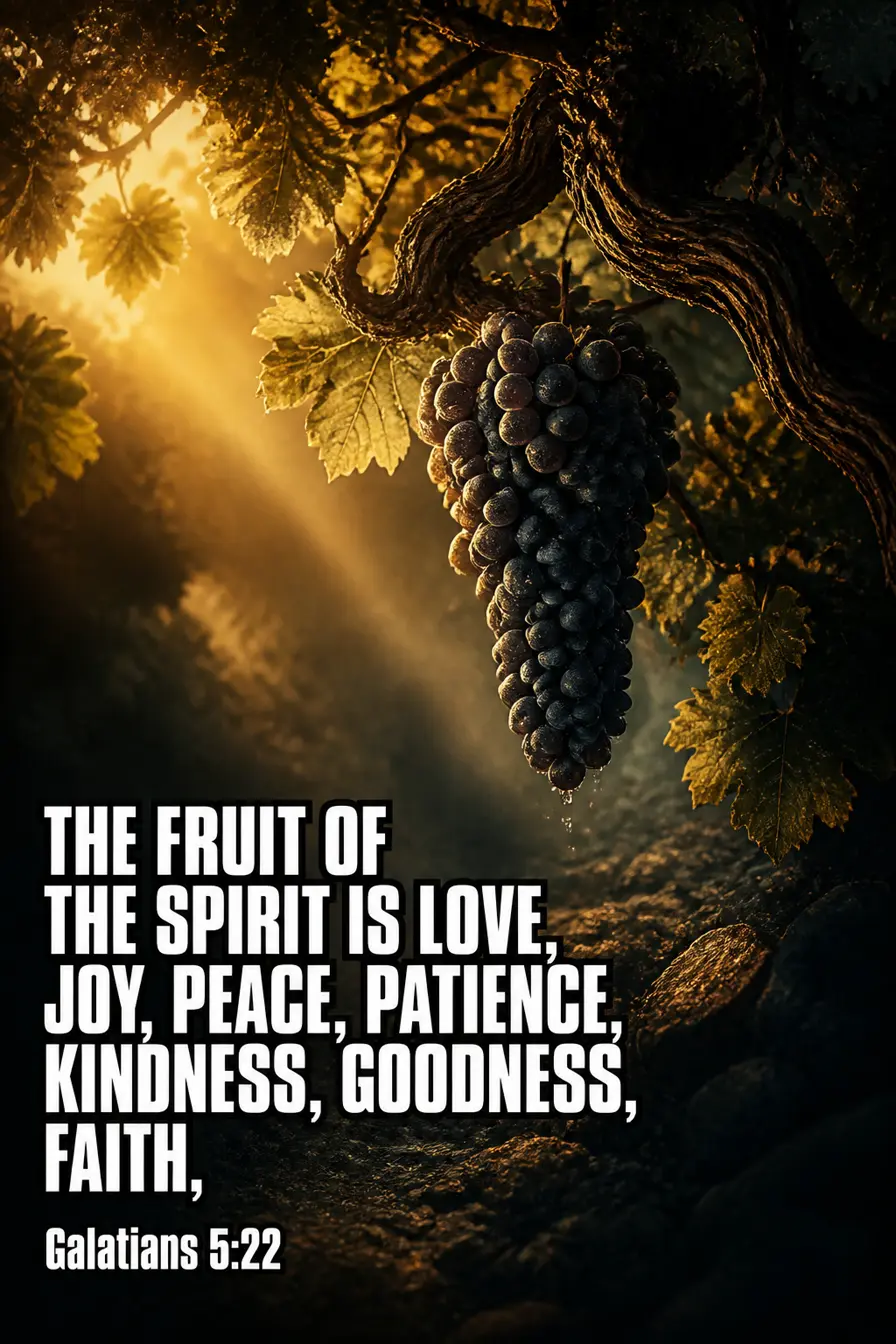
The verse starts with “But”, so it is the second half of a contrast. Just before it, Paul lists “the deeds of the flesh”: a long, ugly catalogue that runs from sexual immorality through hatred, jealousy and outbursts of anger to drunkenness.
Notice the grammar. In Greek the deeds are plural — many separate things a person does. The fruit is singular. Deeds are produced by effort and pile up in a list. Fruit grows, and it grows as a whole.
That is also why the word is fruit rather than, say, achievements. A branch does not strain to produce grapes. Jesus used the same picture in John 15: “He who remains in me and I in him bears much fruit.” The fruit comes from staying connected, not from trying harder at nine separate goals.
Galatians 5:23 — “Against Such Things There Is No Law”
“gentleness, and self-control. Against such things there is no law.” — Galatians 5:23 (WEBU)

The list ends with self-control, and then a dry line that is easy to skip: “Against such things there is no law.”
It makes more sense once you know what the letter is about. Paul wrote Galatians to churches being told that non-Jewish believers needed to keep the law of Moses to be fully accepted. His whole argument is that people are made right with God by faith, not by law-keeping.
So this sentence lands with some humour. You do not need a rulebook to stop people being too loving or too patient. No court has ever prosecuted anyone for excessive kindness. The life the Spirit grows already goes beyond what any law could require.
Galatians 5:25 — Keep in Step
“If we live by the Spirit, let’s also walk by the Spirit.” — Galatians 5:25 (WEBU)

Two verses after the list, Paul gives the only instruction attached to it. It is not “produce the fruit”. It is “walk by the Spirit”.
The verb he uses for walk carries the sense of falling into line, keeping pace with someone. Life by the Spirit has already begun, he says; now match your steps to it.
That reframes the whole list for anyone who reads it and feels like a failure. You are not told to manufacture nine virtues by Friday. You are told to keep pace with the One who grows them, and the very next verse shows where to start: “Let’s not become conceited, provoking one another, and envying one another.”
The Nine, One by One
Love — Romans 5:5: Poured In, Not Worked Up
“God’s love has been poured into our hearts through the Holy Spirit who was given to us.” — Romans 5:5 (WEBU)
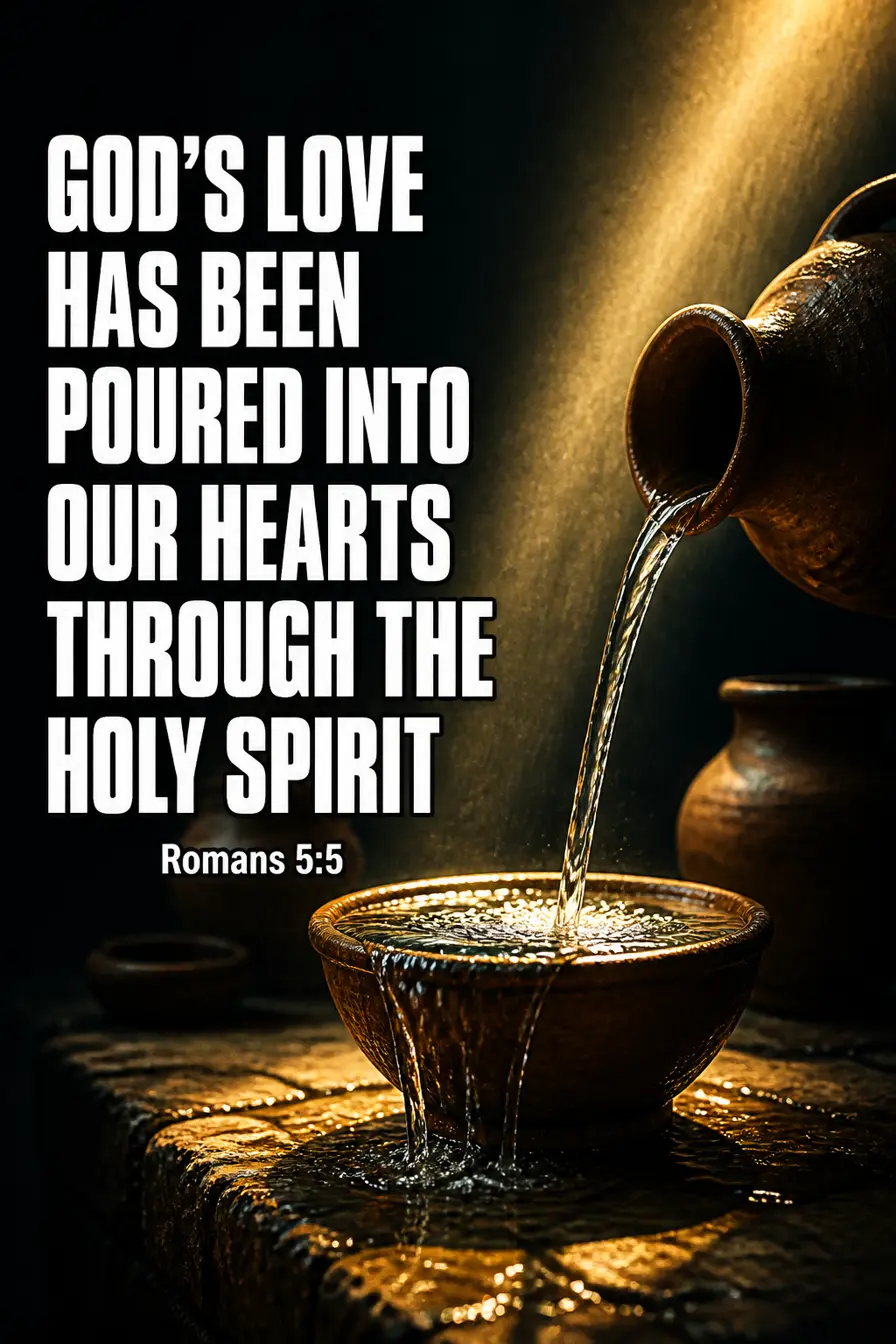
Love comes first in the list, and the word is agape: the love that acts for another person’s good whether or not it feels like it.
Romans 5:5 tells you where it comes from. It has been “poured into our hearts through the Holy Spirit.” The source is God’s love for us, not our effort to love him or others.
That matters on the days when you have no love left for someone. The fruit does not start with your supply. It starts with what has been poured in. Asking God for more of his love for a difficult person is not a failure of the fruit. It is how the fruit grows.
Joy — Philippians 4:4: Written in Chains
“Rejoice in the Lord always! Again I will say, “Rejoice!”” — Philippians 4:4 (WEBU)

This sounds like the easiest command in the Bible until you check where Paul was when he wrote it. Earlier in the same letter he mentions his “bonds” and the palace guard who all knew why he was held. He was a prisoner.
So the joy the Spirit grows is not the same as being in a good mood. It sits “in the Lord”, and it can coexist with chains, uncertainty and grief. Paul says it twice because he expects you to need persuading.
If you are going through something hard, joy here does not mean pretending otherwise. It means finding the place, even a small one, where your circumstances do not have the last word.
Peace — Romans 8:6: The Mind of the Spirit
“For the mind of the flesh is death, but the mind of the Spirit is life and peace;” — Romans 8:6 (WEBU)

Romans 8 uses the same contrast as Galatians 5: flesh against Spirit. Here the result of the Spirit is named directly: “life and peace”.
The biblical idea of peace is broader than calm. Behind the Greek word stands the Hebrew shalom: wholeness, things in their right place, nothing missing. A mind set on what the Spirit wants is a mind with fewer things fighting inside it.
If your thoughts feel like a battlefield, notice that the verse does not tell you to empty your mind. It tells you to point it somewhere. Peace follows the direction of attention, and our Bible verses for fear and anxiety take that further.
Patience — James 5:7: The Farmer and the Rain
“Behold, the farmer waits for the precious fruit of the earth, being patient over it, until it receives the early and late rain.” — James 5:7 (WEBU)
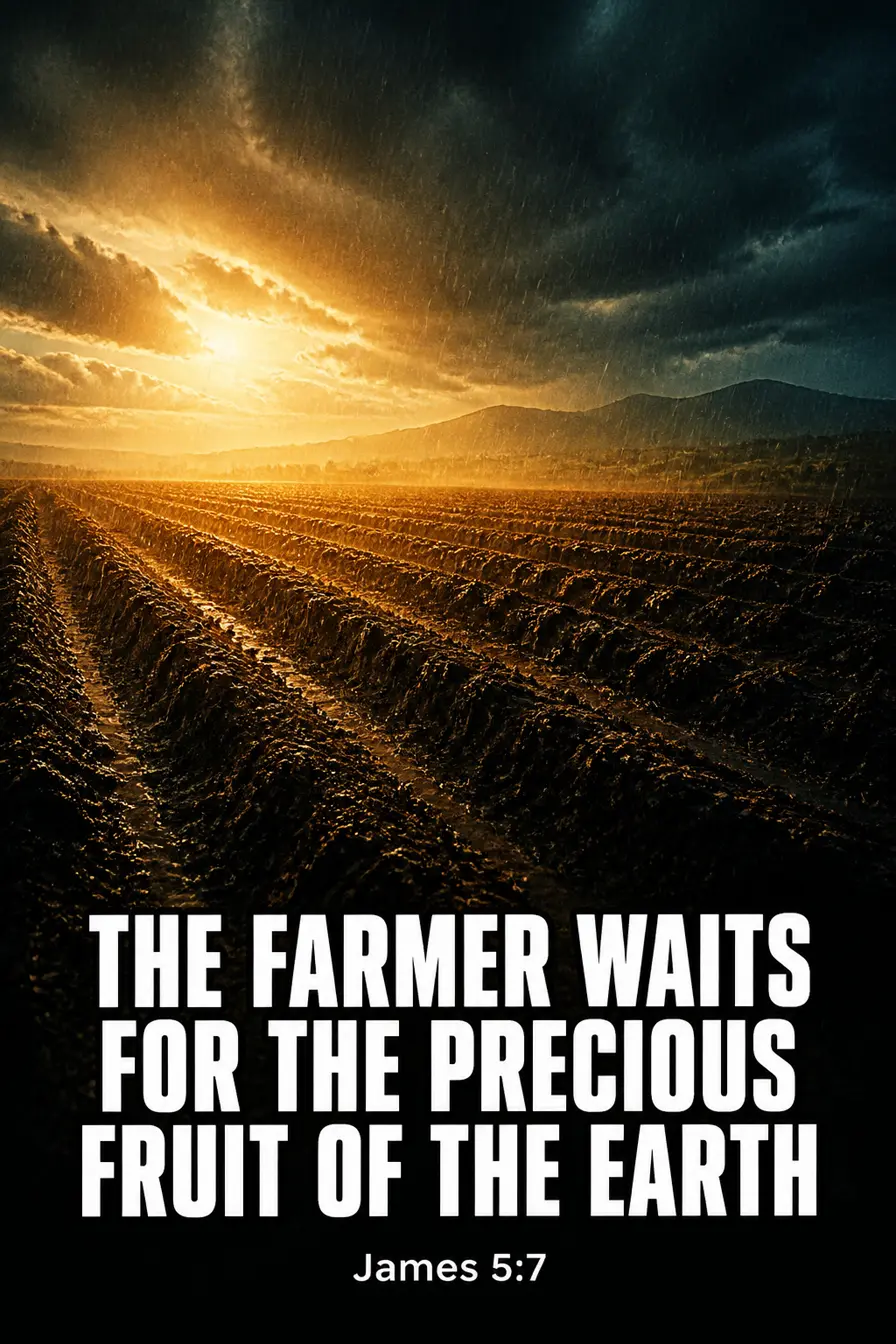
The Greek word for patience in Galatians, makrothumia, is built from “long” and “temper”. It is the opposite of a short fuse: a long one.
James uses the same root and gives the picture. A farmer cannot hurry a crop. He plants, and then he waits through the early rains of autumn and the late rains of spring. Waiting is not wasted time; it is part of how fruit happens.
That is a gentle word for anyone frustrated at how slowly they are changing. Fruit takes seasons. The patience the Spirit grows includes patience with your own growth.
Kindness — Romans 2:4: What Leads to Repentance
“the goodness of God leads you to repentance” — Romans 2:4 (WEBU)
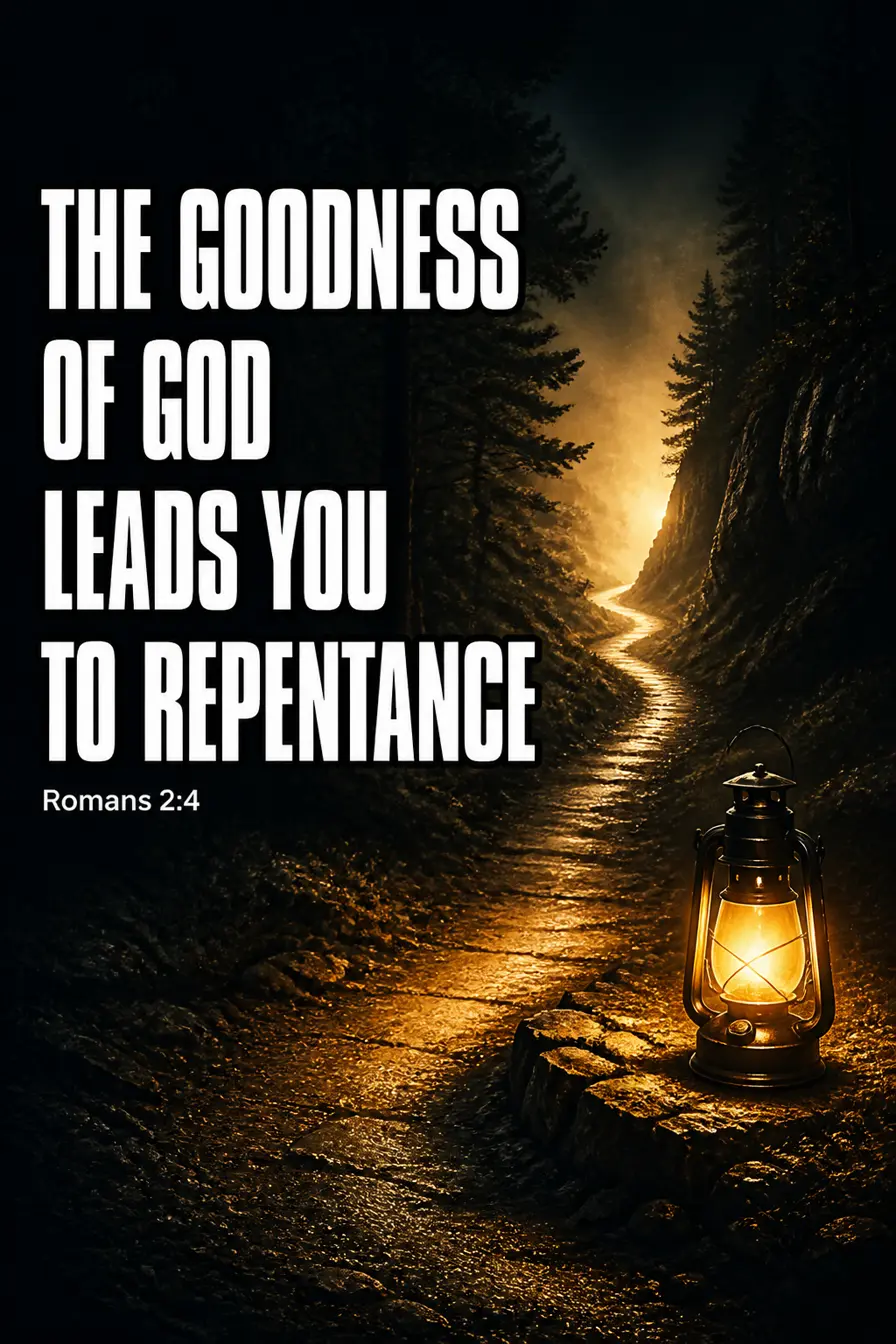
The word translated “kindness” in Galatians 5:22, chrestotes, is the same word Paul uses in Romans 2:4. The World English Bible renders it “goodness” there, but it is the same quality: a useful, generous goodwill toward people who have not earned it.
And look at what it does. It “leads you to repentance”. People are not usually shamed into changing. They are drawn by kindness they did not expect.
That changes how this fruit works in practice. Kindness is not weakness toward people who are in the wrong. It is the very thing God uses to turn them round, and it is how he turned us.
Goodness — Ephesians 5:9: A Rare Word
“for the fruit of the Spirit is in all goodness and righteousness and truth,” — Ephesians 5:9 (WEBU)
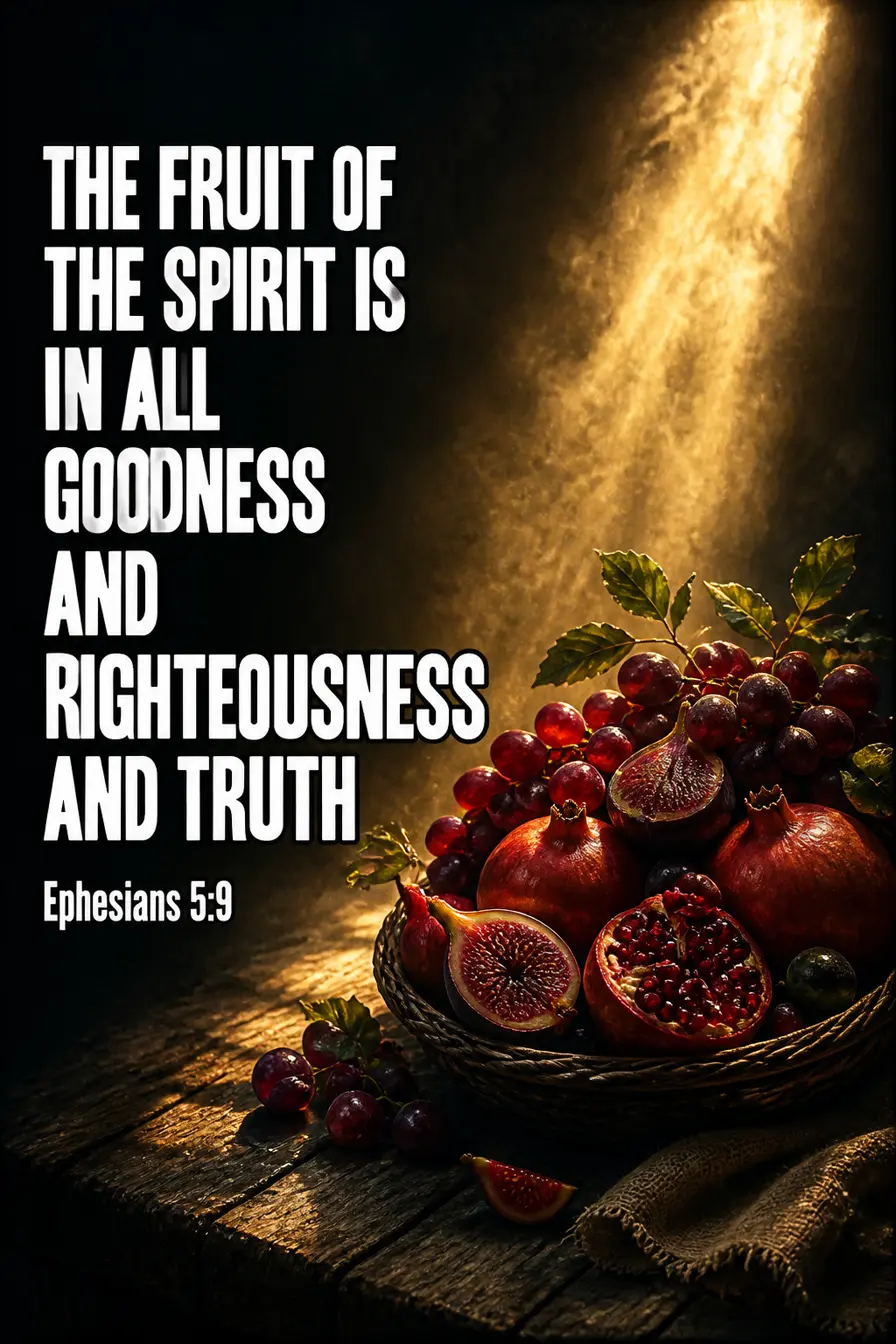
Goodness, agathosune, is one of the rarest words on the list. It appears only four times in the New Testament, and this is one of them. Some manuscripts of Ephesians read “the fruit of the light” here; the text behind the World English Bible reads “the fruit of the Spirit”, the same phrase as Galatians.
Here goodness stands beside righteousness and truth. It is not niceness. It is moral goodness that does the right thing, even when the right thing is uncomfortable.
If kindness is how the fruit treats people, goodness is the backbone underneath it. Both are on the list, and Scripture does not let either one replace the other.
Faith — 2 Timothy 2:13: Faithful When We Are Not
“If we are faithless, he remains faithful; for he can’t deny himself.” — 2 Timothy 2:13 (WEBU)

The World English Bible lists this fruit as “faith”. Many modern translations print “faithfulness”, because the Greek word, pistis, covers both: trusting someone, and being someone others can trust.
In a list of character qualities, the second sense is in view. This is reliability: keeping your word, turning up, being the same person in private as in public.
2 Timothy 2:13 shows where it comes from. God stays faithful even when we are faithless, because faithfulness is who he is. The Spirit grows in us a small copy of that steadiness. If you have let people down, the way back starts from his faithfulness, not yours.
Gentleness — Numbers 12:3: The Most Powerful Man in the Room
“Now the man Moses was very humble, more than all the men who were on the surface of the earth.” — Numbers 12:3 (WEBU)

The Greek word for gentleness in Galatians, prautes, is often translated “meekness”. When Jewish scholars translated the Old Testament into Greek, centuries before Paul, they used the related adjective for Moses here.
Read the verse in context. Moses’ own brother and sister have just turned on him, questioning his leadership. He does not defend himself. And this is the man who confronted Pharaoh and led a nation out of Egypt.
So gentleness in the Bible is not weakness. It is strength that does not need to win every argument. Jesus described himself with the same word: “I am gentle and humble in heart.”
Self-Control — Proverbs 25:28: A City Without Walls
“Like a city that is broken down and without walls is a man whose spirit is without restraint.” — Proverbs 25:28 (WEBU)

The last fruit is enkrateia, self-mastery. Paul uses the related verb elsewhere for athletes in training who exercise self-control “in all things”.
Proverbs gives the picture. In the ancient world a city without walls had no defence. Anything could walk in and take what it wanted. A person with no self-control is the same: every mood, craving and provocation gets straight through.
Notice that self-control closes the list, and that it is listed as fruit, not as willpower. It grows with the others. When love, peace and patience are growing, there is less inside that needs restraining.
How to Use This List
Read Galatians 5:16-26 in one sitting before using the list on its own. Then try three things:
- Read it as a description, not a scorecard. It describes what the Spirit grows, not a test you pass or fail by Sunday.
- Look for the weakest flavour and pray about that one. Because the fruit is one, growth in one area tends to pull the others along.
- Check it against Jesus. Every one of the nine is a description of him first. “By their fruits you will know them,” he said, and this is the fruit he means.
Frequently Asked Questions
What is the Bible verse about the fruit of the Spirit?
Galatians 5:22-23: “But the fruit of the Spirit is love, joy, peace, patience, kindness, goodness, faith, gentleness, and self-control. Against such things there is no law.” The surrounding passage, Galatians 5:16-26, contrasts it with the deeds of the flesh.
What are the 9 fruits of the Spirit?
Love, joy, peace, patience, kindness, goodness, faith (often translated faithfulness), gentleness, and self-control. Paul calls them one fruit, so they grow together rather than one at a time.
Are there 9 or 12 fruits of the Spirit?
Galatians 5:22-23 lists nine. Catholic tradition counts twelve, following the Latin Vulgate’s longer list, which adds long-suffering, modesty and chastity to the nine. The Catechism of the Catholic Church gives that list of twelve.
What is the difference between the fruit and the gifts of the Spirit?
The gifts, listed in 1 Corinthians 12, are abilities the Spirit distributes differently to different people for serving others: teaching, healing, prophecy and more. The fruit is character, and it is meant to grow in every believer. Paul’s point in 1 Corinthians 13 is that gifts without love count for nothing.
Is it fruit or fruits of the Spirit?
The Greek word is singular: fruit. “Fruits of the Spirit” is a common way of referring to the nine qualities, but Paul presents them as one fruit with many aspects, in contrast with the plural “deeds of the flesh”.
How do you grow the fruit of the Spirit?
By staying connected rather than straining harder. Jesus said that whoever remains in him “bears much fruit”, and Paul’s instruction is to “walk by the Spirit”. In practice that means prayer, time in Scripture and life with other believers, and the patience to let fruit take seasons.
Where to Go Next
Read Galatians 5:16-26 today, slowly, and choose one of the nine to pray about this week.
More close readings of single passages sit in the scripture archive, and our famous Bible verses trace twelve more lines back to where they came from, and the twelve sayings in God’s own voice do the same for the lines he speaks.