
There is a particular kind of tiredness that comes from carrying something somebody did to you. It surfaces at odd hours — in the shower, in traffic, halfway through a film — and you are back in the same conversation, arguing your case to somebody who is not in the room. We have all already won that argument a hundred times. It changes nothing.
What tends to arrive at that point is a list. Bible verses on forgiveness, handed over as an instruction to feel differently — and quickly — about someone who has hurt you badly. That is not what these passages do. Most of them were written to people still standing in the damage, and they care far more about what forgiveness is than about hurrying anyone through it.
Two things worth saying plainly before the list. Forgiveness is not the same as reconciliation — one is something you do, the other needs two people. And it never requires staying somewhere you are being harmed.

The Power to Start Again
Rise after failure. Experience restoration and second chances.John 21 · 14 min
That was just the opening. Open the app and search #006 to hear the full 14-minute story — free.
Keep listening free in the app Free on iOS & Android — no sample needed

What God Actually Does With What You Did
Every command to forgive in the New Testament is built on something already done. So the honest place to start is not with your obligation but with the pardon it copies.
Psalm 103:12 — The One Direction That Never Closes
“As far as the east is from the west, so far has he removed our transgressions from us.” — Psalm 103:12 (WEBU)
The geography is the argument. Travel north far enough and you cross the pole and start heading south — north and south meet. East and west never do; keep going east and you simply keep going east, for ever. David picks the one pair of directions with no meeting point. And the psalm is careful about why: a few lines later it says God remembers that we are dust. This is not a pardon issued because the offence was small. It is issued by someone with no illusions about what he is pardoning.

Isaiah 1:18 — An Invitation Issued in a Courtroom
““Come now, and let’s reason together,” says the LORD: “Though your sins are as scarlet, they shall be as white as snow. Though they are red like crimson, they shall be as wool.” — Isaiah 1:18 (WEBU)
The line just before this one is a summons: come now, and let’s reason together. Isaiah 1 is laid out as a legal case against a nation, with the charges read aloud — and then, mid-indictment, the judge offers to talk it through. The colours matter too. Scarlet and crimson name a dye that was chosen precisely because it did not come out; it was the stain you could not launder away. The promise is not that the stain was never that bad. It is that the one thing known for being permanent is not.

Micah 7:19 — Where the Book Chooses to End
“He will again have compassion on us. He will tread our iniquities under foot. You will cast all their sins into the depths of the sea.” — Micah 7:19 (WEBU)
Micah spends most of his book on judgment — corrupt courts, rigged scales, leaders selling verdicts — and then ends here, with sins thrown into deep water. The question that opens this last section is a pun on the prophet’s own name: Micah means “who is like the LORD”, and he signs off by asking exactly that. Note the verb, as well. Nothing is misplaced or overlooked; it is thrown, deliberately, somewhere nothing is recovered from. Where God is concerned, the file is not archived. It is sunk.

1 John 1:9 — Forgiveness Described as Justice
“If we confess our sins, he is faithful and righteous to forgive us the sins and to cleanse us from all unrighteousness.” — 1 John 1:9 (WEBU)
Read the adjectives again, because they are not the ones anybody expects. Not merciful, not generous — faithful and righteous. John is writing to a church being told by confident teachers that sin was not really their problem, and his answer treats forgiveness as a matter of God keeping his word rather than relaxing his standards. That changes what confession is for. You are not talking him into it against his better judgement. You are naming something out loud that he has already committed himself to deal with.

Romans 8:1 — A Sentence That Answers the Previous Page
“There is therefore now no condemnation to those who are in Christ Jesus, who don’t walk according to the flesh, but according to the Spirit.” — Romans 8:1 (WEBU)
The chapter break was added centuries after Paul wrote, and it lands in an unhelpful place. Romans 7 ends with a man losing an argument with himself — doing what he hates, unable to explain it, asking who will rescue him. This is the reply, and it arrives without a gap. Notice the word now. Not eventually, not once you have improved. If the thing you cannot forgive is something you did, this is the verse that has your name on it. Read it as a verdict already handed down, not as a mood to work yourself into.

The Command That Follows From It
Only now does the instruction make sense. Every passage below points back at something the reader has already received.
Ephesians 4:32 — The Measure Is in the Last Three Words
“And be kind to one another, tender hearted, forgiving each other, just as God also in Christ forgave you.” — Ephesians 4:32 (WEBU)
The sentence is built in an order worth copying. Kindness first, then tenderness, then forgiveness — the small things come before the large one, which is roughly how it works in practice. But the weight sits at the end: just as. The standard is not what feels proportionate to the offence; it is what was extended to you. Paul is writing to a congregation of people from wildly different backgrounds who had every reason to resent each other, and he does not ask them to like each other first.
Colossians 3:13 — Bearing With Is Not the Same as Forgiving
“bearing with one another, and forgiving each other, if any man has a complaint against any; even as Christ forgave you, so you also do.” — Colossians 3:13 (WEBU)
Two separate instructions sit in this line, and running them together causes a lot of unnecessary pain. Forgiving deals with a wrong. Bearing with deals with a person — the habits, the bluntness, the way somebody tells a story twice. Most friction inside a family or a church is the second kind, and it does not need pardon at all; it needs tolerance. Sorting which one you are facing is half the work, and most of us get it wrong in the same direction: we grant a solemn forgiveness for something that only ever required patience.

Matthew 6:14-15 — The One Line Jesus Doubles Back On
““For if you forgive men their trespasses, your heavenly Father will also forgive you. But if you don’t forgive men their trespasses, neither will your Father forgive your trespasses.” — Matthew 6:14-15 (WEBU)
Look at where this sits. Jesus has just finished teaching the Lord’s Prayer, and out of everything in it — daily bread, the kingdom, deliverance — he goes back and comments on exactly one petition: the one about forgiving. Nothing else gets a footnote. That placement is the point, and it is uncomfortable by design. This is not a threat that God withholds pardon on a technicality. It is a description of what an unforgiving grip does to the hand that would otherwise be open to receive.

Matthew 18:21-22 — Peter Was Being Generous
“Then Peter came and said to him, “Lord, how often shall my brother sin against me, and I forgive him? Until seven times?” Jesus said to him, “I don’t tell you until seven times, but, until seventy times seven.” — Matthew 18:21-22 (WEBU)
Peter is not being stingy here. He picks seven, a number heavy with completeness, and offers it as a stretch — you can hear him expecting to be commended. The answer he gets, seventy times seven, is not a higher quota. It is the end of quotas: any number you could keep track of is the wrong kind of answer, because counting is itself the problem. And this exchange does not float free. It sits directly after instructions on confronting someone who has wronged you, and directly before a story about a man forgiven an unpayable debt who then throttles a neighbour over a small one.
When It Will Not Come
Some of this cannot be done by deciding to do it. These last two are for the days when the willingness is not there yet.
Mark 11:25 — Attached to Prayer, Not to Feelings
“Whenever you stand praying, forgive, if you have anything against anyone; so that your Father, who is in heaven, may also forgive you your transgressions.” — Mark 11:25 (WEBU)
Standing was the ordinary posture for prayer, so this is not describing a special occasion — it is describing Tuesday. What surrounds it is stranger: Jesus has just cleared the temple and withered a fig tree, and is talking about prayer that moves mountains. Then, without warning, he attaches this. The practical value is the trigger. Forgiveness here is not something you attempt when you finally feel ready; it is something bolted to a routine you already have. You pray, so you forgive. The feelings are invited along, not waited for.
Luke 23:34 — Said More Than Once
“Jesus said, “Father, forgive them, for they don’t know what they are doing.” Dividing his garments among them, they cast lots.” — Luke 23:34 (WEBU)
The Greek verb here is the one used for something ongoing rather than a single utterance — closer to he kept saying than he said. Not a line delivered once and finished, but something repeated while the nails went in. That matters if forgiveness has failed to stick for you: the pattern being modelled is repetition, not a single successful act of will. Luke also puts the sentence about the soldiers gambling for his clothes immediately after, with no comment. He is forgiving people who are, at that moment, still doing it.
The Longest Forgiveness in the Bible
Every passage above is short. The one narrative that shows forgiveness happening across a life is Joseph’s, and the useful thing about it is that Genesis dates it.
He is seventeen when his brothers sell him. He is thirty when he stands before Pharaoh, and the reunion comes seven years of plenty and two years of famine after that — so twenty-two years pass between the pit and the moment he tells them who he is. Then his father lives another seventeen years in Egypt, and the last conversation in the book happens after that. Nearly four decades, and Joseph forgives more than once.
The tell is the weeping. He cries seven times in the story, and the tears track how far along he is.
“He turned himself away from them, and wept. Then he returned to them, and spoke to them, and took Simeon from among them, and bound him before their eyes.” — Genesis 42:24 (WEBU)
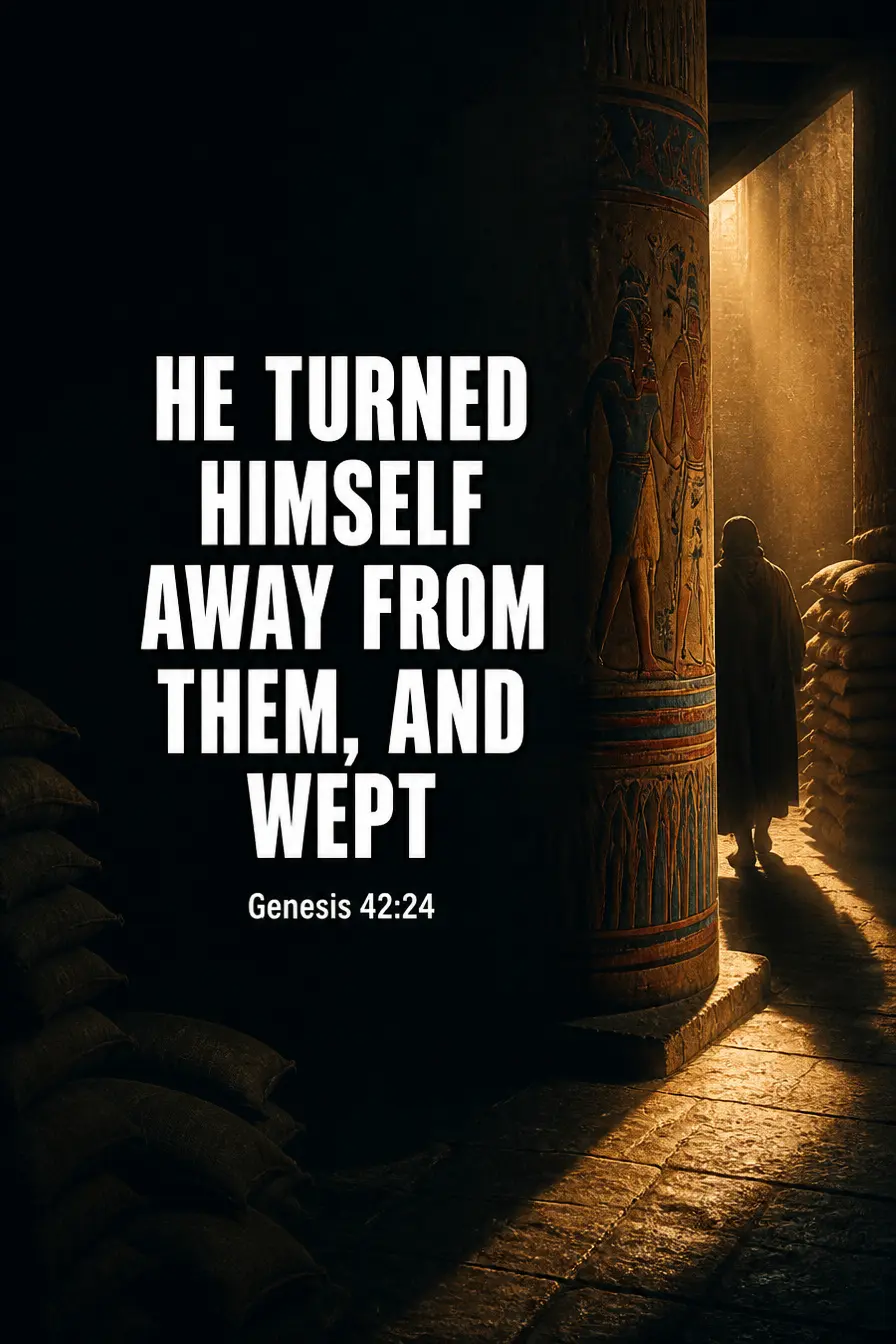
The first tears are hidden, and note what he does immediately after drying them: he binds Simeon and keeps him. Grief and a hard decision in the same paragraph. Whatever is going on in him, it has not yet resolved into either revenge or release.
“Joseph hurried, for his heart yearned over his brother; and he sought a place to weep. He entered into his room, and wept there.” — Genesis 43:30 (WEBU)

“He sought a place to weep.” He is the second most powerful man in Egypt and he has to go and find a room. There is a version of this you will recognize — holding it together in front of the people it concerns, then losing it somewhere private afterwards.
“He wept aloud. The Egyptians heard, and the house of Pharaoh heard.” — Genesis 45:2 (WEBU)

The third time, it is not private any more. He has cleared the room of every Egyptian official and then cries loudly enough that they hear it through the wall and report it to the palace. Twenty-two years of holding a thing in, ending in a noise the neighbours can hear.
“Joseph said to his brothers, “Come near to me, please.” They came near. He said, “I am Joseph, your brother, whom you sold into Egypt.” — Genesis 45:4 (WEBU)

Read what he actually says. “Come near to me” and “whom you sold into Egypt”, in the same breath. He does not soften the sentence, and he does not use it as a weapon either. The wrong is named accurately and the invitation is issued anyway — which is the shape the practice below is trying to reproduce.
“Now don’t be grieved, nor angry with yourselves, that you sold me here, for God sent me before you to preserve life.” — Genesis 45:5 (WEBU)

This is not a claim that what they did was fine. It is a claim about what God did with it afterwards, and the two are different sentences. Joseph never revises the history. He revises what the history is now for.
And then the passage almost nobody quotes, seventeen years later, after their father dies.
“When Joseph’s brothers saw that their father was dead, they said, “It may be that Joseph will hate us, and will fully pay us back for all the evil which we did to him.”” — Genesis 50:15 (WEBU)

Seventeen years of living in the land he gave them, eating food he provided, and they have spent every one of those years waiting for the bill. They assume the only thing holding him back was their father.
So they invent a message. The text gives them a deathbed instruction from Jacob that Jacob is never recorded as giving.
“‘You shall tell Joseph, “Now please forgive the disobedience of your brothers, and their sin, because they did evil to you.”’ Now, please forgive the disobedience of the servants of the God of your father.” Joseph wept when they spoke to him.” — Genesis 50:17 (WEBU)

“Joseph wept when they spoke to him.” Four decades on, and the thing that breaks him is not the original crime. It is being asked for something he had already given, by people who never believed him. That is the cost the word powerful usually hides: the forgiver can complete the work and still not be trusted, and there is no version of this where he can make them believe it.
What he says next is not a speech about how he feels.
“Joseph said to them, “Don’t be afraid, for am I in the place of God?” — Genesis 50:19 (WEBU)
“Am I in the place of God?” It is a question about jurisdiction. He is not saying the debt was small or that he has stopped minding. He is saying the collecting was never his job — and the next verse has him promising to feed them and their children, which is what release looks like when it has run out of words.
One Practice, Not Four Steps
Forgiveness is usually presented as a single decision, which is why so many of us conclude we have failed at it. Mark 11:25 suggests something slower and more repeatable: attach it to praying, and expect to do it again.
A prayer for forgiveness works the same way in both directions, and it starts with a name. Not “the situation” or “what happened at work” — the actual name of the actual person. Vagueness is where resentment hides, and it is very comfortable there.
Say what was taken. One sentence, specific, no case for the prosecution: the money, the years, the trust, the version of your life that did not happen. This is the step people skip, and skipping it is why the forgiveness feels fake. You cannot release a debt you have refused to state.
Hand over the right to collect it. Not the right to be angry, and not your judgement about whether it was wrong — those are yours and they are accurate. What you are giving up is the collecting: the arguing in the shower, the imagined confrontation, the wish that they get theirs.
Then expect it back. It will return, probably within the week, and that is not failure — that is what “seventy times seven” was describing. Do the same three lines again. Over months the returns get further apart, which is what healing actually looks like from the inside. If the wound is a deep one, Bible Verses About Forgiving Others (Even When It’s Hard) stays with that difficulty for longer, and Bible Verses About God’s Forgiveness and Grace is the place to go when the person you cannot pardon is yourself.
More Bible Verses About Forgiveness
The passages above carry the argument. These are the rest of the verses on forgiveness people look for, each with the line that makes it worth having — what to pray when you ask for forgiveness, and what the Bible says about forgiveness you are the one giving.
“I acknowledged my sin to you. I didn’t hide my iniquity. I said, I will confess my transgressions to the LORD, and you forgave the iniquity of my sin. Selah.” — Psalm 32:5 (WEBU)
“I acknowledged my sin to you and did not cover up my iniquity. I said, I will confess my transgressions to the LORD — and you forgave the guilt of my sin.” Three words for the same thing in one verse, which is David refusing to let one euphemism carry it.
“He who conceals his sins doesn’t prosper, but whoever confesses and renounces them finds mercy.” — Proverbs 28:13 (WEBU)
Whoever conceals their sins does not prosper, but the one who confesses and renounces them finds mercy. Two verbs, not one: confessing without renouncing is a report, not a change.
“They will no longer each teach his neighbor, and every man teach his brother, saying, ‘Know the LORD;’ for they will all know me, from their least to their greatest,” says the LORD, “for I will forgive their iniquity, and I will remember their sin no more.”” — Jeremiah 31:34 (WEBU)
“I will forgive their wickedness and will remember their sin no more,” declares the LORD. It is the closing line of the new-covenant promise, and Hebrews quotes it twice.
“I, even I, am he who blots out your transgressions for my own sake; and I will not remember your sins.” — Isaiah 43:25 (WEBU)
“I am he who blots out your transgressions, for my own sake, and remembers your sins no more.” That middle clause is the one that gets skipped. The pardon is not issued because of anything recommending you.
“Who is a God like you, who pardons iniquity, and passes over the disobedience of the remnant of his heritage? He doesn’t retain his anger forever, because he delights in loving kindness.” — Micah 7:18 (WEBU)
Who is a God like you, who pardons sin and forgives the transgression of the remnant of his inheritance? He does not stay angry forever but delights to show mercy.
“Peter said to them, “Repent and be baptized, every one of you, in the name of Jesus Christ for the forgiveness of sins, and you will receive the gift of the Holy Spirit.” — Acts 2:38 (WEBU)
Peter said, repent and be baptized, every one of you, in the name of Jesus Christ for the forgiveness of your sins, and you will receive the gift of the Holy Spirit. It is the first sermon after Pentecost, preached to a crowd that had been part of the execution six weeks earlier.
“In him we have our redemption through his blood, the forgiveness of our trespasses, according to the riches of his grace” — Ephesians 1:7 (WEBU)
In him we have redemption through his blood, the forgiveness of sins, in accordance with the riches of God’s grace.
“Let all bitterness, wrath, anger, outcry, and slander be put away from you, with all malice.” — Ephesians 4:31 (WEBU)
“Get rid of all bitterness, rage and anger, brawling and slander, along with every form of malice.” Paul lists five things in escalating volume — bitterness is silent, wrath and anger and clamor and slander get progressively louder — and then the verse after it is the one about being kind and compassionate to one another.
“Be careful. If your brother sins against you, rebuke him. If he repents, forgive him.” — Luke 17:3 (WEBU)
If your brother or sister sins against you, rebuke them; and if they repent, forgive them. The rebuke is commanded as well as the pardon, which rules out the reading where forgiving means saying nothing.
“If he sins against you seven times in the day, and seven times returns, saying, ‘I repent,’ you shall forgive him.”” — Luke 17:4 (WEBU)
Seven times in a day. Luke’s version puts the same number Peter offered into a single afternoon, which makes the arithmetic feel less theoretical.
“Then his lord called him in and said to him, ‘You wicked servant! I forgave you all that debt because you begged me.” — Matthew 18:32 (WEBU)
“I forgave you all that debt because you begged me.” The parable that follows Peter’s question turns on the size difference: a debt no wage could clear against a sum worth about a hundred days’ work.
“Confess your sins to one another and pray for one another, that you may be healed. The insistent prayer of a righteous person is powerfully effective.” — James 5:16 (WEBU)
Confess your sins to each other and pray for each other so that you may be healed. The prayer of a righteous person is powerful and effective. James puts confession between people rather than only between a person and God.
A note on wording, since it causes confusion here more than anywhere. These quotations are the World English Bible, which is in the public domain, and most readers know these lines in the NIV or the ESV instead. The sense is identical every time; only the English differs. The ones people notice:
- Isaiah 1:18 reads “let us reason together” or “let us argue it out” elsewhere, and “though your sins are like scarlet… they shall be like wool” where this text has as scarlet and as wool. Red as crimson is the same phrase either way.
- 1 John 1:9 is best known as “he is faithful and just to forgive us our sins” — this text’s “faithful and righteous” translates the same word.
- Ephesians 4:32 is usually “be kind and compassionate to one another, tenderhearted, forgive one another, as in Christ God forgave you”, where this page reads tender hearted and forgiving each other.
- Colossians 3:13 commonly runs “if anyone has a complaint against another… as the Lord has forgiven you, so you also must forgive”.
- Matthew 6:14 is “if you forgive others their trespasses, your heavenly Father will also forgive you”, and Mark 11:25 “so that your Father in heaven may forgive you your trespasses”.
- Ephesians 4:31 lists “bitterness and wrath and anger and clamor and slander be put away from you” where this text says outcry.
- Acts 2:38 is “repent and be baptized every one of you in the name of Jesus Christ”, which is exactly what the line above says once the commas are read past.
Frequently Asked Questions
What does the Bible say about forgiveness when the person is not sorry?
Scripture never makes an apology the condition. What the Bible says about forgiveness is that it is released by the one who was wronged, whether or not the other person ever turns to God or to you. Luke 23:34 is spoken over people mid-offence who have not asked for anything, and Mark 11:25 attaches forgiveness to your prayer rather than to their repentance. Repentance is what reconciliation needs — the relationship being restored. Forgiveness is what you release regardless, and the two are not the same transaction.
Does forgiving mean you have to trust them again?
No. Trust is rebuilt by changed behaviour over time; forgiveness is given without waiting for that. Scripture treats consequences and pardon as compatible — the debt is released, the arrangements can still change. Forgiving someone does not oblige you to hand them the same access, the same responsibility, or the same place in your life.
How many times does the Bible say to forgive?
Jesus answers this directly in Matthew 18:22: seventy times seven, which is a refusal to give a number rather than a large one. Peter had offered seven and expected praise. The point is that a running total is the wrong instrument — anyone still counting has not really let go of anything.
What if you have forgiven and still feel angry?
That is normal and it is not evidence of failure. Forgiveness is a decision about what you will do with a debt, not a feeling that arrives on schedule; anger often lingers long after the decision is genuinely made. Repeat the same act when it resurfaces. If the memories are intrusive or the anger is affecting your health, talk to a professional as well.
Where to Take This Next
That is the whole importance of forgiveness as Scripture frames it: not a feeling you turn on, but a debt you stop collecting. Being able to forgive comes from having been forgiven — you show mercy to others out of the mercy already shown, which is why every command above points backwards before it points at you.
Pick the one name that came to mind while you were reading — you already know which. Do not try to resolve it tonight. Say the name, say what it cost, and hand over the collecting, then expect to do it again on Thursday.
More on this across the whole span, from being pardoned to pardoning, is in the forgiveness archive, and Bible Verses About Reconciliation and Forgiveness takes up the harder question of what happens when the other person is still in the room.