Guilt keeps its own calendar. Years after the thing itself, a smell or a name or a quiet Tuesday afternoon brings the whole file back, and the sentence that was supposed to settle it — God has forgiven you — sounds like something kind people say. That gap is not weak faith. It is the ordinary distance between being handed a verdict and being shown the evidence behind it.
Which is why the Bible verses about forgiveness of sins are worth reading in the order Scripture puts them. The Bible does not only announce that God forgives. It argues the case. One New Testament letter in particular, Hebrews, spends chapters building that argument, and the whole thing turns on a detail so small that most readers walk straight past it: what a priest did with his body once the work was finished.
Every priest under the old system stood. This one sat down.
What follows tracks that argument from a goat walking into open desert to a seat at God’s right hand, and it ends where you actually are — with what to do about a conscience that will not stay quiet.

Rise after failure. Experience restoration and second chances.John 21 · 14 min
That was just the opening. Open the app and search #006 to hear the full 14-minute story — free.
Keep listening free in the app Free on iOS & Android — no sample needed

The Old System Was Built to Keep the Account Open
Most people assume the animal sacrifices of the Old Testament removed sin, and that Jesus did the same job better. The writer of Hebrews says something stranger. The old sacrifices were never meant to close the account. They were designed to keep reading it out loud.
Hebrews 10:3 — The Sacrifices Were a Reminder, Not an Eraser
“But in those sacrifices there is a yearly reminder of sins.” — Hebrews 10:3 (WEBU)
Once a year, on the Day of Atonement, the nation of Israel stopped everything and watched the high priest work through a long, exact ritual. Ask most readers what that day accomplished and they will say it wiped the slate. The letter says the opposite: the day existed to remind. Every autumn, the same ceremony told the same people the same thing about the same debt. A receipt you have to reprint every twelve months is not a receipt. It is a statement of what is still owed.

Two verses earlier he has already said why the system could not finish: the law was “having a shadow of the good to come, not the very image of the things” (Hebrews 10:1, WEBU), and a shadow only tells you the shape of something real that has not arrived yet.
Then comes the blunt line:
“For it is impossible that the blood of bulls and goats should take away sins.” — Hebrews 10:4 (WEBU)
Not insufficient. Not partial. Impossible. The writer is not lowering the value of the old ceremonies; he is telling you what they were for. They were a promissory note, and a note is only ever a picture of the payment.
The Day Two Goats Were Chosen and Only One of Them Died
The ceremony behind all of this is worth knowing in detail, because it is where the Bible’s picture of forgiveness of sins gets its physical shape. It is described in Leviticus 16, and it involved two animals.
“Aaron shall cast lots for the two goats: one lot for the LORD, and the other lot for the scapegoat.” — Leviticus 16:8 (WEBU)
One goat was killed. The other was not. What happened to the second one is the part people forget.
Leviticus 16:21 — Both Hands on the Head
“Aaron shall lay both his hands on the head of the live goat, and confess over him all the iniquities of the children of Israel, and all their transgressions, even all their sins; and he shall put them on the head of the goat, and shall send him away into the wilderness by the hand of a man who is ready.” — Leviticus 16:21 (WEBU)
Read the physical instruction slowly. Not a touch. Not a wave. Both hands, pressed down, while the words were said out loud over a living animal. The gesture is a transfer, and the text says so plainly: he shall put them on the head of the goat. A man was appointed in advance to walk it out.
Notice too how the sentence piles up. All the iniquities. All their transgressions. Even all their sins. Three words for going wrong, each stacked with “all”. Whoever wrote this was closing every loophole a guilty person might look for, which means there is no drawer in your own history the picture was not built to hold.
Leviticus 16:22 — Carried to a Place With No Road Back
“The goat shall carry all their iniquities on himself to a solitary land, and he shall release the goat in the wilderness.” — Leviticus 16:22 (WEBU)
“A solitary land” means a place where nobody lives. The animal was not killed and it was not kept. It was walked out past the edge of the camp and let go somewhere no Israelite had any reason to travel, carrying a load that was no longer anybody’s to fetch back.
The sin was not merely covered while remaining in the room. It was put somewhere unreachable, in a direction nobody would follow. And the word the text uses for the goat’s departure is release — the animal goes free carrying exactly what the people were set free from.
Isaiah 53:6 — The Verse That Names Who the Goat Was
“All we like sheep have gone astray. Everyone has turned to his own way; and the LORD has laid on him the iniquity of us all.” — Isaiah 53:6 (WEBU)
Isaiah was writing centuries before the New Testament, in a nation that had watched that ceremony every year for generations. His readers knew exactly what “laid on him” meant, because they had seen hands pressed down on a goat’s head and heard sins named over it.
Then Isaiah changes one thing. The load does not go onto an animal chosen by lot. It goes onto a person, described in the surrounding chapter as wounded, rejected and silent under it. Christians have read that chapter as a description of Jesus from the very beginning — one of the earliest recorded conversations about it, in Acts 8, is an Ethiopian official reading this exact page and asking who it is about.
The Detail the Whole Argument Turns On
Here is where Hebrews sets two sentences side by side and lets the difference do the work. They are consecutive verses. Read them one after the other and watch the verbs.
Hebrews 10:11 — Every Priest Stands
“Every priest indeed stands day by day serving and offering often the same sacrifices, which can never take away sins,” — Hebrews 10:11 (WEBU)
Stands day by day. A priest’s working life was spent upright, because the job never reached an end: another morning, another offering, another queue of people with another year of wrong behind them. The verse then closes with the flat assessment we already met — these sacrifices can never take away sins — so you are not left hoping the standing might eventually pay off. The writer gives you the outcome before you can invest in it.

Hebrews 10:12 — And This One Sat Down
“but he, when he had offered one sacrifice for sins forever, sat down on the right hand of God,” — Hebrews 10:12 (WEBU)
One posture, and the argument is over. Sitting down is what you do when the work is done. Nobody sits in the middle of a job that still needs finishing, and no priest in the old ceremony ever did.
Count the limits removed in that half-sentence. One sacrifice, not a series. For sins, plural and unnamed, so the offering is not itemised against a list you might exceed. Forever, so there is no renewal date. Then the posture, which is the writer’s way of saying that the question of your forgiveness is not currently being processed. It was settled, and the one who settled it sat down.

An earlier chapter says the same about the room he entered: through his own blood he “entered in once for all into the Holy Place, having obtained eternal redemption” (Hebrews 9:12, WEBU). “Having obtained” is finished action. If you are waiting to feel forgiven before you believe you are, that verse puts the sequence the other way round.
Scripture Describes Forgiveness of Sins as a Transaction
One of the quietest surprises in these passages is the vocabulary. When the New Testament writers describe what happened to your sin, they keep reaching for the language of debt, ledgers and courtrooms. That is not decoration. It is how you talk about something with a fixed amount and a settled outcome.
Colossians 2:14 — The Handwritten Note of Debt
“wiping out the handwriting in ordinances which was against us. He has taken it out of the way, nailing it to the cross.” — Colossians 2:14 (WEBU)
“The handwriting” is the giveaway. In the ancient world a debt was recorded in a note written out by hand, often signed by the debtor, so nobody could dispute whose obligation it was. That is the object Paul has in view: a written record, in your own hand, of what you owe.
He says three things happen to it, and they escalate. It is wiped out. It is taken out of the way. And then it is nailed up in public, on the same cross where the debt was paid, where anybody walking past can read that it has been settled. Paul is not describing a quiet mercy that hopes nobody asks questions. He is describing a closed account posted where the whole street can see it.

The verse before it is worth having as well, because it names who was carrying the note: “You were dead through your trespasses and the uncircumcision of your flesh. He made you alive together with him, having forgiven us all our trespasses” (Colossians 2:13, WEBU).
Romans 4:8 — A Line the Ledger Will Not Carry
“Blessed is the man whom the Lord will by no means charge with sin.”” — Romans 4:8 (WEBU)
“Charge” is an accounting verb — to enter an amount against a name. Paul is quoting David here, from a psalm written a thousand years earlier: “Blessed is he whose disobedience is forgiven, whose sin is covered” (Psalm 32:1, WEBU). Two men, separated by a millennium, both reaching for the same picture.
The strength of the phrase is in “by no means”. Not a charge that is reduced, deferred, or written off with a note in the margin. There is no mechanism left by which the entry gets made. This is what the Bible means by the forgiveness of sins: not a generous creditor who keeps the file open, but an account where the line cannot be written.

2 Corinthians 5:21 — The Exchange Runs Both Ways
“For him who knew no sin he made to be sin on our behalf, so that in him we might become the righteousness of God.” — 2 Corinthians 5:21 (WEBU)
Most descriptions of forgiveness stop halfway: your record is cleared, and you are left standing at zero. Paul says the traffic moves in both directions. Something went onto Jesus, and something came back to you.
A cleared record still leaves you with nothing to your name. Paul’s claim is that you are not returned to neutral but given a standing that was never yours to earn. A few verses earlier he uses another ledger word for the same event — God was “not reckoning to them their trespasses” (2 Corinthians 5:19, WEBU) — and reckoning is simply counting up.

What God Promises to Do With the Memory
Go back to Hebrews 10:3 for a moment — the yearly reminder of sins. Now read what the same chapter says God has promised instead. The two sentences are pointed at each other.
Hebrews 10:17 — Remember No More
““I will remember their sins and their iniquities no more.”” — Hebrews 10:17 (WEBU)
This is a quotation, and knowing that changes how it lands. The writer is citing a promise God made through the prophet Jeremiah, hundreds of years earlier, about a new covenant he intended to make; the same words appear back in Hebrews 8:12.
So the old system produced an annual reminder, and the promise attached to the new one is its exact reverse. God is not saying his memory has failed. He is saying he has committed himself to never raising it again — which is what a person means when they tell you a matter is closed between the two of you.

Hebrews 10:18 — The Sentence That Ends the Argument
“Now where remission of these is, there is no more offering for sin.” — Hebrews 10:18 (WEBU)
“Remission” is an old word for cancellation — the same one still used when a debt or a disease is said to be in remission. The logic is tight enough to feel almost mathematical: if the thing has been cancelled, there is nothing left to bring an offering for.
This is why the New Testament never asks a Christian to produce another sacrifice for sin. Not a better year. Not a stretch of penance to make the forgiveness stick. Whatever you were planning to offer God to finally settle this, the letter rules it out — not because your offering is unwelcome, but because it would be payment on an account that no longer exists.
The Same Promise, Drawn in Pictures
Hebrews argues the case in the vocabulary of a courtroom and a ledger. Long before the letter was written, the same promise was already being made in images — a compass, a dye, deep water. They are the verses most people can half-quote, and they are making the argument this letter formalises.
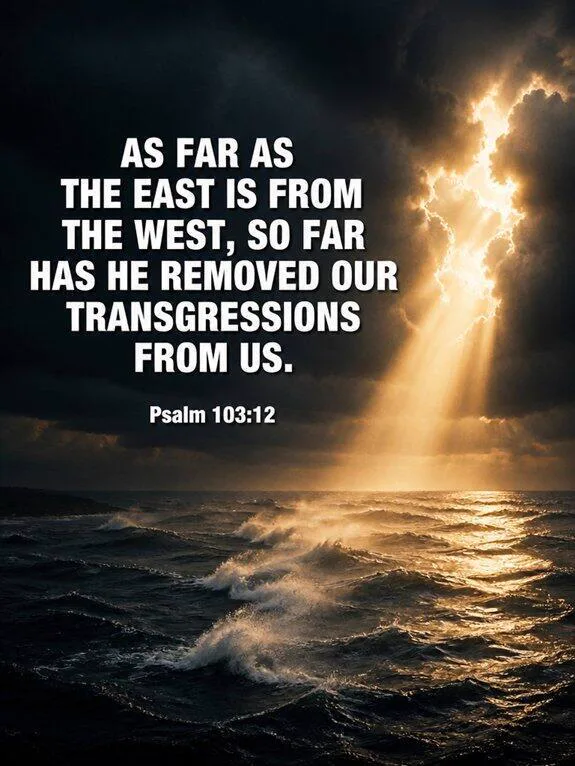
Psalm 103:12 — The One Direction That Never Closes
“As far as the east is from the west, so far has he removed our transgressions from us.” — Psalm 103:12 (WEBU)
The geography is the argument. Travel north far enough and you cross the pole and start heading south — north and south meet. East and west never do; keep going east and you simply keep going east, for ever. David picks the one pair of directions with no meeting point. And the psalm is careful about why: a few lines later it says God remembers that we are dust. This is not a pardon issued because the offence was small. It is issued by someone with no illusions about what he is pardoning.
Isaiah 1:18 — An Invitation Issued in a Courtroom
““Come now, and let’s reason together,” says the LORD: “Though your sins are as scarlet, they shall be as white as snow. Though they are red like crimson, they shall be as wool.” — Isaiah 1:18 (WEBU)
Isaiah 1 is laid out as a legal case against a nation, with the charges read aloud — and then, mid-indictment, the judge offers to talk it through. The colours matter too. Scarlet and crimson name a dye chosen precisely because it did not come out; it was the stain you could not launder away. The promise is not that the stain was never that bad. It is that the one thing known for being permanent is not.

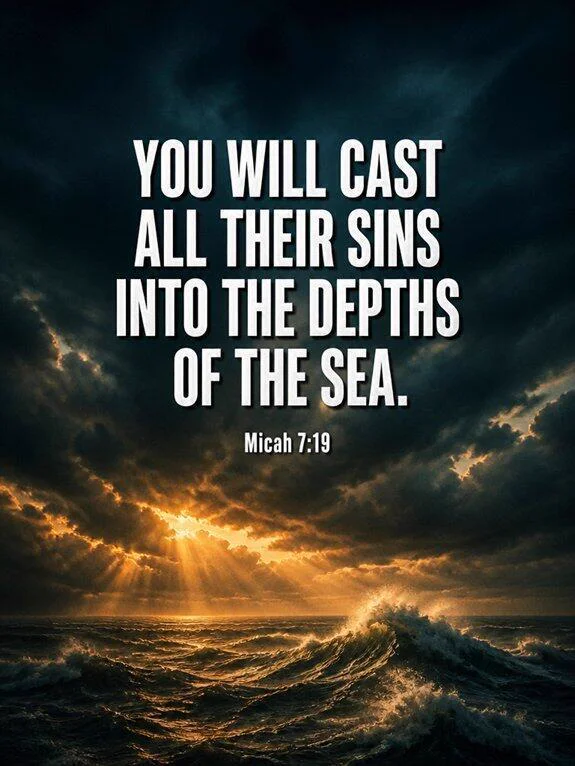
Micah 7:19 — Where the Book Chooses to End
“He will again have compassion on us. He will tread our iniquities under foot. You will cast all their sins into the depths of the sea.” — Micah 7:19 (WEBU)
Micah spends most of his book on judgment — corrupt courts, rigged scales, leaders selling verdicts — and then ends here, with sins thrown into deep water. The question that opens this last section is a pun on the prophet’s own name: Micah means “who is like the LORD”, and he signs off by asking exactly that. Note the verb, as well. Nothing is misplaced or overlooked; it is thrown, deliberately, somewhere nothing is recovered from. Where God is concerned, the file is not archived. It is sunk.
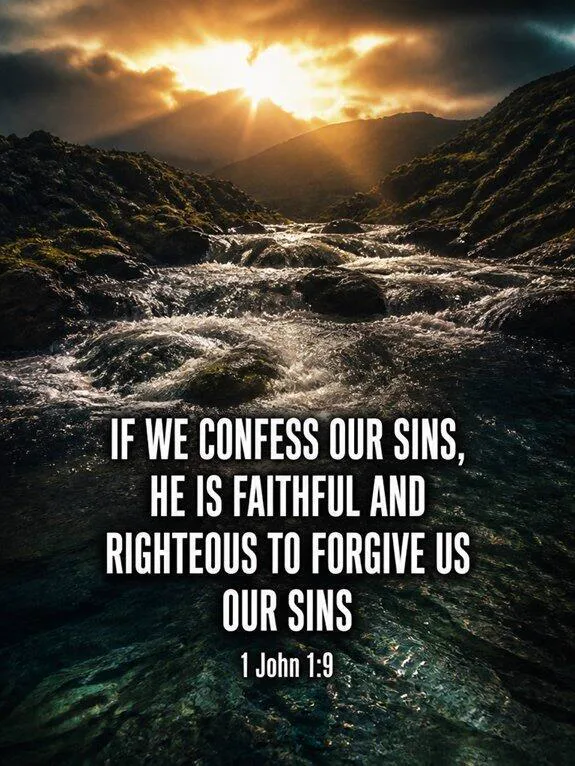
1 John 1:9 — Forgiveness Described as Justice
“If we confess our sins, he is faithful and righteous to forgive us the sins and to cleanse us from all unrighteousness.” — 1 John 1:9 (WEBU)
Read the adjectives again, because they are not the ones anybody expects. Not merciful, not generous — faithful and righteous. John is writing to a church being told by confident teachers that sin was not really their problem, and his answer treats forgiveness as a matter of God keeping his word rather than relaxing his standards. That changes what confession is for. You are not talking him into it against his better judgement. You are naming out loud something he has already committed himself to deal with.
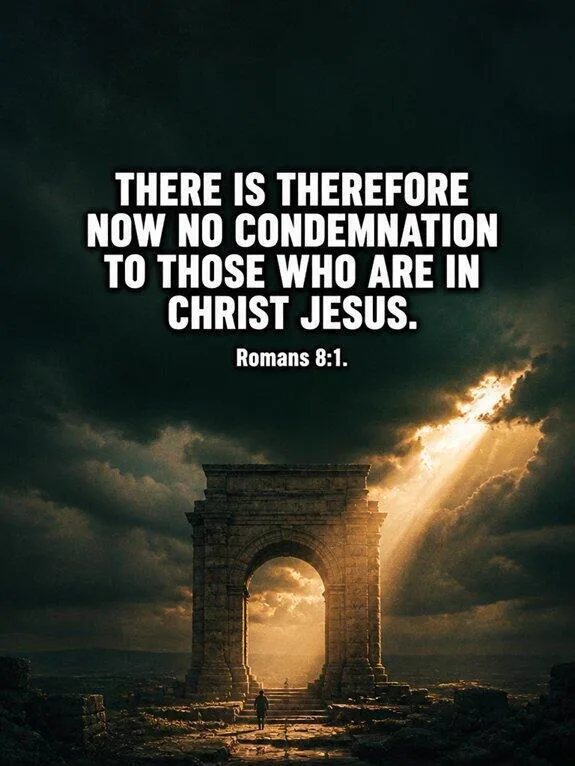
Romans 8:1 — A Sentence That Answers the Previous Page
“There is therefore now no condemnation to those who are in Christ Jesus, who don’t walk according to the flesh, but according to the Spirit.” — Romans 8:1 (WEBU)
The chapter break was added centuries after Paul wrote, and it lands in an unhelpful place. Romans 7 ends with a man losing an argument with himself — doing what he hates, unable to explain it, asking who will rescue him. This is the reply, and it arrives without a gap. Notice the word now. Not eventually, not once you have improved. Read it as a verdict already handed down, not as a mood to work yourself into.
Why Forgiven People Still Feel Guilty
If the account is closed, why does the guilt keep arriving? The letter anticipates that question, and answers it with two verbs in one sentence.
Hebrews 10:14 — Finished, and Still in Progress
“For by one offering he has perfected forever those who are being sanctified.” — Hebrews 10:14 (WEBU)
“Has perfected forever” is complete. “Are being sanctified” is ongoing — sanctified simply means being made holy, the slow business of your actual behaviour catching up with your actual standing. Both are true of the same person at the same moment.
That is the answer to the most common source of Christian guilt. You are not gradually earning a status you might reach one day. You already have it, and what is still moving is your life. Confusing the two is what makes an ordinary bad week feel like evidence against you.
The writer even names the target he was aiming at. He asks why the old sacrifices did not simply stop, and answers his own question: they would have, “because the worshipers, having been once cleansed, would have had no more consciousness of sins” (Hebrews 10:2, WEBU). A finished sacrifice is supposed to reach the conscience, not only the record. He says the same thing again about Jesus — his blood is meant to “cleanse your conscience from dead works to serve the living God” (Hebrews 9:14, WEBU).
Which is worth saying plainly: a settled account and a quiet mind are not the same thing, and the second one usually takes longer. If the weight never lifts and it is closing down your days, put yourself in the hands of a doctor or a counsellor — needing that help is not a smaller faith, and it sits alongside prayer rather than replacing it.
What About the Sins You Have Not Committed Yet
Every honest reader arrives here eventually. Whatever was settled at the cross, you will do something tomorrow that you would rather not. Two verses deal with that directly.
Hebrews 7:25 — He Lives to Keep Asking
“Therefore he is also able to save to the uttermost those who draw near to God through him, seeing that he lives forever to make intercession for them.” — Hebrews 7:25 (WEBU)
“To the uttermost” means all the way, with nothing left over. And notice the tense of what follows: he lives forever to make intercession. The sacrifice is finished and he sat down, but the speaking on your behalf is present and continuous.
Those two do not contradict each other. The payment is not being topped up; the case is never left unattended. Whatever tomorrow costs you in shame, somebody is already speaking about you in the room where it matters.
1 John 2:1 — A Counselor in the Room
“My little children, I write these things to you so that you may not sin. If anyone sins, we have a Counselor with the Father, Jesus Christ, the righteous.” — 1 John 2:1 (WEBU)
Watch John set up the sentence and then immediately allow for it failing. He states the goal — so that you may not sin — and in the next breath plans for the day you do. He is not lowering the standard. He is refusing to leave you without provision when you fall short of it.
“Counselor” here is a legal word; other English Bibles render it advocate, which is the same idea in courtroom clothes. It means somebody who stands with you and speaks for you. And the qualification John lists is not your record but his: Jesus Christ, the righteous.
Matthew 26:28 — Jesus Said the Phrase Himself
“for this is my blood of the new covenant, which is poured out for many for the remission of sins.” — Matthew 26:28 (WEBU)
Jesus said this at a supper table on the last ordinary evening of his life, holding a cup, to a group of friends who did not yet understand what the next day would be. He is telling them in advance what his death is for.
That settles the interpretation at its source. The forgiveness of sins is not a meaning the church attached afterwards to make a tragedy bearable. It is the reason Jesus gave himself, before it happened, in a room where nothing had gone wrong yet.

How to Ask for Forgiveness, in Plain Words
All of the above is the argument. This is the part you can do today, and it is far simpler than the argument is.
Acts 3:19 — Repent and Turn
““Repent therefore, and turn again, that your sins may be blotted out, so that there may come times of refreshing from the presence of the Lord,” — Acts 3:19 (WEBU)
Peter said this outdoors, in the temple courts, to a crowd that included people who had been in Jerusalem the week Jesus was killed. He does not tell them to feel worse. He tells them to change direction — repent means to turn around, and he says it again in ordinary words, turn again, in case anybody missed it.
“Blotted out” is ink language. A blot is what you make when you spill over writing and the letters underneath stop being readable. And look at what he says comes next. The expected result of confessing sin is not exhaustion. It is being able to breathe again.

So what does asking for God’s forgiveness actually look like? There is no formula, and no set of words that works better than another. A prayer for forgiveness only needs to be honest. Name the thing, without softening it into a general apology for being human. Say what you want to do differently. Then ask, and stop asking — because you are not trying to talk a reluctant God into being merciful. You are agreeing with a God who has already dealt with it.
John puts both halves of that in two sentences. First the honesty: “If we say that we have no sin, we deceive ourselves, and the truth is not in us” (1 John 1:8, WEBU). Then the promise: “If we confess our sins, he is faithful and righteous to forgive us the sins and to cleanse us from all unrighteousness” — a verse we look at more closely in our study of God’s forgiveness and grace.
Notice which words describe God there. Not lenient. Faithful and righteous — that is, doing what he said he would do, and doing what is right. Forgiveness is not God bending his own rules for you. It is God keeping a promise.
A few more verses are worth having near you as you pray, and each belongs to a study of its own:
- “In him we have our redemption through his blood, the forgiveness of our trespasses, according to the riches of his grace” (Ephesians 1:7, WEBU) — the measure is his riches, not your worthiness. More on that in God’s forgiveness and grace.
- “I, even I, am he who blots out your transgressions for my own sake; and I will not remember your sins.” (Isaiah 43:25, WEBU) — God gives his own reason for doing it.
- “draw near with boldness to the throne of grace, that we may receive mercy and may find grace for help in time of need.” (Hebrews 4:16, WEBU) — the invitation is to come boldly, not carefully.
And then there is the part that is harder than being forgiven. Having received this, you are asked to hand it on: “bearing with one another, and forgiving each other, if any man has a complaint against any; even as Christ forgave you, so you also do” (Colossians 3:13, WEBU). If that is the wall you are standing in front of, we work through it verse by verse in forgiving others when it is hard.
Grace and Mercy Are Not the Same Thing
Two words turn up constantly in Bible verses on forgiveness, and most of us use them as though they were one word. Mercy is not getting the bad you have earned. Grace is getting the good you have not. Forgiveness of sins runs on both at once, and Micah packs them into a single question: “Who is a God like you, who pardons iniquity, and passes over the disobedience of the remnant of his heritage? He doesn’t retain his anger forever, because he delights in loving kindness.” (Micah 7:18, WEBU). Notice the last word. Pardoning is not something God does reluctantly.
Which is worth saying plainly to anyone who has been circling this page all week. You do not have to work out whether you need forgiveness more or less than the next person. Everyone in the New Testament who came to Jesus Christ for the forgiveness of sins arrived on identical footing. God’s grace is not rationed according to how well you followed the argument above, and God’s love is not the prize at the end of it — it is the reason the argument exists at all.
So if you have read this far and still wonder whether God is merciful and forgiving toward you specifically, the answer in every one of these passages is the same. Seek forgiveness in plain words tonight. Turn to God and say the thing. Forgiveness isn’t a status you qualify for after enough effort; it is something handed to you, and the forgiveness of your sins was settled long before you thought to ask.
And when you have received it, the next thing Scripture asks is the hard one: to forgive others, and to forgive one another the way you have been forgiven. That sentence costs more than everything above it, which is why it gets an article of its own.
Questions About the Forgiveness of Sins
What does the Bible say about the forgiveness of sins?
The Bible says the forgiveness of sins is complete, permanent and already accomplished through the death of Jesus. Hebrews 10:12 describes him offering one sacrifice for sins forever and then sitting down, and Hebrews 10:18 concludes that where sins are cancelled, no further offering for sin is needed. It is described as a finished transaction rather than an ongoing negotiation.
Does God forgive the same sin over and over?
Yes. 1 John 2:1 is written to people who are expected to sin again, and it promises a Counselor with the Father for exactly that moment. Hebrews 7:25 says Jesus lives forever to make intercession for those who come to God through him. A repeated sin needs the same honest turning as the first one; it does not need a new sacrifice.
What is a good prayer for forgiveness?
An honest one. Name the specific thing rather than apologising in general, say what you intend to do differently, and ask God to forgive you on the basis of what Jesus did rather than on how sorry you feel. David’s own prayer after his worst failure begins “Have mercy on me, God, according to your loving kindness” (Psalm 51:1, WEBU) — mercy asked for on the grounds of God’s character, not his own record.
Why do you still feel guilty after being forgiven?
Because a settled record and a settled conscience are two different things, and the second usually lags behind. Hebrews 10:14 holds both together: perfected forever as a completed fact, being sanctified as a process still running. Feelings follow the process. The forgiveness is attached to the fact.
What does the Bible say about forgiveness when the same sin keeps coming back?
Scripture treats repetition as expected rather than disqualifying. 1 John 2:1 is addressed to believers who will sin again and promises a Counselor with the Father when they do. What forgiveness and mercy ask of you is honesty and a turn in direction, not a guarantee that you will never need to come back. The sacrifice does not get used up.
Is there any sin God will not forgive?
Jesus’ own answer starts wide: “all sins of the descendants of man will be forgiven, including their blasphemies with which they may blaspheme” (Mark 3:28, WEBU). The single exception he names in the next verse is spoken to men who were watching him heal people and calling it the work of evil — a settled, deliberate rejection of God’s Spirit. People frightened they have committed it are showing exactly the concern those men did not have.
Where This Leaves You Tonight
The evidence in these verses points one way. The account was closed by somebody else, the record was posted in public, and the one who paid it sat down. Nothing you do tonight adds to that, and nothing you did yesterday subtracts from it.
So take the specific thing you have been carrying, say it plainly to God, and then let the asking stop. If the feelings take longer to arrive than the facts do, that is normal, and it is not evidence against you.
More verses on this in our forgiveness archive.