
There is a specific kind of exhaustion that comes from a relationship that will not mend. You have forgiven, genuinely, more than once. You have written the message and deleted it. Somebody at church has told you that if you had really forgiven, things would be right by now — and that sentence has done more damage than the original offence.
So the first thing to say about bible verses about forgiveness and reconciliation is that Scripture treats them as two different things. One is commanded of you outright. The other has a condition attached that is not in your hands, and the Bible says so plainly. Getting that distinction wrong is why so much of this hurts more than it should.
Everything below is arranged around it: what God did first, what Jesus asked of us, how a repair actually starts, and what to do when it does not finish.

Rise after failure. Experience restoration and second chances.John 21 · 14 min
That was just the opening. Open the app and search #006 to hear the full 14-minute story — free.
Keep listening free in the app Free on iOS & Android — no sample needed

Forgiveness Is One-Sided. Reconciliation Takes Two.
Romans 12:18 — “As Much as It Is Up to You”
“If it is possible, as much as it is up to you, be at peace with all men.” — Romans 12:18 (WEBU)

Two qualifiers in one short sentence, and Paul put both there deliberately. If it is possible concedes that sometimes it is not. As much as it is up to you draws a line around your share and stops it there. Nowhere else does a command about relationships come with its limits written into it like this. Forgiveness he asks of you without conditions; peace with another person he asks for only up to the edge of what you control, because the rest belongs to somebody who may not want it.
Proverbs 18:19 — A Brother Offended
“A brother offended is more difficult than a fortified city. Disputes are like the bars of a fortress.” — Proverbs 18:19 (WEBU)

Nothing sentimental here at all. A walled city could be besieged for years and this says a wounded brother is the harder problem — and the second image explains why: disputes are like the bars of a fortress, meaning the barrier is on the inside and only opens from there. If you have been surprised by how immovable a family rift is, Proverbs got there first and did not pretend otherwise.
The Reconciliation That Came First
Every verse about repairing a human relationship sits downstream of this one, and the order matters.
2 Corinthians 5:18-19 — The Ministry of Reconciliation
“But all things are of God, who reconciled us to himself through Jesus Christ, and gave to us the ministry of reconciliation; namely, that God was in Christ reconciling the world to himself, not reckoning to them their trespasses, and having committed to us the word of reconciliation.” — 2 Corinthians 5:18-19 (WEBU)

Notice who moves. God reconciled us to himself — the injured party crossed the distance, not the offender. And then the strange part: having done it, he hands the same job over. The ministry of reconciliation is not a title for clergy; Paul is describing what the whole thing is now for. Not reckoning to them their trespasses is an accounting phrase — the ledger closed rather than the debt forgotten.
Romans 5:10-11 — While We Were Enemies
“For if while we were enemies, we were reconciled to God through the death of his Son, much more, being reconciled, we will be saved by his life. Not only so, but we also rejoice in God through our Lord Jesus Christ, through whom we have now received the reconciliation.” — Romans 5:10-11 (WEBU)
Enemies is a strong word and Paul does not soften it. The reconciliation described here did not wait for a change of attitude on the offending side — it happened while the hostility was still active, which is precisely the order most of us insist on reversing. And received the reconciliation makes it a thing handed over rather than achieved.
Colossians 1:21-22 — Alienated in Your Mind
“You, being in past times alienated and enemies in your mind in your evil deeds, yet now he has reconciled in the body of his flesh through death, to present you holy and without defect and blameless before him,” — Colossians 1:21-22 (WEBU)
Enemies in your mind locates the estrangement somewhere specific, and anybody who has fallen out with a relative will recognise the accuracy. The distance grows in the mind long before it shows up in behaviour: the story you tell yourself about them hardens, and by the time anyone speaks, there is a whole case assembled.
Ephesians 2:13-16 — The Middle Wall
“But now in Christ Jesus you who once were far off are made near in the blood of Christ. For he is our peace, who made both one, and broke down the middle wall of separation, having abolished in his flesh the hostility, the law of commandments contained in ordinances, that he might create in himself one new man of the two, making peace, and might reconcile them both in one body to God through the cross, having killed the hostility through it.” — Ephesians 2:13-16 (WEBU)

The middle wall was a literal thing. In the Jerusalem temple a low barrier separated the court where Gentiles could stand from the one they could not enter on pain of death; inscriptions warning them off have been dug up. Paul’s readers knew exactly which wall he meant. He is our peace — not he makes peace, he is it. And killed the hostility treats the animosity itself as the thing put to death, rather than one of the parties.
What Jesus Said About Forgiving
Matthew 6:14-15 — The Condition
““For if you forgive men their trespasses, your heavenly Father will also forgive you. But if you don’t forgive men their trespasses, neither will your Father forgive your trespasses.” — Matthew 6:14-15 (WEBU)
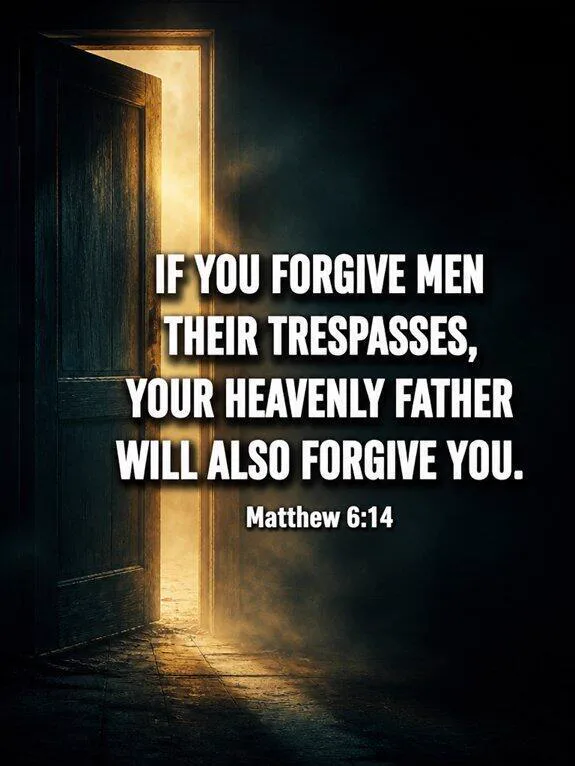
Jesus attaches this immediately after the Lord’s Prayer, as though anticipating that the line about forgiving debtors would be skimmed. It is the hardest sentence in the Sermon on the Mount and it is not softened anywhere. Worth being precise, though: it is about forgiving, which is yours to do. It says nothing about whether the relationship is restored, which is not.
Matthew 18:21-22 — Seventy Times Seven
“Then Peter came and said to him, “Lord, how often shall my brother sin against me, and I forgive him? Until seven times?” Jesus said to him, “I don’t tell you until seven times, but, until seventy times seven.” — Matthew 18:21-22 (WEBU)
Peter’s seven was generous — rabbinic teaching of the period commonly suggested three. He is expecting to be praised. The answer removes the counting altogether, and the point is not arithmetic: anyone keeping a tally to seventy-seven is not forgiving, they are recording. Jesus dismantles the register rather than extending it.
Matthew 18:32-33 — The Unforgiving Servant
“Then his lord called him in and said to him, ‘You wicked servant! I forgave you all that debt because you begged me. Shouldn’t you also have had mercy on your fellow servant, even as I had mercy on you?’” — Matthew 18:32-33 (WEBU)
The parable Jesus tells straight after Peter’s question, and the numbers are the argument. The servant is forgiven ten thousand talents — an absurd sum, more than the annual tax revenue of a province — and then throttles a colleague over a hundred denarii, about three months’ wages. Real money, not nothing. The story does not say the second debt was trivial. It says the comparison is.
Luke 17:3-4 — Rebuke, Then Forgive
“Be careful. If your brother sins against you, rebuke him. If he repents, forgive him. If he sins against you seven times in the day, and seven times returns, saying, ‘I repent,’ you shall forgive him.”” — Luke 17:3-4 (WEBU)

The step most lists leave out is right there in the middle: rebuke him. Jesus does not describe silent absorption of harm as the ideal. Naming the wrong to the person who did it is part of the process, and it is what makes the difference between forgiveness and pretending. The repeating in verse 4 is the hard part, and it assumes each return is genuine.
How a Repair Actually Starts
Matthew 5:23-24 — Leave Your Gift There
““If therefore you are offering your gift at the altar, and there remember that your brother has anything against you, leave your gift there before the altar, and go your way. First be reconciled to your brother, and then come and offer your gift.” — Matthew 5:23-24 (WEBU)

Read the direction carefully, because it runs the way nobody expects. It is not if you have something against your brother. It is if he has something against you — the person who is owed nothing is the one told to get up and walk out. And the setting is deliberately extreme: mid-worship, gift already in hand, at the altar. Whatever was about to happen there can wait.
Matthew 18:15 — Between You and Him Alone
““If your brother sins against you, go, show him his fault between you and him alone. If he listens to you, you have gained back your brother.” — Matthew 18:15 (WEBU)
Between you and him alone rules out the most common modern first move, which is to tell somebody else first. And gained back your brother names the objective — not being proved right, not an apology extracted, the person returned. If the aim of the conversation is to win it, this verse is not describing what you are doing.
Genesis 33:4 — Esau Ran
“Esau ran to meet him, embraced him, fell on his neck, kissed him, and they wept.” — Genesis 33:4 (WEBU)

The best picture of reconciliation in Scripture, and it belongs to the brother who was wronged. Jacob had stolen Esau’s blessing and fled for twenty years; the chapter before this has him dividing his family into two camps so that if one is attacked the other might escape, and sending waves of livestock ahead as bribes. He is expecting to be killed. Esau ran. Every calculation Jacob made was unnecessary, and the offended party covered the distance at a run.
Genesis 50:20 — You Meant Evil
“As for you, you meant evil against me, but God meant it for good, to save many people alive, as is happening today.” — Genesis 50:20 (WEBU)
Joseph says this to the brothers who sold him into slavery, and the first clause is the one usually cut. “You meant evil against me” — he names it accurately, out loud, to their faces, and does not describe it as a misunderstanding. Reconciliation here does not require pretending the harm was smaller than it was. It requires putting something larger beside it.
Keeping a Repaired Thing Repaired
Ephesians 4:31-32 — Be Kind to One Another
“Let all bitterness, wrath, anger, outcry, and slander be put away from you, with all malice. And be kind to one another, tender hearted, forgiving each other, just as God also in Christ forgave you.” — Ephesians 4:31-32 (WEBU)

The list before the kindness is worth reading slowly, because it is a sequence rather than a heap: bitterness settles first, then flares into wrath and anger, then gets loud as outcry and slander. Put away is a removal word — this is not managing the bitterness, it is taking it out. The order tells you where to intervene, and it is early.
Colossians 3:13 — Bearing With One Another
“bearing with one another, and forgiving each other, if any man has a complaint against any; even as Christ forgave you, so you also do.” — Colossians 3:13 (WEBU)

Bearing with is the unglamorous half and it is listed first. It means putting up with the thing about somebody that will not change — not forgiving a specific offence but tolerating an ongoing friction. Most relationships that survive do so on this rather than on dramatic reconciliations, and Paul pairs the two as though they were the same work at different speeds.
Proverbs 17:9 — He Who Repeats a Matter
“He who covers an offense promotes love; but he who repeats a matter separates best friends.” — Proverbs 17:9 (WEBU)
Here is the specific mechanism by which repairs come undone. Repeats a matter — bringing the settled thing up again, in the next argument, to somebody else, as evidence. Covering is not the same as denying; it is declining to re-open. And notice who gets separated: best friends, not enemies. The damage is done between people who were close enough for the repetition to land.
Hebrews 12:14-15 — The Root of Bitterness
“Follow after peace with all men, and the sanctification without which no man will see the Lord, looking carefully lest there be any man who falls short of the grace of God, lest any root of bitterness springing up trouble you and many be defiled by it,” — Hebrews 12:14-15 (WEBU)
Root is doing the work: the visible part is not where the problem lives, and a bitterness left in the ground comes back. The last phrase is the one worth sitting with — many be defiled by it. Unresolved resentment does not stay between the two people involved. It reaches the family, the friends, the church, and everyone learns to route around it.
James 5:16 — Confess to One Another
“Confess your sins to one another and pray for one another, that you may be healed. The insistent prayer of a righteous person is powerfully effective.” — James 5:16 (WEBU)

To one another is mutual and horizontal, which is the uncomfortable bit — confessing upward to God is easier than saying it to the person’s face. James connects it directly to healing, and the healing is plural: that you may be healed, both of you, not just the one who was wronged.
When Reconciliation Does Not Happen
Some of this will not resolve, and pretending otherwise is what makes people give up on the whole idea.
You can forgive somebody who never asks. Forgiveness releases what you are holding; it does not require their participation and it does not depend on their repentance. Reconciliation does — Luke 17:3 makes repentance part of the process, and you cannot supply it for them.
You can forgive somebody you should not be alone with. Restored trust is not the same as forgiveness, and nothing in Scripture asks a person to return to danger to prove they have forgiven. Matthew 18 escalates precisely because some situations do not resolve one-to-one. Where there has been abuse or violence, safety comes first and a pastor is not a substitute for the police.
You may do everything and it still not mend. That is what Romans 12:18 anticipates. As much as it is up to you is permission to have done your part and stopped, and to stop carrying the failure of the other half as though it were yours.
If a rift is affecting your sleep, your work or your health, that is worth saying to a doctor or a counsellor as well as to God. Scripture and clinical care are not rivals here either.
Questions People Ask
Can you forgive without reconciliation biblically?
Yes. Forgiveness is commanded of you without conditions (Matthew 6:14-15) and depends on nobody else. Reconciliation requires the other person: Luke 17:3 makes repentance part of it, and Romans 12:18 explicitly limits the command to “as much as it is up to you”. Forgiving and remaining estranged is a biblically coherent position, not a failure.
What is the difference between forgiveness and reconciliation?
Forgiveness is one-sided and internal — releasing a debt you are owed. Reconciliation is two-sided and relational — the relationship itself restored. You can complete the first alone. The second needs repentance, changed behaviour and often time, none of which you can produce for another person.
What did Jesus say about forgiveness?
Three things, and they fit together. Forgive without keeping count (Matthew 18:21-22, seventy times seven). Forgive because of the size of what you were forgiven (the parable in Matthew 18:32-33). And name the wrong rather than swallow it — Luke 17:3 says rebuke him, then forgive if he repents.
What are the first steps toward reconciliation?
Matthew 18:15 gives the order: go directly, alone, before telling anyone else, and aim at gaining the person rather than winning the argument. Matthew 5:23-24 adds the urgency and the direction — if you remember that somebody has something against you, you are the one who goes, even mid-worship.
What does the Bible say about reconciliation with God?
That he moved first. 2 Corinthians 5:18-19 says God reconciled us to himself and then gave us the same work to do; Romans 5:10 says it happened while we were still enemies, not after we improved. Ephesians 2:14 describes the barrier as broken down rather than negotiated around.
Some of these repairs take one conversation and some take a decade, and a few never come. What Scripture asks of you is the half you can reach: forgive without counting, go first, name the thing accurately, and let the other half be the other person’s.
If you want more on the forgiving itself, Bible Verses About Forgiveness of Sins goes deeper, Bible Verses About Forgiving Others Even When It’s Hard covers the cases that will not release, and the full Forgiveness archive holds the rest.