Two words get quoted from John 11 and the rest of the chapter gets left alone. “Jesus wept” turns up on sympathy cards and in sermons, and it is the shortest verse in the Bible, and it is genuinely the point. But the forty-odd verses around it are stranger and more useful than the two on their own, because they contain a delay nobody explains away, an accusation made twice, a complaint about the smell, and an instruction given to the neighbours rather than to the dead man.
Anyone searching for Bible verses for grief after the loss of a loved one is better served by that chapter whole than cropped. It tidies nothing up. Nobody in it is told to stop crying, and the one person who could have prevented the death is asked to his face why he did not.
What follows walks through it in order, with the passages elsewhere in Scripture that describe what loss actually does to a person — including the ones about not eating and not sleeping. Then the verse that most people think says “don’t grieve” and does not say that at all.

Find peace in chaos. The valley is not your destination, but the path.Psalm 23 · 11 min
That was just the opening. Open the app and search #001 to hear the full 11-minute story — free.
Keep listening free in the app Free on iOS & Android — no sample needed

He Was Late, and the Text Gives the Reason
The chapter opens with a message from two sisters: their brother Lazarus is seriously ill, and Jesus is a couple of days’ walk away. What happens next is the detail that changes everything after it.
John 11:5 — The Text Establishes the Love First
“Now Jesus loved Martha, and her sister, and Lazarus.” — John 11:5 (WEBU)
John puts this sentence in deliberately. He is about to describe behaviour that will look like indifference, and he closes off that reading before it can start. This is not a stranger, not a busy teacher with other priorities, and not somebody who did not care much either way. The word is loved, and all three of them are named.

John 11:6 — And Then He Waited
“When therefore he heard that he was sick, he stayed two days in the place where he was.” — John 11:6 (WEBU)
Read the joint between those two verses. It is not “but” he stayed — the connective John reaches for makes the waiting a consequence of the love rather than a contradiction of it, and he does not soften that anywhere in the chapter.
By the time Jesus arrives, Lazarus has been dead four days. He is not late by an hour. He is late by enough that everybody has already given up, gone to the tomb, and started the formal mourning. That is the shape of the delay a lot of grieving people describe: not a God who was absent, but one who appeared to take his time while the worst of it happened. This chapter does not deny that experience. It records it, and puts a word of consequence in the middle of it.

Both Sisters Said the Same Sentence
Martha and Mary meet Jesus separately. Martha goes out to the road; Mary stays in the house until she is called. Their temperaments are different, the settings are different, and what comes out of their mouths is identical.
John 11:21 — Martha Says It Standing Up
“Therefore Martha said to Jesus, “Lord, if you would have been here, my brother wouldn’t have died.” — John 11:21 (WEBU)
This is an accusation, said to his face, by somebody who believes in him. She is not doubting his power — she is naming his absence. Grief very often sounds exactly like this: not “I no longer believe”, but “you could have, and you did not”.
Jesus does not correct the sentence. He does not explain the two-day delay to her, and he does not point out that she is being unfair. He answers with a promise about her brother and then lets her carry on talking.

John 11:32 — Mary Says It on the Ground
“Therefore when Mary came to where Jesus was and saw him, she fell down at his feet, saying to him, “Lord, if you would have been here, my brother wouldn’t have died.”” — John 11:32 (WEBU)
Word for word, the same sentence. Two sisters, two very different personalities, one shared thought — which means they had been saying it to each other in the house for four days.
That is worth knowing if the same sentence has been running in your own head. It is not a failure of faith with a scriptural warning attached. It is the line the Bible gives to two women it treats as entirely sympathetic, and the response it gets is the next verse rather than a rebuke.

He Cried at a Funeral He Was About to Reverse
John 11:35 — Two Words
“Jesus wept.” — John 11:35 (WEBU)
Here is what makes this the strangest sentence in the chapter. He already knows how the afternoon ends. He has said so out loud, twice. In about four minutes he will call Lazarus out of the tomb alive, and the crying is going to look, in hindsight, completely unnecessary.
He cries anyway.
Whatever comfort is on offer in Scripture, it is not the comfort of being told your loss is smaller than it feels. The person who could see straight past this particular death to its reversal stood in front of the tomb and wept. The tears were not a mistake he had to make before he knew better; they were the response of somebody who did know better.

John 11:36 — What the Neighbours Concluded
“The Jews therefore said, “See how much affection he had for him!”” — John 11:36 (WEBU)
The bystanders read the tears correctly. They do not say he was weak, or overwhelmed, or failing to trust God. They say the crying is evidence of how much he loved the man.
That is a small thing to take away and a useful one. If you have been apologising for crying in front of people this month, or waiting until the car, the crowd in this chapter drew the obvious conclusion and drew it kindly. Tears are treated in Scripture as a measure of love, not a lapse in faith.

Grief Stays Ugly Even With Hope Standing in the Room
John 11:39 — Martha Objects About the Smell
“Jesus said, “Take away the stone.” Martha, the sister of him who was dead, said to him, “Lord, by this time there is a stench, for he has been dead four days.”” — John 11:39 (WEBU)
The Bible could have left this line out. It is undignified, it is about a body decomposing, and it comes from the same woman who has just made a confession of faith three verses earlier.
Both things are true of her at once, which is the honest part. Believing something about resurrection did not stop her thinking about the practical horror of opening the tomb. Faith and revulsion sat in the same person on the same afternoon, and the text does not ask her to choose.

John 11:43 — He Uses the Name
“When he had said this, he cried with a loud voice, “Lazarus, come out!”” — John 11:43 (WEBU)
Not “come out”. Lazarus, come out. The name is in the sentence.
Four days of mourning had turned him into the dead man, the body, the brother — and the first word spoken at the tomb is the name his sisters called him. Whatever else the resurrection means in this chapter, it is not the arrival of an abstraction. It happens to one named person that a specific household is missing.

John 11:44 — The Unwrapping Is Given to Somebody Else
“He who was dead came out, bound hand and foot with wrappings, and his face was wrapped around with a cloth. Jesus said to them, “Free him, and let him go.”” — John 11:44 (WEBU)
Lazarus walks out still tied up. The miracle does not include the grave clothes, and Jesus does not remove them.
He said to them — to the crowd, to the neighbours, to the sisters. Free him. The part that could only be done by God is done by God; the part that needs human hands is handed to the people standing there. That division of labour is worth holding onto in a season of loss. Some of what you need this month is not going to arrive by prayer alone, because Scripture assigns it to somebody who can drive you to an appointment, sit in your kitchen, or answer the phone at eleven at night.

The Verse People Think Says “Do Not Grieve”
1 Thessalonians 4:13 — Read the Second Half
“But we don’t want you to be ignorant, brothers, concerning those who have fallen asleep, so that you don’t grieve like the rest, who have no hope.” — 1 Thessalonians 4:13 (WEBU)
This verse gets quoted at bereaved Christians as though it were an instruction to stop. It is not. The sentence does not end at grieve — it ends at like the rest, who have no hope.
Paul is not banning the emotion. He is distinguishing between two kinds of the same grief, and the difference he names is hope, not volume. A Christian funeral in the New Testament is still a funeral. The tears are the same temperature. What changes is what the mourner expects afterwards, and nothing in this sentence asks you to feel less in the meantime.

1 Thessalonians 4:14 — What the Hope Is Attached To
“For if we believe that Jesus died and rose again, even so God will bring with him those who have fallen asleep in Jesus.” — 1 Thessalonians 4:14 (WEBU)
Notice how the argument is built. It does not rest on the character of the person who died, or on how much faith the family can manage this week. It rests on something that already happened to somebody else: Jesus died and rose again.
That is a deliberately low bar to stand on when you have very little. The hope in this passage is not a feeling you have to generate at a graveside; it is a past event you are being asked to believe happened. On the days when you cannot summon anything, the argument still holds, because none of the load is on you.

When You Have No Words Left for Praying
Romans 8:26 — Somebody Else Does the Praying
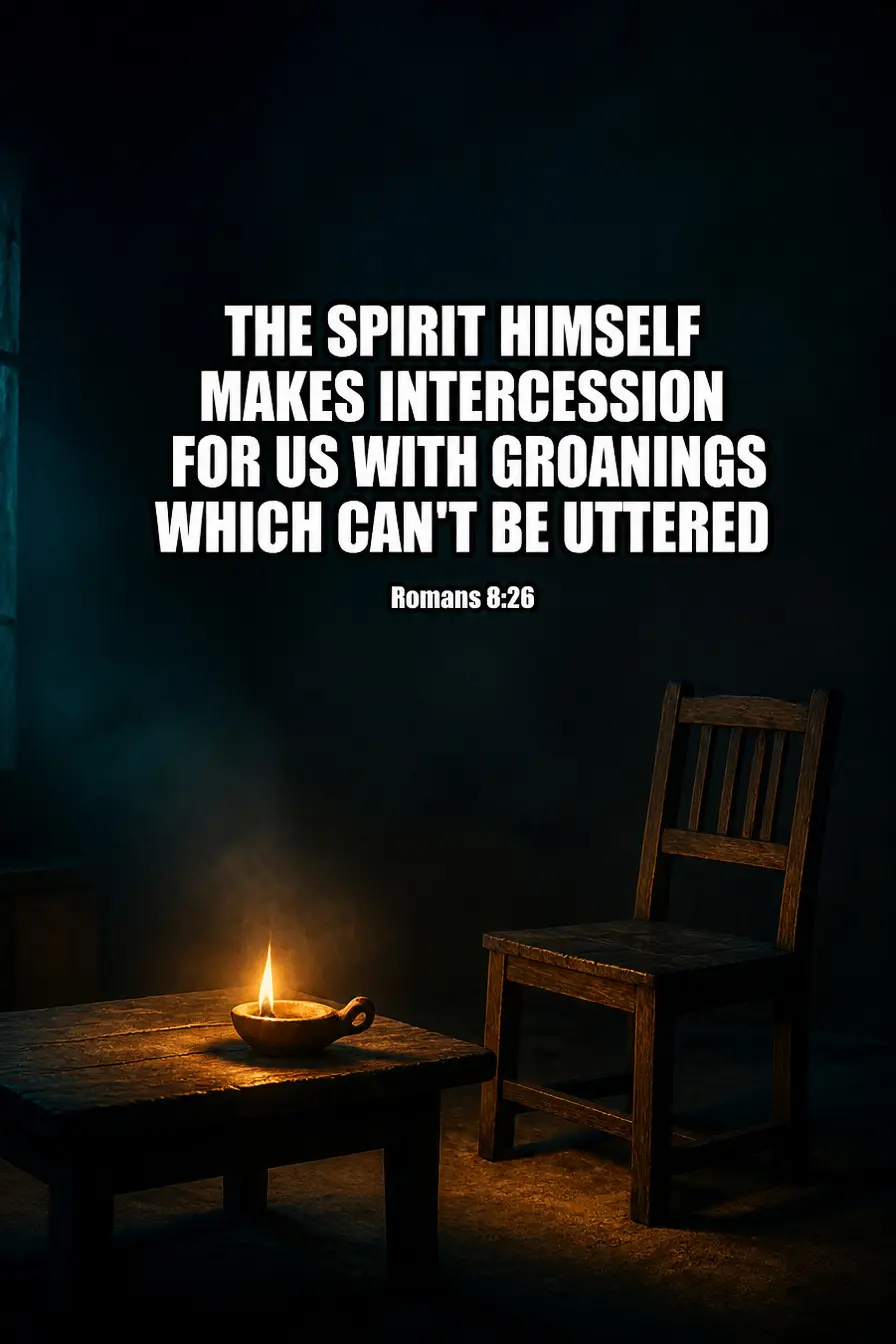
“In the same way, the Spirit also helps our weaknesses, for we don’t know how to pray as we ought. But the Spirit himself makes intercession for us with groanings which can’t be uttered.” — Romans 8:26 (WEBU)
Grief takes language away first. People who have prayed easily for thirty years describe sitting down to pray after a death and finding nothing there at all.
Paul writes as though that were expected. We don’t know how to pray as we ought is stated as a general condition, not as a failing peculiar to you. And the answer is not better technique — it is that the praying gets done by somebody else on your behalf, in groanings which can’t be uttered. That last phrase is the most sympathetic thing in the passage. What is going on inside you does not have to reach the standard of a sentence before God receives it.
Scripture Describes What Loss Does to a Body
One of the reasons the Psalms are useful in bereavement is that they are unembarrassed about the physical part. Grief is not treated there as a mood.
Psalm 42:3 — Not Eating
“My tears have been my food day and night, while they continually ask me, “Where is your God?”” — Psalm 42:3 (WEBU)
Food day and night is a plain description of somebody who has stopped eating. The psalm reaches for the mealtimes to say how constant it is, because meals are the fixed points of an ordinary day and they are the first thing loss takes apart.
The second half of the verse is the other half of the experience: other people asking questions he cannot answer. Grief is rarely just the absence. It usually comes with an audience.

Psalm 31:9 — The Body Is Named
“Have mercy on me, LORD, for I am in distress. My eye, my soul, and my body waste away with grief.” — Psalm 31:9 (WEBU)
Three things are listed and only one of them is inward. Eye, soul, body. David is describing something that has got into his eyesight and his weight, not only his mood.
Which is worth saying plainly, because grief that flattens you physically is normal and is described in Scripture without alarm. It is also the point at which practical help matters most: if you have stopped eating or sleeping, or the weight is not lifting at all over months, put yourself in the hands of a doctor or a grief counsellor. Needing that is not a smaller faith, and it sits alongside prayer rather than replacing it.

Genesis 50:1 — Joseph at His Father’s Bedside
“Joseph fell on his father’s face, wept on him, and kissed him.” — Genesis 50:1 (WEBU)
Joseph is, at this point, the second most powerful man in Egypt. He has governors under him and a nation depending on his administration, and the verse records him lying across his father’s body in a room, crying.
There is no comment attached. The Bible does not explain that he pulled himself together shortly afterwards, and the next verses are about arranging the burial — practical, unhurried, and entirely compatible with what just happened in that room.
If the funeral was months ago and what is left is missing one particular person — a mother or father, a husband or wife, a child, a friend — we have gathered Bible verses about missing someone who has died, grouped by who it was.

Acts 8:2 — The Church Still Wailed
“Devout men buried Stephen and lamented greatly over him.” — Acts 8:2 (WEBU)
The timing of this one carries the argument. This is after the resurrection, in the earliest church, at the funeral of a man whose dying words were a prayer. These are people with the hope of 1 Thessalonians 4 fully in hand.
They lamented greatly. The resurrection did not shorten the funeral or lower the volume. Whatever Christian hope does to grief, the book of Acts does not think it makes grief quieter.

How God Regards the Death of the People You Loved
Psalm 116:15 — Precious
“Precious in the LORD’s sight is the death of his saints.” — Psalm 116:15 (WEBU)
Precious is a valuation word — the same kind of word used of gems and of a price paid. The psalm is not saying God enjoys the death of the people who trust him. It is saying he does not regard it as routine.
That is the answer to a fear a lot of bereaved people carry without saying out loud: that the death was a small administrative event in a very large universe, noticed by nobody except the family. Scripture puts a price on it. Abraham felt the same need for something solid and bought a field to bury his wife in, telling his neighbours “Give me a possession of a burying-place with you, that I may bury my dead out of my sight.” (Genesis 23:4, WEBU) — the first property transaction in the Bible is a grave.

Comforting Bible Verses to Keep Close
Everything above is the argument. These are the lines to have where you can reach them at three in the morning, and each one belongs to a fuller study on this site.
- “Blessed be the God and Father of our Lord Jesus Christ, the Father of mercies and God of all comfort, who comforts us in all our affliction” (2 Corinthians 1:3-4, WEBU) — comfort arrives and then moves outward.
- “The LORD is near to those who have a broken heart, and saves those who have a crushed spirit.” (Psalm 34:18, WEBU) — for the brokenhearted and the crushed in spirit, nearness is the promise rather than removal.
- “Blessed are those who mourn, for they shall be comforted.” (Matthew 5:4, WEBU) — the blessing is attached to the mourning, not to getting past it.
- “He will wipe away every tear from their eyes. Death will be no more; neither will there be mourning, nor crying, nor pain any more.” (Revelation 21:4, WEBU) — God’s own hand does the wiping, which means the tears are still there to be wiped.
- “Even though I walk through the valley of the shadow of death, I will fear no evil, for you are with me.” (Psalm 23:4, WEBU) — through, not around.
- “nor height, nor depth, nor any other created thing will be able to separate us from God’s love which is in Christ Jesus our Lord.” (Romans 8:39, WEBU) — death is the first item on Paul’s list of things that cannot do it.
- “I will in no way leave you, neither will I in any way forsake you.” (Hebrews 13:5, WEBU) — a double negative in both halves, which is the strongest way the sentence could have been built.
And one practical note about other people. If somebody you love is the one grieving, the instruction in Scripture is smaller than most of us assume: “Rejoice with those who rejoice. Weep with those who weep.” (Romans 12:15, WEBU). Not explain, not fix, not find the silver lining. We work through what that looks like week by week in comforting verses for grief and mourning, and the resurrection side of it in verses for grief and loss.
Take one thing from this page rather than all of it. God’s love does not require you to be coping well to be operating, God’s goodness is not measured by how this month feels, and the Spirit is already praying the part you cannot say. If you can manage a sentence tonight, make it a request for mercy. If you cannot, Romans 8:26 says that is covered.
When the Comforting Verses Stop Working
Some weeks the comforting Bible verses for grief do not land at all. You read them, you agree with every word, and nothing moves. That is worth naming, because it is the point at which a lot of people quietly decide something has gone wrong with their faith.
Nothing has. The grieving process is not a straight line in Scripture and it is not one in life either. Job’s friends sat with him for a week before anybody spoke. David wrote psalms of sorrow and grief that never resolve inside the psalm. Whole books of the Bible are written by people in the middle of it, and none of them are asked to move along on a schedule.
Two things are worth holding while you wait. The first is that God’s love is not measured by how this month feels. Faith isn’t a mood, and the death of a loved one does not put a dent in God’s goodness even when it puts a hole in everything you can see. The second is that comfort in the Bible is nearly always described as something you receive from God rather than something you manufacture — the God of all comfort “comforts us in all our affliction”, and Paul’s next sentence is that “as the sufferings of Christ abound to us, even so our comfort also abounds through Christ” (2 Corinthians 1:5, WEBU). The comfort is scaled to the suffering, not to your performance.
So when the verses go quiet, take comfort in the smaller things Scripture actually asks of you in a time of need. Say one honest sentence. Let somebody provide comfort in a practical form. Read a psalm rather than trying to feel one. And if you need a reason to keep asking, the promise attached to those who put their trust in Jesus is that he will never leave you nor forsake you — a God who understands your pain from the inside, who cried at a friend’s grave, and who cares deeply enough to have wept at a funeral he was about to undo.
Many Bible verses about grief and sadness end with a turn. Some do not. Both kinds are in the book on purpose, and you are allowed to be in either one today.
Questions About Grief and the Bible
What are the best Bible verses for grief?
The most useful are the ones that describe grief rather than hurrying it. John 11 has Jesus arriving four days late, both sisters telling him so, and God crying at a graveside. Psalm 42:3 and Psalm 31:9 name what loss does to eating, sleeping and the body. Romans 8:26 covers the days when praying is not possible. 1 Thessalonians 4:13-14 supplies the hope without asking you to stop.
Does the Bible say Christians should not grieve?
No. 1 Thessalonians 4:13 is the verse usually quoted for that, and it says not to grieve “like the rest, who have no hope” — a comparison, not a prohibition. Acts 8:2 shows the earliest church lamenting greatly at a funeral, after the resurrection, and John 11:35 has Jesus weeping at a tomb he was about to open.
Why does God let people die when he could stop it?
John 11 is the passage that faces the question head-on rather than answering it. Jesus deliberately waits two days after hearing Lazarus is ill, and the text says he did it because he loved the family. Both sisters tell him to his face that he could have prevented the death. He does not explain the delay to either of them, and he weeps with them instead.
What do you say to someone who is grieving?
Romans 12:15 gives the whole instruction: “Weep with those who weep.” Job’s friends got it right for exactly seven days, while they sat on the ground with him and said nothing. The Bible’s model for comfort is presence and shared tears, not explanation, and the practical version is usually a meal, a lift, or answering the phone late at night.
How do you pray when grief has taken your words?
Romans 8:26 answers this directly: the Spirit “makes intercession for us with groanings which can’t be uttered” precisely because “we don’t know how to pray as we ought”. The passage treats wordlessness as the normal condition rather than a failure. Sitting in silence, or repeating one line from a psalm, is enough.
Where to Start Tonight
If you have read this far because somebody has died, the chapter above is not asking you to be further along than you are. Martha said the hardest sentence in it out loud, and Mary said it again, and neither was corrected.
So say the unedited version to God tonight, including the part that sounds like blame. Then read John 11 straight through, all of it, not the two words. And let somebody do the unwrapping — the phone call, the meal, the lift — because Scripture hands that job to the people standing nearby rather than to you.
More on this in our grief collection, and the comforting verses that sit with you instead of explaining are for the days when explanation is the last thing you want.