
Nobody looks this up when things are fine.
People reach for Bible verses about relationships at a particular moment — after the conversation that went wrong, during the week where somebody has gone quiet, or at the point where the real question is whether to keep going. The search usually carries a hope with it: that Scripture will say something about whether this is the right person.
It mostly does not. The Bible is close to silent on picking and detailed on conducting. Almost everything it says about relationships is mechanical — how you answer when provoked, whose interests you are tracking, what you repeat about somebody when they are not in the room. Unglamorous, and a good deal more useful than a compatibility test.
These twelve are grouped by the four things that break relationships: who you stand next to, how you speak, what you do when it goes wrong, and what love is measured against.

When Everything Falls Apart
When the people you counted on are gone. God stays closest to the broken.Job · 12 min
That was just the opening. Open the app and search #004 to hear the full 12-minute story — free.
Keep listening free in the app Free on iOS & Android — no sample needed

What the Bible Says About Relationships Before It Mentions Romance
Amos 3:3 — Walking Together Requires a Prior Agreement
“Do two walk together, unless they have agreed?” — Amos 3:3 (WEBU)

This is not a verse about dating, and knowing that makes it better. Amos is mid-argument, firing off rhetorical questions — does a lion roar with no prey, does a bird fall into a trap with no snare — to establish that effects have causes.
The observation stands on its own, though. Two people walking the same road at the same pace did so because something was settled first, and the agreement is usually unspoken — which is why nobody notices it until it breaks: what the weekends are for, how much the other person’s family gets to decide, whether this is heading somewhere. Most relationships that stall are not short of feeling. They are short of a conversation nobody has started.
2 Corinthians 6:14 — What a Yoke Actually Is
“Don’t be unequally yoked with unbelievers, for what fellowship do righteousness and iniquity have? Or what fellowship does light have with darkness?” — 2 Corinthians 6:14 (WEBU)
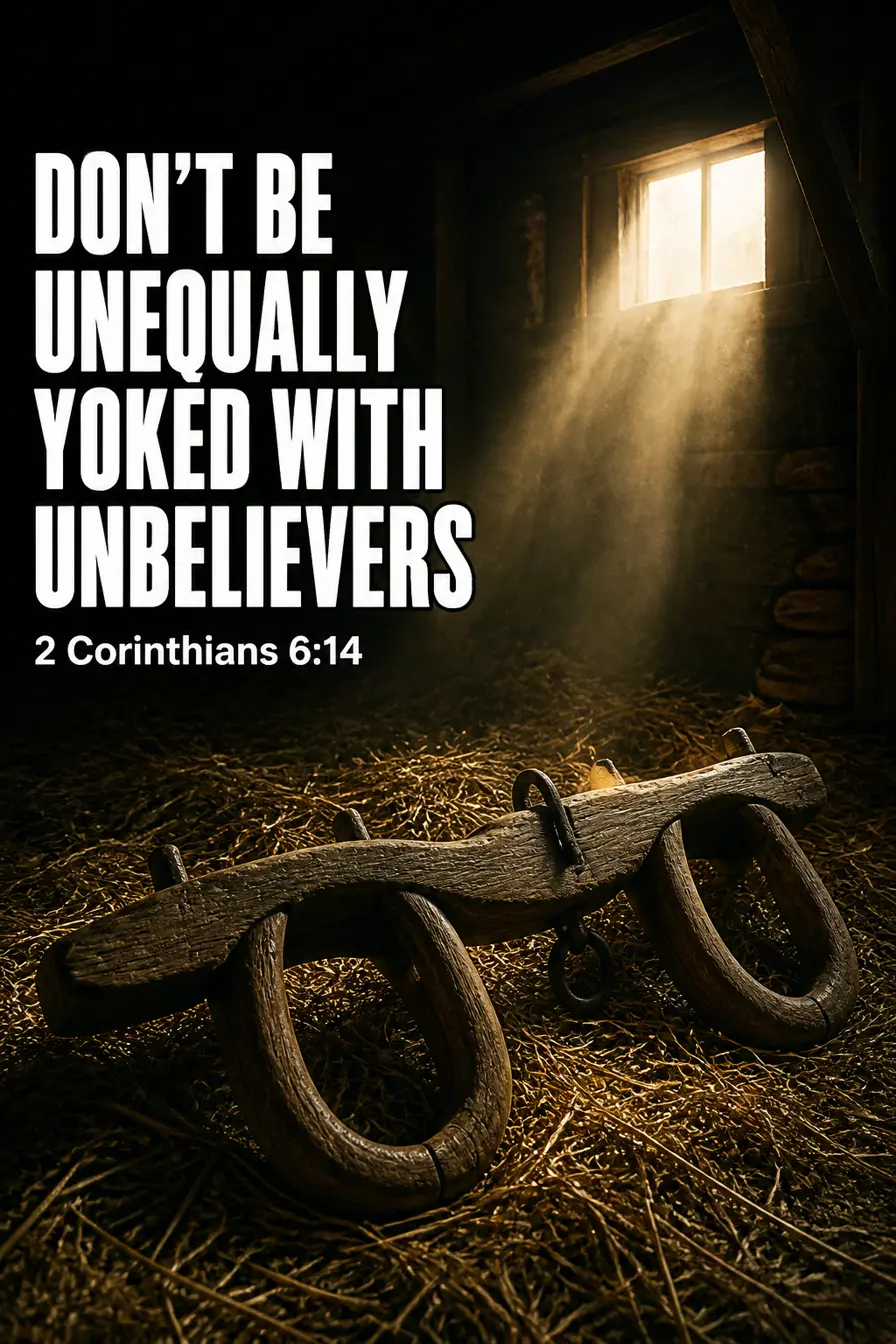
The picture is farming equipment. A yoke is a wooden beam joining two animals at the neck so they pull one plough, and it only works if they are matched. Put a tall animal beside a short one and neither pulls straight: the stronger one drags, the weaker one is pulled off its feet.
Two things follow. The verse is about direction, not about whether somebody is decent company — mismatched animals are not bad animals. And Paul’s subject is not romance at all; the passage is about a church entangled with the temple worship around it. The image transfers well, which is why it gets quoted at people who are dating, but it asks what you are both pulling towards rather than how you feel about each other.
1 Corinthians 15:33 — Paul Quotes a Comedy
“Don’t be deceived! “Evil companionships corrupt good morals.”” — 1 Corinthians 15:33 (WEBU)

Notice the quotation marks. The line is not Paul’s — it comes from a Greek comic playwright, and his readers would have known it from the theatre rather than the synagogue. He reaches for popular culture because the point is common sense before it is theology.
The verb matters more than the noun. Corrupt is a spoiling word, the kind used of food going off — gradual, unremarkable while it happens, obvious only afterwards. Nobody changes their standards in an afternoon. A remark stops landing as wrong, then a second one, and six months later you would not recognise the line you used to hold. If you have wondered why a friendship leaves you slightly worse each time, this is the mechanism.
Bible Verses About Relationships and the Way You Speak
Proverbs 15:1 — The Temperature Is Set by You
“A gentle answer turns away wrath, but a harsh word stirs up anger.” — Proverbs 15:1 (WEBU)

Read both halves and notice what is missing. There is no instruction about the other person, no test for whether their anger was fair, no clause excusing you if they started it. Both halves describe your output and its effect.
That is the whole usefulness of it. In an argument the one variable you control is the next sentence, and this proverb says that sentence sets the temperature of everything after it. It is not a rule about being nice, either: a gentle answer can be completely direct. What it cannot be is matched in heat. Most rows we regret were about the second reply, not the topic.
Ephesians 4:29 — A Higher Bar Than Honesty
“Let no corrupt speech proceed out of your mouth, but only what is good for building others up as the need may be, that it may give grace to those who hear.” — Ephesians 4:29 (WEBU)

The test here is not whether a thing is true. It is whether it builds, as the need may be — fitted to what this particular person needs at this particular moment.
That is a much higher bar, and it catches a lot of what we say to people we love. A remark can be accurate, deserved, and still fail this verse, because accuracy was never the standard. The phrase also rules out the opposite error, since flattery is not fitted to anybody’s need either. What it asks is that you know the person well enough to tell the difference — more attention than being honest takes.
James 1:19 — The Order Is the Point
“let every man be swift to hear, slow to speak, and slow to anger;” — James 1:19 (WEBU)

Three instructions, and a sequence rather than a list. Anger comes third because it is downstream: it arrives after you have stopped listening and started composing your reply.
So anger is rarely the thing to work on directly. Catch it at the first step and the third mostly does not happen, because you cannot be furious and genuinely trying to understand somebody at the same time. Notice the asymmetry too — one swift, two slow. The verse asks you to be quick at exactly one thing and deliberately slow at everything else, the reverse of how most arguments run.
Verses for a Relationship That Is Going Badly
Romans 12:9 — Love With the Mask Off
“Let love be without hypocrisy. Abhor that which is evil. Cling to that which is good.” — Romans 12:9 (WEBU)

The word translated hypocrisy comes from the stage. A hypocrite was an actor, somebody delivering lines from behind a mask, and Paul’s instruction is literally love with no mask on.
Then look at the two verbs that follow: abhor, cling. Both are violent. This is not a mild sentence about being pleasant; it asks for something with teeth, held hard in one direction and refused hard in the other. Politeness passes for love for a surprisingly long time, and the difference only shows when something costs. Unmasked love says the hard thing and stays in the room afterwards.
Philippians 2:3-4 — “Not Just” Is Doing the Work
“doing nothing through rivalry or through conceit, but in humility, each counting others better than himself; each of you not just looking to his own things, but each of you also to the things of others.” — Philippians 2:3-4 (WEBU)

Two small words save this verse from self-erasure. Not just — your own interests are not cancelled, the field is widened to include somebody else’s. A different instruction from having no needs, and the one actually written down.
The context sharpens it. Paul is writing from prison to a church with a specific problem: two women in the congregation, named later in the letter, who could not get along, and a community taking sides around them. So this is conflict advice, composed for people who each had a defensible case. Rivalry is the diagnosis. Being right is not the same as being on the same side.
Proverbs 16:28 — What Gossip Actually Damages
“A perverse man stirs up strife. A whisperer separates close friends.” — Proverbs 16:28 (WEBU)

The target is named precisely: close friends. Not acquaintances, not strangers, not people who barely knew each other. The specific damage of talking about somebody behind their back is that it takes apart bonds that were already strong.
That inverts how it feels from the inside. Repeating a private thing usually feels like intimacy — you are trusting the person you are telling. The verse says the cost lands somewhere else, on a relationship that was working, and quietly enough that the two people separated may never learn why things cooled.
Bible Verses About Love in Relationships That Actually Hold
John 13:34 — What Is New About the New Commandment
“A new commandment I give to you, that you love one another. Just as I have loved you, you also love one another.” — John 13:34 (WEBU)

“Love one another” was not new. It is in Leviticus, centuries earlier, and every rabbi in the room would have known it.
What is new is the measure. “Just as I have loved you” replaces the old standard of loving your neighbour as yourself, and the timing makes the point unmissable: he says it minutes after getting up from supper, taking a towel, and washing the feet of twelve men including the one about to hand him over. The comparison had been demonstrated before it was stated. Whatever else this commandment means, the bar is not your own sense of what is reasonable.
Luke 6:31 — Where the Golden Rule Sits
“As you would like people to do to you, do exactly so to them.” — Luke 6:31 (WEBU)

Everybody knows this line. Almost nobody knows where Luke puts it, and the placement changes what it asks.
It sits in the middle of the paragraph about loving your enemies, between blessing those who curse you and lending without expecting anything back. So the people in view are not your friends. This is a rule for somebody who has already treated you badly — far harder than the version printed on mugs, where it reads like ordinary decency. Read in place, it tells you to work out how you would want to be treated by somebody you had wronged, then do that.
1 John 4:20 — The Only Test You Can Actually Run
“If a man says, “I love God,” and hates his brother, he is a liar; for he who doesn’t love his brother whom he has seen, how can he love God whom he has not seen?” — 1 John 4:20 (WEBU)

This is an argument from evidence, and it is blunter than most verses get — he is a liar, with no softening.
The logic runs on visibility. A claim about loving somebody invisible cannot be checked by anyone, including the person making it. The brother standing in the kitchen can be. So the relationship in front of you is where a claim about God gets tested — an uncomfortable idea, and a clarifying one. It also explains why Scripture spends so little time on choosing people and so much on how to treat them. The person you find difficult is not an obstacle to the spiritual life. In this verse they are the instrument that measures it.
One Thing to Do This Week
Take James 1:19 and use only the first instruction.
For one week, in any conversation that starts going wrong, do not reply until you can state the other person’s position in a sentence they would accept as accurate. Not agree with. State. If you cannot, you are not listening yet, and that is where the sequence breaks.
It works because it is checkable. “Be more patient” has no failure condition and quietly becomes nothing; this one you either managed or did not, and you find out within about ninety seconds. It also has an effect the verse does not explain: saying somebody’s argument back to them accurately takes most of the heat out of the room, because what people escalate for is usually the feeling of not being heard rather than the disagreement itself.
Start with the relationship that is mildly annoying rather than the genuinely broken one. The skill builds more easily on low stakes, and the broken one needs what forgiving somebody actually involves more than a listening technique.
Frequently Asked Questions
What is the best Bible verse for relationships?
Proverbs 15:1 is the most immediately usable: a gentle answer turns away wrath, and a harsh word stirs up anger. It works because it asks nothing of the other person and applies to every kind of relationship — partner, parent, colleague, friend. For a broader standard rather than a tactic, John 13:34 sets the measure at “just as I have loved you”.
What does Proverbs 17:17 say about relationships?
It says a friend loves at all times, and a brother is born for adversity — two clauses making different claims. The first is about consistency across ordinary weeks; the second says some bonds exist for the bad ones. Our collection on what the Bible asks of friendship takes it apart in full.
What Bible verse says love never gives up?
That is 1 Corinthians 13, where love bears all things and endures all things, and a few lines later never fails. The chapter went to a divided church rather than a couple, which is why every item on its list is a behaviour rather than a feeling. Our verses on marriage work through it in that setting.
What are signs that God wants you to leave a relationship?
Scripture gives no checklist, and anyone offering twelve signs is inventing them. What it does give is two questions. Amos 3:3 asks whether you are actually agreed on where this is going, and 2 Corinthians 6:14 asks whether you are pulling in the same direction at all. Where there is harm, safety is not a spiritual question and the answer is to get out and get help.
What does the Bible say about relationship troubles?
It treats conflict as normal and gives procedure rather than reassurance. Philippians 2:3-4 names rivalry as the usual cause and widening your attention as the fix; James 1:19 puts listening before speaking before anger; Ephesians 4:29 rules out remarks that are true but not built for the person hearing them.
Where to Start
One conversation, one week, no reply until you can say their side back accurately. The only item here that changes anything before Sunday.
The rest of the relationships archive sits alongside this page. The two closest neighbours are worth a look if your situation is more specific than the general case: the verses on friendship for the people who choose to stay, and the verses on marriage for the relationship nobody writes instructions for after the wedding.